

Collective licensing for AI just landed its first paying customer. On November 12, 2026, the nonprofit Internet Licensing Collective (ILC), which until now went by RSL Collective, named Yahoo Scout as its first commercial licensee. The deal gives publishers of any size a free way to get paid when Yahoo Scout uses their pages, without negotiating a contract of their own, and the same license is open to other AI companies that sign later.
This collective licensing guide covers what the ILC offers, how its royalty pools split the money, how big the market could get, and the practical steps to enroll your own site. It draws on the ILC’s launch release and publisher documentation, reporting from Digiday, and a new economic study from Mather Economics.
A note on the numbers. Collective licensing market size figures in this article are Mather Economics estimates, not payments anyone has made. Neither the ILC nor Yahoo has said what Yahoo is paying, so we do not guess at fees or per-site earnings.
Table of Contents
What Is Collective Licensing?
Collective licensing means many rights holders pool their work so a buyer can sign one agreement instead of thousands. The buyer pays a blanket fee, and an administrator splits that money among the members based on agreed rules.
Music is the classic example. In its new report, Mather Economics explains that ASCAP introduced the blanket license in 1914 because a songwriter had no realistic way to track and bill every venue playing their songs. ASCAP now has more than one million songwriter, composer and publisher members, and BMI more than 1.4 million, the report says.
The ILC applies collective licensing to web content. Most publishers cannot negotiate with each AI lab, and the labs cannot sign millions of separate contracts, so a collective sits in the middle. For a small or midsize site that will never get a call from an AI lab, collective licensing may be the only realistic way to get paid for AI use at all.
What the ILC and Yahoo Scout Deal Includes
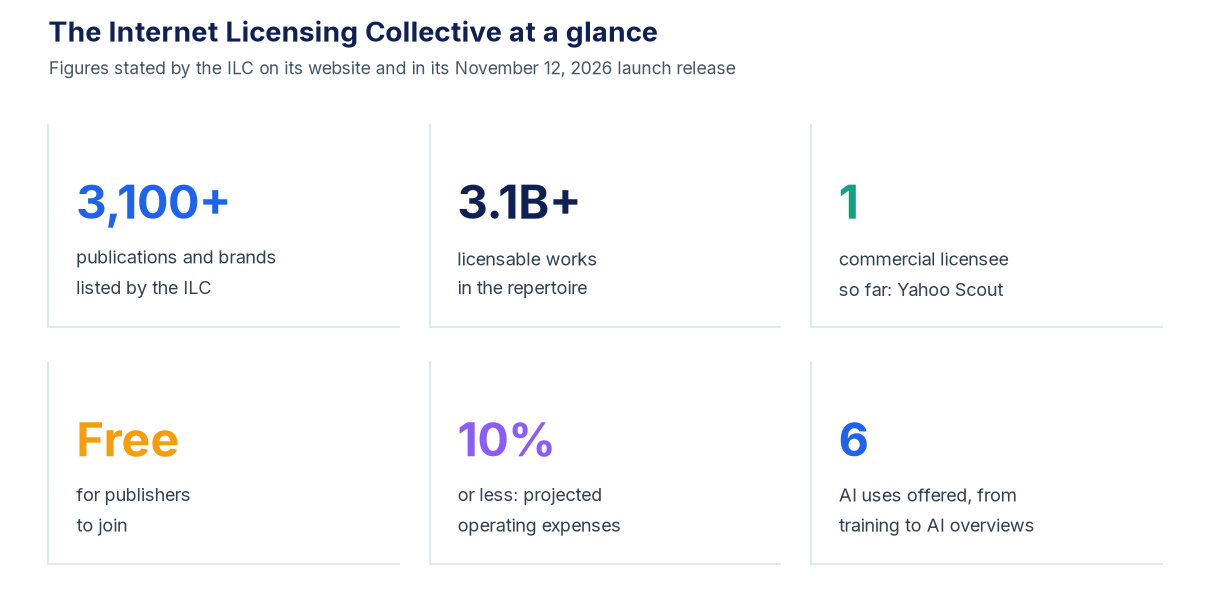
According to the ILC’s launch announcement, more than 3,000 media brands, content owners and platforms are behind the collective, and its website now lists 3,100+. Yahoo Scout, Yahoo’s AI answers product, is its first commercial customer and will get continuing access to permissioned content for Scout answers.
AI companies sign one blanket license and choose only the uses they need. The ILC’s publisher page lists six: training, inference, retrieval, grounding, agents and AI overviews. Publishers join at no cost, the arrangement is non-exclusive, and existing direct deals stay in place. A publisher is only part of a given license if it opts in.
The price is not public. Digiday reported that ILC co-founder Doug Leeds declined to share what Yahoo pays, saying only that the fee is linked to “demand-side revenue.” Yahoo declined to be interviewed for that piece. In the release, Eric Feng, SVP and GM of Yahoo Research Group, said: “AI answers are only as good as the sources behind them.”
How the Royalty Pools Pay Publishers
In collective licensing, the payout design is the part publishers should study most closely. Digiday reports that the ILC keeps a separate royalty pool for each AI company that signs, rather than one giant fund. You only share in money from AI products that actually use your content.
Leeds told Digiday this protects niche publishers. A broad answer engine might draw on hundreds or thousands of sites, while a specialized health product might use a handful of medical publishers whose work is worth far more to it. “An AI vertical in health might be very low volume, but much higher specific value,” he said.
Within each pool, the ILC’s Allocation Rules decide each publisher’s share. The ILC says three factors carry weight: how your work contributes to an answer (shaping it, grounding it or being cited counts more), how often AI relies on it, and how valuable the AI product is. Leeds gave Digiday an example: content used just to check a fact may earn less than content shown in detail with a clear credit. The precise formula was not shared.
The ILC runs as a nonprofit and says it administers licensing at cost. It projects operating expenses at or below 10%, with the rest going to rights holders. Its FAQ says publishers get a dashboard showing licensee-reported usage broken down by website, plus earnings and payment history.
How Big Could the Collective Licensing Market Get?
Alongside the launch, Mather Economics published The Price of Intelligence, a study it says it started on its own and that the ILC did not commission or fund. Building on AI scaling-law research, Mather estimates that, in economic terms, AI firms should be willing to hand over 15% to 35% of revenue to keep access to content covered by the ILC license.
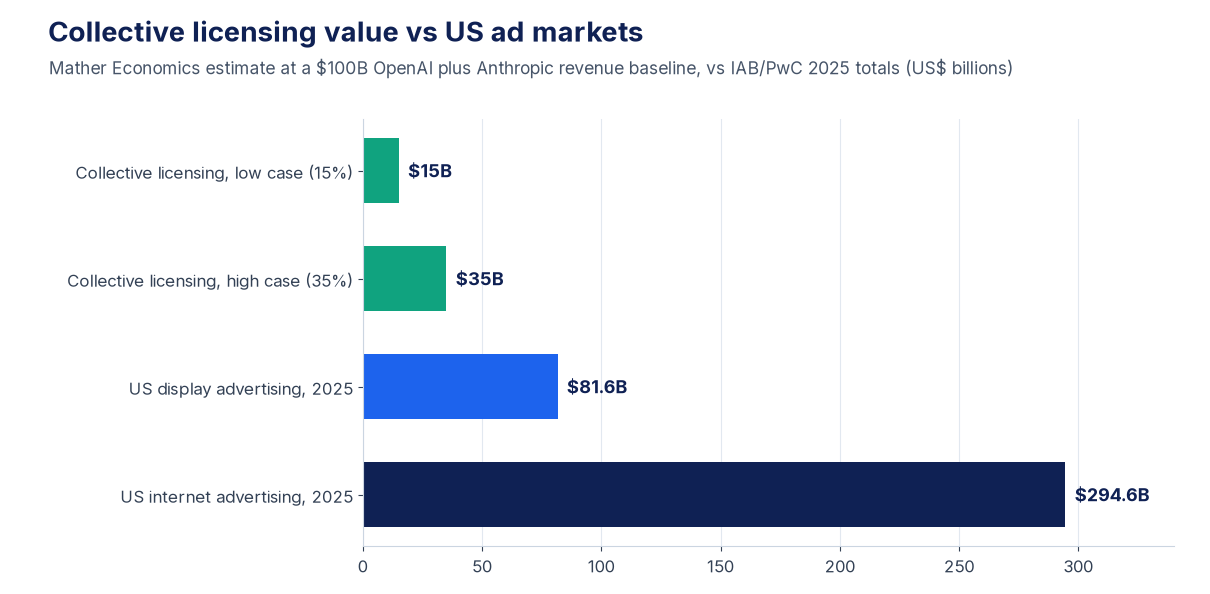
To turn that into dollars, Mather uses $100 billion, rounded down, as the 2026 annualized revenue base for OpenAI and Anthropic together. At that baseline, collective licensing would be worth $15 billion to $35 billion a year from those two firms alone. Mather stresses that willingness to pay is an economic measure and does not mean any AI company has agreed to those terms.
For publishers, the useful comparison is display advertising. Citing IAB and PwC, Mather puts 2025 US display ad revenue at $81.6 billion and total US internet ad revenue at $294.6 billion. The collective licensing estimate equals roughly 18% to 43% of display, or about 5% to 12% of all internet advertising. If the $100 billion base grew 50% a year, Mather calculates the licensing value would pass the 2025 display total in year three at the 35% rate, and in year five at 15%.
How AI Payouts Compare With Other Content Markets
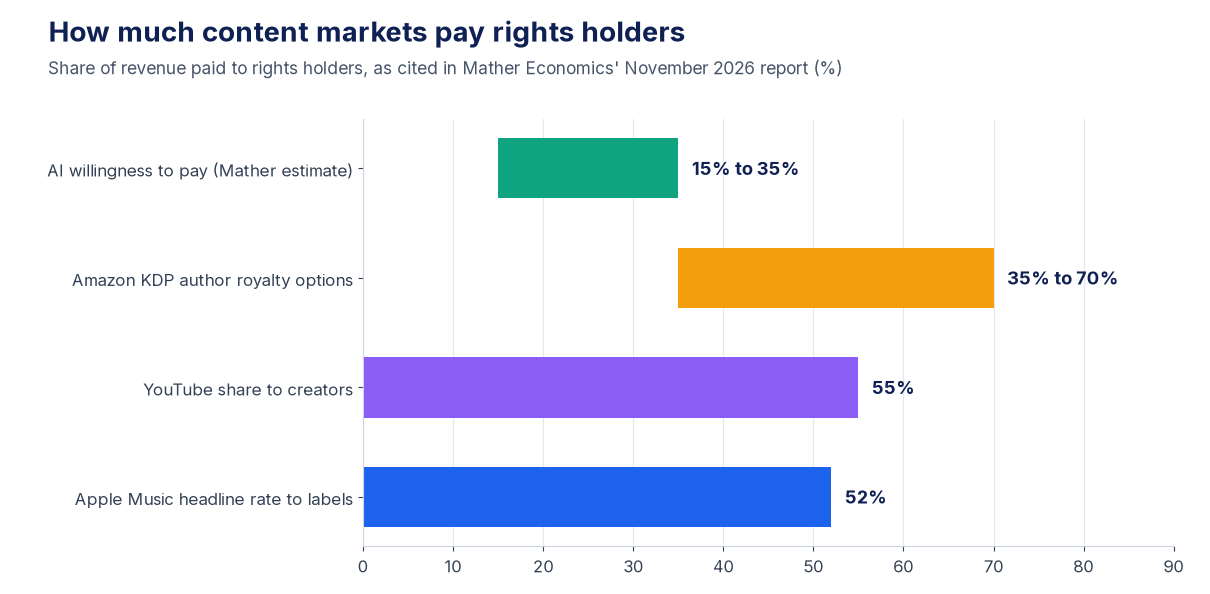
Is a 15% to 35% collective licensing share realistic? Mather points to other markets built on licensed content. Apple Music cites a 52% headline rate paid to labels. YouTube gives creators 55% of net ad revenue on watch-page videos. Amazon KDP lets authors choose a 35% royalty, or 70% on eligible e-books. Spotify passes about two-thirds of music revenue to rights holders. Mather adds that these rates do not set the right rate for AI. They show that mature content markets routinely share a big slice.
The report also notes that more than 90 AI licensing deals have been announced publicly, and the payments that were disclosed add up to hundreds of millions of dollars a year. Mather describes them as one-to-one deals that reach only a small slice of the content out there, which is the gap collective licensing aims to fill.
Traffic pressure explains the urgency. Mather cites Ozone data showing US publishers in its group saw about 32% to 37% fewer ad requests in Q2 2026 than a year earlier, and US programmatic spend across the group fell 44% year over year in the first half. Mather is careful to say it cannot measure how much of that loss AI caused.
How to Join: RSL Files and Robots.txt
Getting into collective licensing does not require a site rebuild. The ILC’s FAQ says anyone who owns the rights to what they publish online can sign up, whether a single creator or a big media company. The setup uses RSL (Really Simple Licensing), an open standard that turns your licensing terms into something machines can read.
Based on the ILC publisher onboarding guide, the flow boils down to four steps:
- Create a free account in the ILC Publisher Portal, or enroll through a platform partner.
- Publish an RSL file that says which content is licensable. It can cover a whole site or only a path such as /articles/.
- Add a License: line to robots.txt pointing to your RSL file. Each subdomain you license needs its own robots.txt file.
- Enroll your sites and subdomains, then track usage and payments in your dashboard.
WordPress publishers have an easier path. The ILC’s partner page lists a WordPress RSL plugin that publishes machine-readable licensing terms, along with partners such as Fastly and Supertab. The ILC homepage also lists Raptive among the names it presents as backers, alongside names like The Guardian, Stack Overflow, wikiHow and WebMD.
7 Smart Moves for Publishers
1. Confirm you own what you license. Only content you hold rights to qualifies for collective licensing. Leave out syndicated wire stories, licensed photos and guest posts where rights are unclear.
2. Decide your scope. You can license your whole domain or just one section. Starting with evergreen guides and original research keeps your options open for premium content later.
3. Keep direct deals possible. Collective licensing is non-exclusive. Digiday reports that a publisher that signs its own deal with an AI company can take its content out of the collective.
4. Choose licensees and uses on purpose. The ILC lets you pick which AI companies can license your work and for which uses. Today Yahoo Scout is the only licensee, so review those settings each time a new one signs.
5. Line up your robots.txt signals. The RSL License: line sits next to any crawler blocks you already use. Our guide to the AI training opt-out explains how those blocking rules work, so the two do not contradict each other.
6. Watch your dashboard, not just your traffic. Licensing pays for use inside AI answers, which standard traffic analytics may not reflect. Check the usage reports by website, and compare them with your citations and referrals. For a wider view of the options, see our overview of AI content licensing.
7. Treat it as an extra stream, not a rescue. With one licensee and an undisclosed fee, collective licensing will not replace ad revenue soon. Keep your ad stack and audience plans strong, and treat any licensing check as upside.
What to Watch Next
Three things will show whether collective licensing pays off. The first is new licensees: Leeds told Digiday the ILC is talking with “some” major AI companies but would not name them. The second is the size of the first payouts publishers see in their dashboards. The third is competition from pay-per-value models, which Digiday has reported Google and Microsoft are testing.
Yahoo’s role is worth tracking too. Scout only recently left beta, and our breakdown of Yahoo Scout covers what its search changes mean for traffic. For now, enrolling is free and non-exclusive, and the ILC says declaring your content takes just minutes.
Frequently Asked Questions
What is collective licensing for AI?
Collective licensing lets many publishers pool their content so an AI company can sign one blanket agreement instead of separate contracts. An administrator, in this case the nonprofit Internet Licensing Collective, splits the fees among members using set allocation rules.
Who is the first ILC licensee?
Yahoo Scout, Yahoo’s AI answers product, was announced as the Internet Licensing Collective’s first commercial licensee on November 12, 2026. Neither the ILC nor Yahoo has disclosed what Yahoo is paying.
Does it cost anything to join the ILC?
No. Joining is free for publishers and creators, and participation is non-exclusive, so existing direct licensing deals stay in place. A publisher is only part of a given license if it opts in.
How does the ILC decide what each publisher earns?
The ILC keeps a separate royalty pool for each AI company. Within each pool, its Allocation Rules weigh how your work contributes to an answer, how often AI relies on it, and how valuable the AI product is. The exact formula has not been disclosed.
How big could collective licensing get?
Mather Economics estimates that, in economic terms, AI firms should rationally be ready to pay 15% to 35% of revenue for content covered by the ILC license. At a $100 billion baseline for OpenAI and Anthropic, that equals $15 billion to $35 billion a year, compared with $81.6 billion in 2025 US display ad revenue.
How do I add my site to the ILC?
Create a free account in the ILC Publisher Portal or join through a platform partner, publish an RSL file that says which content is licensable, add a License: line to robots.txt, and enroll your sites and subdomains. WordPress sites can use the WordPress RSL plugin listed by the ILC.
Related posts:

How to Get Tier 1 Traffic Without SEO: 2026 Strategy Guide

How to Monetize TikTok: Making Money on TikTok in 2025
AI Video Generator Monetization: Turning AI Content Into Real Revenue

Why a Crypto Candle Never Tells the Whole Story: Adding Volume and Order Flow to Technical Analysis
Application Monetization Tools: Turning Your App into a Revenue Machine
