Yahoo Scout left beta on November 10, 2026, and it now sits underneath all of Yahoo Search. Yahoo says the AI answer engine has delivered more than 3 billion answers since its Q1 2026 launch, and that every response includes prominent links to sources. For publishers, that makes Yahoo one of the few big search players openly promising to send traffic back to the open web while it adds AI answers.

This guide explains what changed, how Pivot Search decides between links and AI answers, how big Yahoo really is in US search, and the practical moves that can help your site show up as a source. It draws on Yahoo’s own announcements, StatCounter Global Stats, and reporting from The Next Web.
A note on the data. Usage figures such as answer counts and user totals come from Yahoo itself, and we label them that way. Yahoo has not published referral or click-through data for Scout, so we do not estimate any traffic numbers here.
Table of Contents
What Changed With Yahoo Scout This Week
According to Yahoo’s November 10 announcement, Scout has left beta and now runs inside a rebuilt Yahoo Search. Yahoo says it used the beta to make answers more accurate and faster, and to make sure every response points people back to the open web with clear source links.
The launch has four parts. Pivot Search is the rebuilt Yahoo Search that blends traditional results with Scout AI answers. Yahoo Scout Everywhere puts contextual answers inside Yahoo Finance, Sports and News, with Yahoo Shopping listed as coming soon. A new Yahoo Scout app adds voice and image search. And Scout Memories will use what people have done in Scout before to shape later answers, and users can see, delete or switch off those memories.
Scout is also moving beyond Yahoo’s own sites. Yahoo says Firefox users on desktop in the US can now pick Yahoo Scout as the browser’s AI sidebar option, then ask questions and check answers, citations and links without leaving the page they are on.
Availability matters for planning. Yahoo says the rebuilt search works on desktop and mobile web in the US, the UK, Europe and Switzerland, while the Scout app for iOS and Android is US only for now. Yahoo also says its first national brand campaign for Scout, starring Jimmy O. Yang, begins rolling out Thanksgiving week across TV, streaming and social channels.
How Pivot Search Works
Pivot Search does not replace the familiar results page. Yahoo says the new search looks at each query and lets people switch between classic results and a Yahoo Scout AI answer without leaving the page.
Yahoo gives a clear rule of thumb for when an AI answer is offered. When a question would be better served by one, such as weighing two options against each other or working through a how-to, the search suggestions include a Scout answer. In a Built by Yahoo design note, the company adds that searches for a stock symbol, a sports team or a website you want to visit will not prompt an AI answer, since the quicker route is a single click.
The same note says short AI summaries appear only on searches where they add something, and that one toggle flips between classic search and Scout without making you retype the query. Yahoo also says each Scout answer links to the sites it draws on.
For publishers, that split is the key detail. Navigational queries still lead to classic links. Comparison and how-to queries are the ones most likely to trigger an AI answer, so that is where your pages either become a cited source or get summarized without a visit.
How Big Is Yahoo Search in the US?
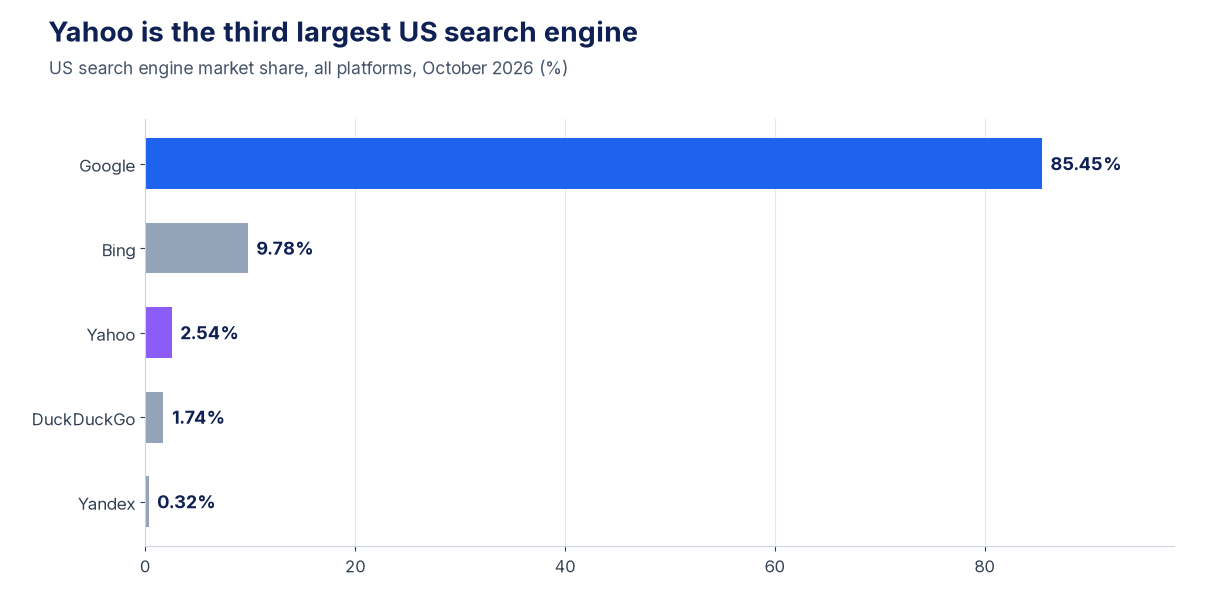
Yahoo bills itself as the No. 3 search engine in the US, and independent data backs up the ranking. StatCounter Global Stats puts Yahoo at 2.54% of US search across all platforms in October 2026. That is behind Google at 85.45% and Bing at 9.78%, and ahead of DuckDuckGo at 1.74%.
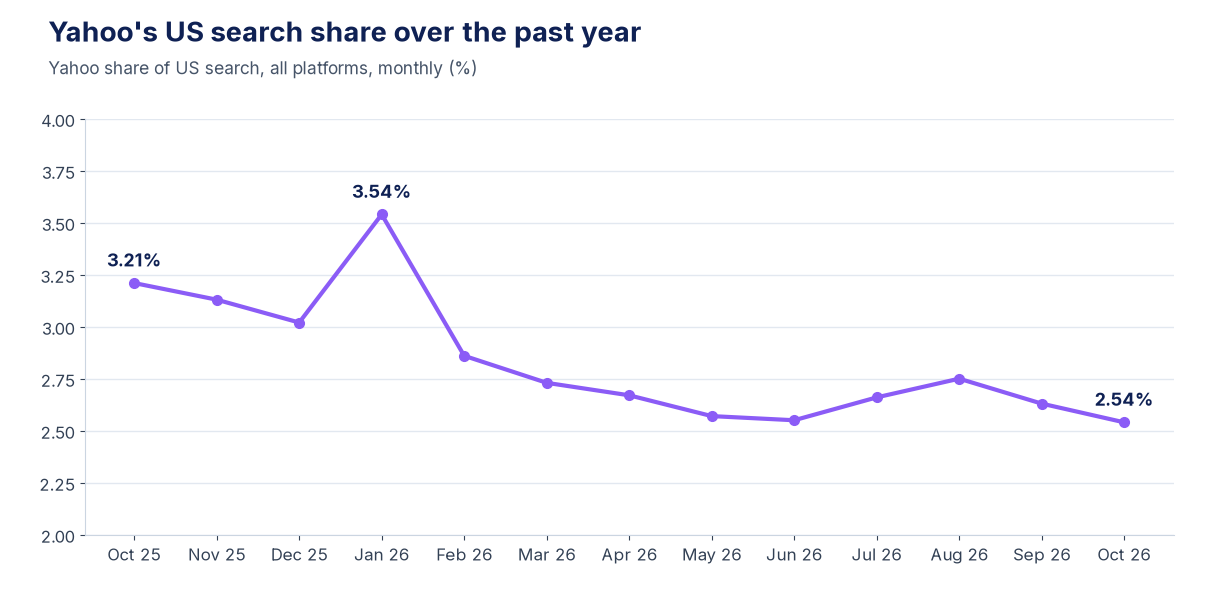
The same StatCounter series shows Yahoo’s US share at 3.21% in October 2025, a peak of 3.54% in January 2026, and 2.54% in October 2026. Scout launched in beta on January 27, so the first three months of that series predate it. Share data alone does not show why Yahoo’s share moved, so read it as context rather than a verdict on Scout.
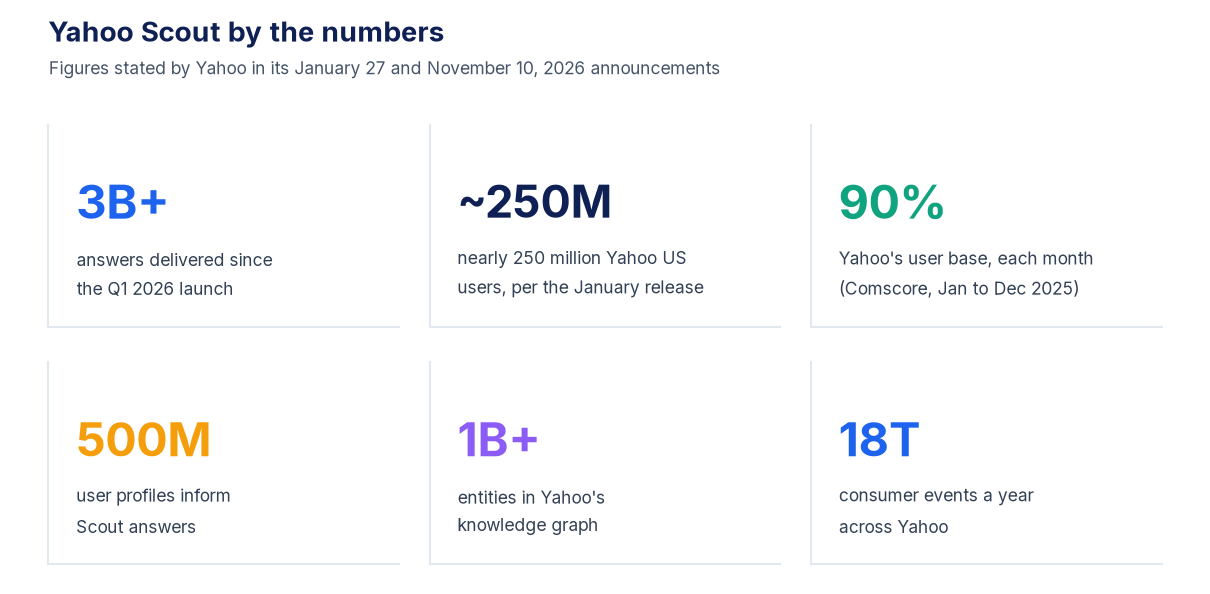
A small search share is not the whole picture. Yahoo’s January launch release said its nearly 250 million US users can use Scout, and that its user base reaches 90% of US internet users each month, citing Comscore figures for January to December 2025. Scout Everywhere means those answers also appear on Finance, Sports and News pages, not only in the search box.
What Powers Scout and Where the Answers Come From
When Yahoo introduced the product on January 27, 2026, its launch release said Scout pulls together material from the open web along with Yahoo’s own data and content. Yahoo also said Scout draws on 500 million user profiles, more than 1 billion entities in its knowledge graph, and 18 trillion consumer events a year across its properties.
Two partnerships shaped Scout at launch. In January, Yahoo named Anthropic’s Claude as Scout’s main AI model and said Scout uses Microsoft Bing’s grounding API to base its answers on trusted sources across the open web. The model mix has since changed. Fast Company reported on November 10 that Yahoo now uses a mix of outside models, Google’s Gemini among them, in place of Claude alone. Yahoo’s November release does not mention Bing.
That Bing link is the practical takeaway. If Scout grounds its answers through Bing, your visibility in Bing’s index is likely to matter for whether you can be cited at all. Yahoo has not published how it picks sources, so treat Bing readiness as a sensible precaution rather than a guaranteed ranking factor.
Yahoo also said in January that it is joining Microsoft’s Publisher Content Marketplace pilot, which it described as supporting sustainable revenue opportunities for publishers. Yahoo has not shared payment terms for that pilot.
Links, Ads and the Publisher Bargain
Yahoo’s pitch to publishers is links. Its November release claims Scout gives links and sources more prominence than any rival AI answer engine, and says the goal is to send traffic back to publishers the way traditional search does.
Yahoo CEO Jim Lanzone made the same case on stage at HumanX in Amsterdam in September. The Next Web reported that he said Scout shows many blue links to publishers, both because users need to see sources and because sending traffic back is part of the internet’s social contract.
Lanzone also argued that payments from AI companies to publishers will never add up to enough, and that advertising should keep funding search. According to The Next Web, he pictured sponsored results as a block of advertiser links written as a paragraph rather than a list. He said click-through rates will shift and efficiency could slip, but he expects more volume and better-converting clicks.
That is a useful contrast with the wider zero-click trend we covered in our look at zero-click search. Whether Yahoo Scout actually sends meaningful visits is something only your own analytics can answer, because Yahoo has not released referral numbers.
7 Smart Moves to Get Ready for Yahoo Scout
1. Segment Yahoo traffic in analytics now. Create a saved view for referrals from Yahoo hostnames before the Thanksgiving week campaign starts. A clean baseline lets you see whether Pivot Search and the brand push change your Yahoo visits, instead of guessing.
2. Check your Bing setup. Since Yahoo said at launch that Scout uses Bing’s grounding API, confirm your key pages are crawled and indexed in Bing Webmaster Tools, and fix any crawl errors. This is basic hygiene that also helps your visibility in Bing itself.
3. Write for the queries that trigger answers. Yahoo gives comparisons and step-by-step instructions as examples of queries where a Scout answer is suggested. Give those pages a direct answer near the top, a clear comparison table or numbered steps, and a named source for every claim.
4. Make your pages easy to cite. Use descriptive headings, short paragraphs, dates on time-sensitive facts, and clear author information. Our guide to AI visibility covers how to track citations across answer engines.
5. Map your content to Yahoo’s verticals. Scout Everywhere runs inside Yahoo Finance, Sports and News, with Shopping coming soon. If you publish in those areas, those surfaces are where readers will meet Scout answers on related topics.
6. Keep your ad stack ready for any new visits. If Yahoo Scout does send readers, they arrive on article pages, so make sure your layouts load fast and your ad units are in place. A visit you cannot monetize is only half a win.
7. Watch the money side, not just the clicks. Follow Microsoft’s Publisher Content Marketplace pilot and any news on Scout ad formats. Our explainer on AI payment models compares how publishers are getting paid when AI reads their pages.
What to Watch Next
Three signals will show whether Yahoo Scout becomes a real traffic source. The first is your own Yahoo referral trend through the holiday campaign. The second is whether Yahoo publishes any click or referral data to back its traffic promise. The third is how sponsored results look inside Scout answers once Yahoo rolls out the generative AI search advertising opportunities it promised advertisers in January, since that will shape how many organic links stay visible.
For now, the smart approach is low cost and measurable. Get indexed in Bing, structure your comparison and how-to pages for citation, set a Yahoo baseline, and let the data tell you how much attention Scout deserves in your search plan.
Frequently Asked Questions
What is Yahoo Scout?
Yahoo Scout is Yahoo’s AI answer engine. It launched in beta in Q1 2026 and, as of November 10, 2026, has left beta and now runs inside a rebuilt Yahoo Search. Yahoo says it has delivered more than 3 billion answers since launch.
What is Pivot Search?
Pivot Search is Yahoo’s rebuilt search. Yahoo says it looks at each query and lets people switch between classic results and a Yahoo Scout AI answer on the same page. Questions like comparisons or step-by-step instructions get a Scout answer suggested.
Does Yahoo Scout link to publishers?
Yahoo says each Scout answer links to the sites it draws on, and claims Scout gives links and sources more prominence than any rival AI answer engine. Yahoo has not published referral or click-through data.
Where is the new Yahoo Search available?
Yahoo says the rebuilt search works on desktop and mobile web in the US, the UK, Europe and Switzerland. The Scout app for iOS and Android is US only for now, and US desktop users can pick Scout in Firefox’s AI sidebar.
What technology powers Yahoo Scout?
At launch in January 2026, Yahoo said Scout used Anthropic’s Claude as its main AI model, plus Microsoft Bing’s grounding API and Yahoo’s own data and content. Fast Company reported in November that Yahoo now uses a mix of outside models, Google’s Gemini among them, in place of Claude alone.
How big is Yahoo in US search?
StatCounter Global Stats puts Yahoo at 2.54% of US search across all platforms in October 2026, third behind Google at 85.45% and Bing at 9.78%. Yahoo describes itself as the No. 3 search engine in the US.
Related posts:

Choosing the Best WordPress Theme – 9 Things to Look For

Why In-Stream Ads Remain One of the Most Effective Video Monetization Methods

How Bloggers Are Using Image to Video AI to Unlock New Traffic and Revenue Streams

Who Can Be Held Liable in a Truck Accident Claim?

13 Time Management Tips for The Busy Blogger