

Outcome-based advertising is how publishers sell measurable results, such as clicks, leads or sales, instead of only selling reach on a CPM. The idea is not new, but this week it got fresh proof. On November 12, 2026, AdExchanger reported that Schibsted is winning budgets back from Meta with direct-sold native ads that are optimized by AI and priced per click.
At the same time, buyers keep asking every partner to show what their money returned. This guide explains what outcome-based advertising means for a website owner, what the newest data says about how advertisers reward proof, and six smart steps you can take before your next media kit goes out.
Table of Contents
Table of Contents
What is outcome-based advertising?
In a classic CPM deal, an advertiser pays for every thousand impressions, whether or not anyone acts on the ad. In outcome-based advertising, the price or the goal is tied to an action the advertiser cares about. That can be a cost per click (CPC), a cost per acquisition or action (CPA), or a CPM deal that is judged on the return it produces.
For publishers, the shift matters because the biggest platforms have trained advertisers to think this way. “Advertisers have been trained by Meta to just care about ‘I put money in and I see how much money comes out,'” Aly Nurmohamed, founder and CEO of Nodals AI, told AdExchanger.
So outcome-based advertising is less about a new ad format and more about a new sales promise. You are no longer only selling space next to your content. You are selling a forecast that your audience will act, backed by your own data.
Why buyers want outcome-based advertising now
The walled gardens still dominate. Citing eMarketer, AdExchanger noted that Meta, Google and Amazon are expected to take 62.3% of global digital ad spending in 2026, and that Meta is set to bring in more ad revenue than Google for the first time. Their pitch to advertisers is simple: put a budget in, set a goal, and let the system chase results.
But there are signs of movement toward independent partners. In a July 2026 poll of 166 brands and agencies run by eMarketer and Datum Intelligence, 63.9% said they had shifted mobile spend out of the walled gardens and toward independent partners over the previous 12 months. Only 1.2% made the reverse move.
The catch is that those budgets follow proof. Independent publishers that can only report impressions are competing on price. Publishers that can show what an impression led to have something the walled gardens cannot easily copy: a direct relationship with a known audience.
How Schibsted sells clicks instead of CPMs
Schibsted Media Group owns VG, which AdExchanger calls Norway’s largest digital news publisher at roughly 2.4 million visitors a day, and Sweden’s Aftonbladet, which says it draws 3.6 million visitors a day. According to Christer Ljones, director of ad data capabilities at Schibsted Marketing Services, the group’s properties together reach roughly 50% of the audience in the markets it covers.
About two thirds of Schibsted’s ad revenue comes from direct sales and about one third from programmatic. Even so, advertisers were telling Schibsted that it looked expensive next to Meta. Nurmohamed summed up the request as: “I don’t want to buy on a CPM, and you’re really expensive relative to Meta. Here’s what I’m doing with Meta. Can you replicate it?”
Schibsted’s answer was to build its own optimization engine with Nodals AI, a London firm that builds custom ad optimization algorithms for publishers across Europe and the US. Nodals feeds the publisher’s first-party signals into the model, including logged-in data, how far readers scroll and how often they click on content or ads, so it can forecast which readers are most likely to click and then buy from a given advertiser.
The publisher tested the technology last summer. Since then it has been developing a line of native ad products, sold directly, that carry AI optimization inside and charge per click instead of per thousand impressions. Ljones was realistic about the goal: “you don’t need to beat them on the average. You just need to beat them with meaningful scale at the margin.”
Ljones said the pitch has found success with advertisers who have been putting more money into Meta lately while seeing diminishing returns. He described the opening offer this way: “Let’s take 10% of whatever you spend on Meta, and you can probably keep most of your conversions and get more [from us].” That is outcome-based advertising in practice: a small, testable budget, a performance price and a clear comparison point.
What the buyer survey says about proof
The eMarketer and Datum Intelligence survey polled 166 brand and agency decision makers who purchase mobile ads programmatically. It focuses on mobile, but its findings on proof and payment models are useful for any publisher pitching outcome-based advertising or direct deals.
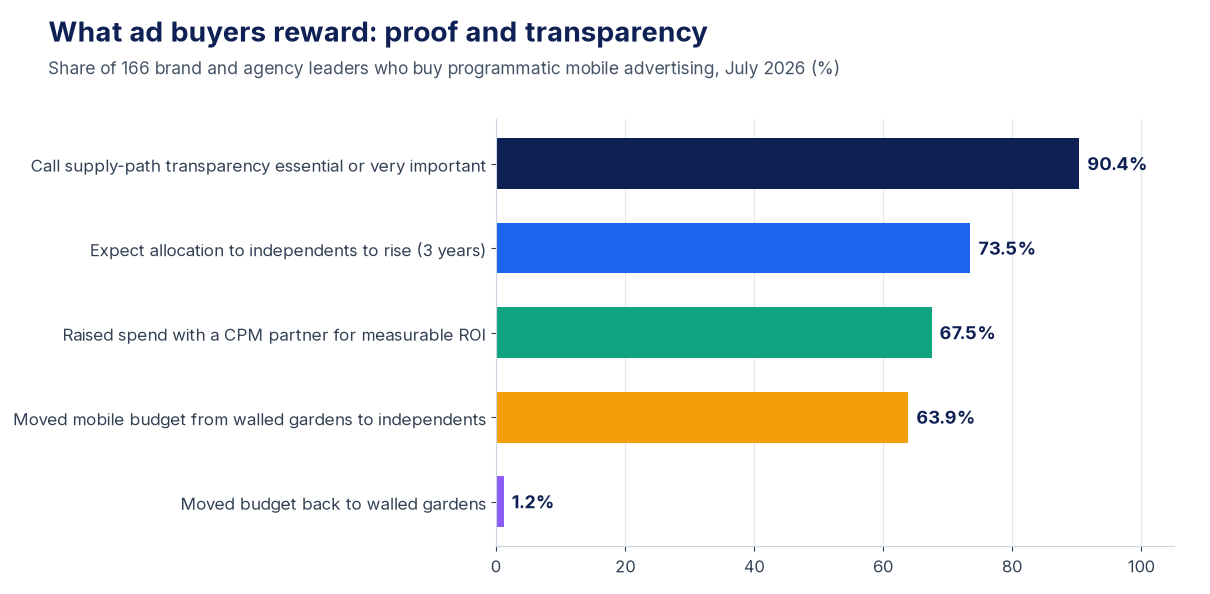
Transparency comes first. When picking a partner, 90.4% of respondents rate full supply-path transparency as essential or very important, and pricing transparency is the second most cited selection criterion at 45.8%. Over the next three years, 73.5% expect to give independent channels a bigger share of budget.
Buyers also keep their own scorecard no matter how they pay. About 72% told the researchers that accountability stays the same or mostly the same whatever the payment model, whether they pay by CPM, by the click or by the install. On CPM buys, 31.3% always track ROI at the channel level and another 41.6% usually do, while just 5.4% never do.
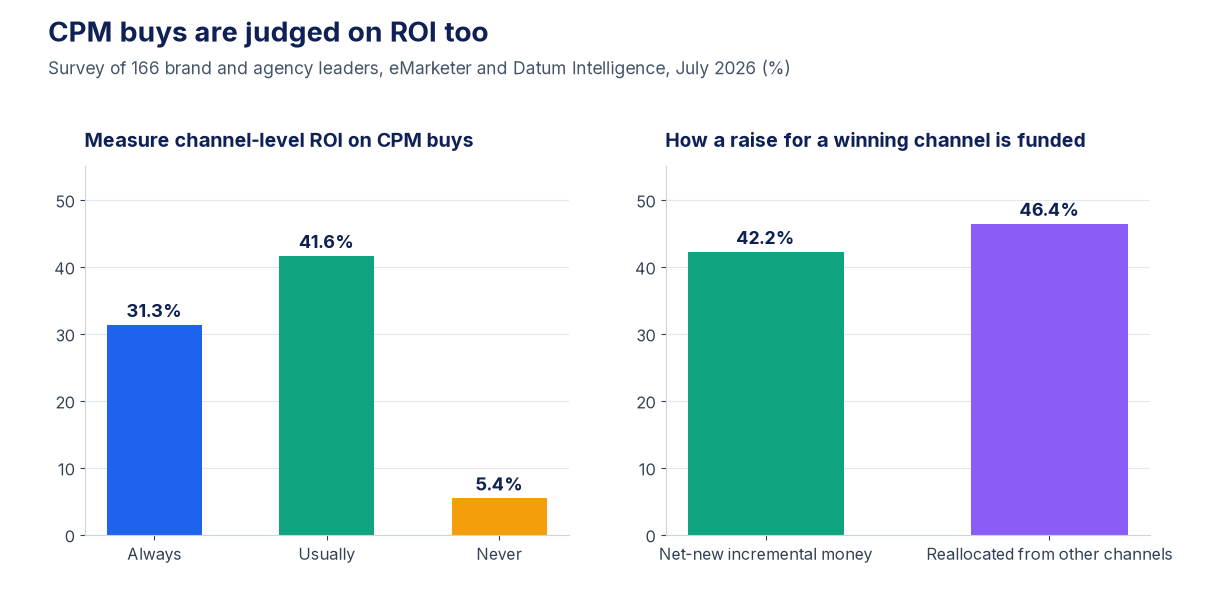
That is the most important outcome-based advertising lesson for publishers: you may still sell on CPM, but your CPM is being judged like a performance buy. The reward for passing that test is real. In the survey, 67.5% raised spend with a partner paid on CPM because that partner showed measurable ROI. When a channel over-performs, 42.2% pay for its raise with net-new money and 46.4% move budget from other channels.
ChatGPT Ads shows where bidding is heading
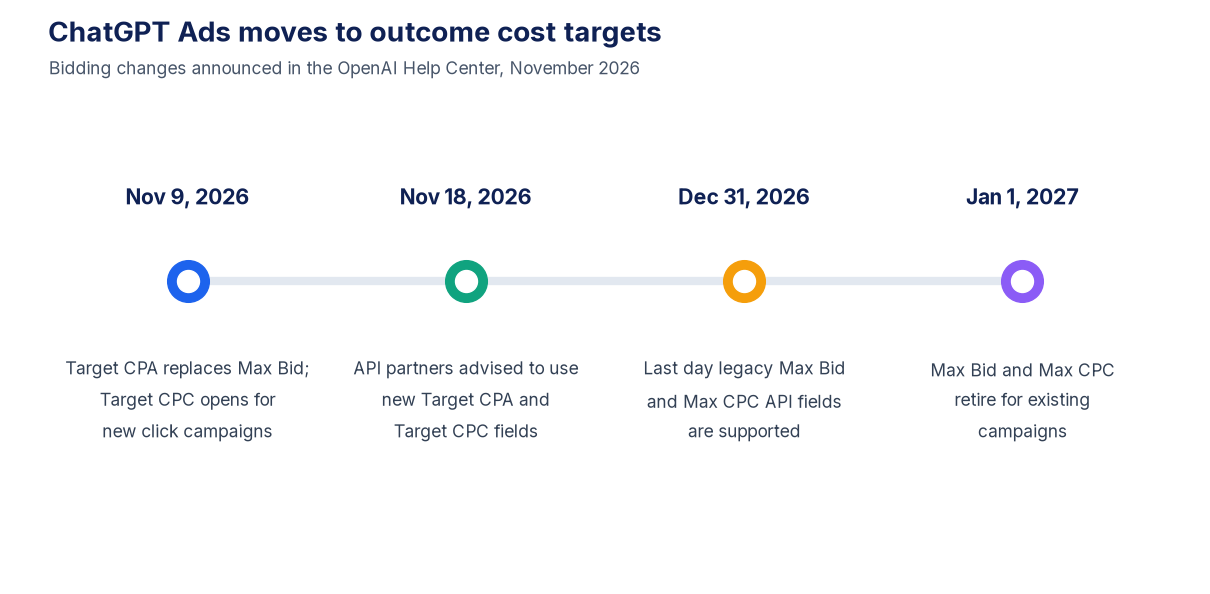
The newest ad platforms are moving toward outcome-based advertising too. According to the OpenAI Help Center, starting Monday, November 9, Target CPA replaced Max Bid for advertisers creating new conversion campaigns that aim at a specific cost per conversion, and Target CPC became available for new click campaigns. Maximize Results (Autobid) is now called Intelligent bidding.
Campaigns that already use Max Bid or Max CPC have until January 1, 2027, when both legacy controls retire. API partners are advised to switch to the new API fields for Target CPA and Target CPC from November 18, and OpenAI will keep supporting the legacy fields through December 31. OpenAI also notes that the bidding goal and the billing event are separate settings, so a campaign can optimize for conversions while being charged for clicks or impressions. We covered the wider publisher impact in our guide to what ChatGPT Ads means for publishers.
Why should a website owner care about an advertiser setting? Because every buyer who uses these tools gets used to typing in a target cost and letting the system find results. When that buyer calls your sales team, they will expect a similar outcome-based advertising conversation about goals, not just about rates.
6 smart steps to start outcome-based advertising
You do not need Schibsted’s scale to test outcome-based advertising. These six steps keep the risk small while you learn what your audience can deliver.
- Pick one outcome you can measure. Clicks are the easiest place to start because you can count them on your own pages. Leads or sales need the advertiser’s tracking and a shared definition of a conversion.
- Audit your first-party signals. Schibsted’s model uses logged-in data, scroll depth and click behavior. List what you already collect with consent, and see our guide on how to monetize first-party data.
- Start with native or sponsored formats. Schibsted chose direct-sold native ads for its CPC product. Formats you control end to end are easier to optimize than open auction display.
- Ask for a small test budget. Borrow Schibsted’s approach: it asks advertisers for 10% of what they spend on Meta. Ask for a slice of an existing budget rather than a brand-new one.
- Report ROI on CPM deals too. Since most buyers measure ROI even on CPM buys, add clicks, engaged time or conversions to your reporting before they ask.
- Package it as a direct or curated deal. Outcome pricing works best when you know the buyer. Our guide to programmatic deals for publishers covers deal types that keep pricing and data in your hands.
Risks to watch before you change pricing
Outcome-based advertising moves some risk from the advertiser to you. If a campaign does not produce clicks, you earn less from the same inventory. Ljones himself said Schibsted “won’t be necessarily as good as Meta on average” at driving performance, so it competes at the margin instead.
Data quality is the second risk. OpenAI tells its own advertisers that weak or missing conversion signals can cut delivery and leave part of a budget unspent. The same logic applies to a publisher deal: if the advertiser’s tracking is broken, your results will look worse than they are. Agree on the conversion event and the reporting source before launch.
Finally, keep a floor while you test outcome-based advertising. A hybrid deal, such as a CPM with a performance bonus, or a CPC deal with a minimum spend, protects your revenue while you learn what your audience can deliver.
FAQ
What is outcome-based advertising?
Outcome-based advertising ties the price or the goal of a campaign to an action the advertiser cares about, such as a click, a lead or a sale, instead of only paying for impressions on a CPM. It can be priced per click (CPC), per acquisition (CPA), or sold on CPM and judged on return.
How is Schibsted using outcome-based advertising?
Schibsted worked with Nodals AI to build custom optimization algorithms fed by its first-party data, such as logged-in data, scroll depth and clicks. It is now developing directly sold native ad products with AI optimization inside that charge per click instead of per thousand impressions.
Do advertisers measure ROI even on CPM deals?
Yes. In the July 2026 eMarketer and Datum Intelligence survey of 166 brand and agency leaders, 31.3% always measure channel-level ROI on CPM buys and another 41.6% usually do, while just 5.4% never do.
Are budgets moving away from walled gardens?
In the same survey, 63.9% had moved mobile spending from walled gardens toward independent partners over the prior 12 months, while just 1.2% had moved spending the other way. Even so, eMarketer projects that Meta, Google and Amazon will capture 62.3% of global digital ad spending in 2026.
What changed in ChatGPT Ads bidding?
Starting November 9, 2026, Target CPA replaced Max Bid for new conversion campaigns and Target CPC became available for new click campaigns. Existing campaigns lose Max Bid and Max CPC on January 1, 2027, and Maximize Results (Autobid) is now called Intelligent bidding.
How can a small publisher start with outcome-based advertising?
Pick one measurable outcome such as clicks, audit your first-party signals, start with native or sponsored formats you control, ask for a small test budget, report ROI on CPM deals too, and package it as a direct or curated deal. While you test, keep a revenue floor with a hybrid deal.
Related posts:

14 Creative Ad Units To Include In Your Next Ad Proposal

Master the Balance: Refreshing Ads Without Hurting SEO in 2026
Agentic Advertising: How Publishers Can Get Agent-Ready

How to Sell Ads on Your Website Directly: 11 Tips & Tricks

Seven Examples Of Media Kits That “Make It Rain”
