

Search traffic used to be the payment. You let crawlers in, they sent readers back, and your ads, affiliate links, and signups did the rest. AI answers are breaking that bargain, and AI content licensing is the industry’s attempt to write a new one. In one week in October 2026, Google said more than 400 publications had joined its paid News AI pilot, Reach reported a 29.7 percent drop in indirect digital revenue, and The New York Times joined a coalition building licensing standards. For an independent site, the question is no longer whether this market exists. It is whether you can get into it, and on what terms.
This guide covers why licensing has become a real revenue line, who is getting paid today, the four models you can actually access, and a readiness checklist for smaller publishers who do not have a legal team on call.
Why AI Content Licensing Became a Revenue Line
The short answer is lost referrals. Reuters, citing a Reuters Institute report based on Chartbeat data, reported that Google organic search referrals to more than 2,500 websites fell 33 percent globally between November 2024 and November 2025. In an April 2026 IAB survey of 110 United States publishers, 95 percent said AI driven discovery was having a moderate or significant impact on their business, and 60 percent of small and mid sized digital publishers reported reduced referrals from discovery surfaces.
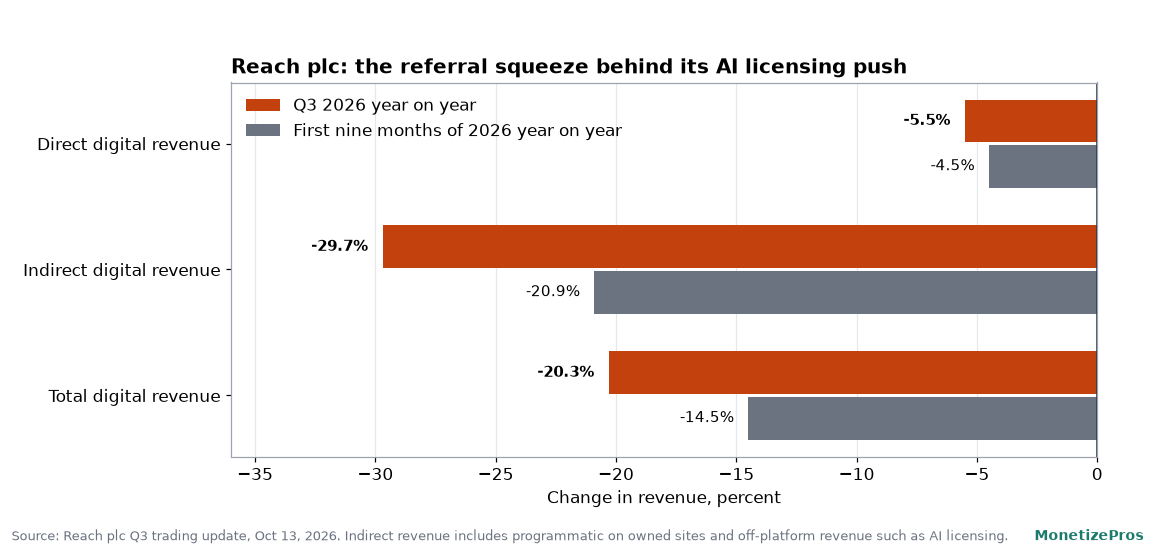
Reach plc, the UK publisher behind the Daily Express and the Daily Star, shows what that looks like in a revenue line. In its Q3 2026 trading update on October 13, Reach reported digital revenue down 20.3 percent year on year, with indirect revenue, which includes programmatic advertising on its own sites, down 29.7 percent. It blamed “industry-wide disruption in referrals, primarily from Google” and said off platform revenue, including AI licensing from “a recently secured agreement with a major tech platform”, was partly offsetting the decline.
Reach’s chief executive, Piers North, told Digiday the publisher had seen well over 100 million successful scrapes of its content over six months, and described its new Google deal as a model for future AI partnerships. That is the shift in one sentence: content that used to be paid for with traffic is now being paid for, sometimes, with a license fee.
Who Is Getting Paid for AI Content Licensing Today
More publishers than you might think, but not evenly. In the IAB study, 51 percent of publishers said they had already signed one or more AI or LLM licensing agreements, 35 percent were negotiating, and only 4 percent were not pursuing licensing. The split by size is stark. Six in ten large media publishers had signed, and so had 56 percent of news and financial publishers. Among small independent publishers and blogs, only 20 percent had signed, and 30 percent were not pursuing licensing at all.
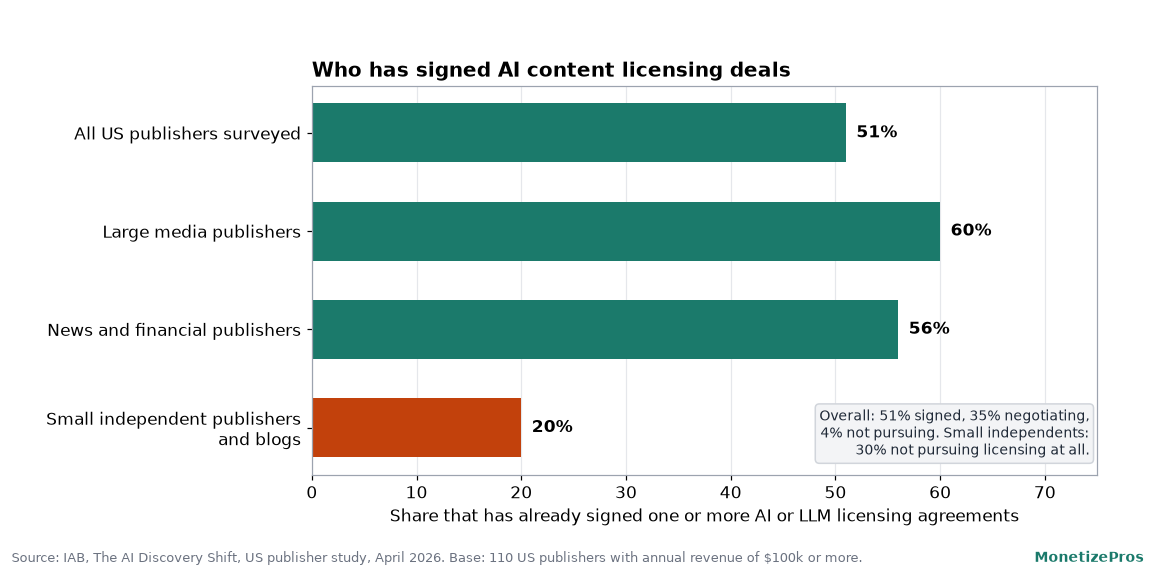
Note the survey base: publishers with at least $100,000 in annual revenue. If your site earns less than that, the survey does not describe you directly, and the 20 percent figure for small independents is the closer benchmark. Most deal terms are also confidential. Google’s October 15 announcement named Axios, CNN, the Financial Times, and Forbes alongside local outlets such as the Texas Tribune and Oil City News, but gave no fees.
The Four AI Content Licensing Models You Can Actually Access
1. Platform pilots
Google runs at least two. Its News AI pilot, which Google now calls a licensing program, pays participating news publications “for the delivery and use of enhanced content” for features such as article overviews and audio briefings in Google News. Separately, Digiday reported on September 14, 2026 that Google has been testing an AI contribution pilot inside Search Console that pays publishers when their content “significantly” contributes to answers in Gemini, AI Overviews, and AI Mode. Participants see a monthly earnings figure, Google has approached at least dozens of publishers for it, and Digiday found the program appealed more to small and mid sized publishers than to large ones. One source told Digiday early payouts were “peanuts” relative to advertising revenue.
2. Licensing marketplaces and pay per crawl
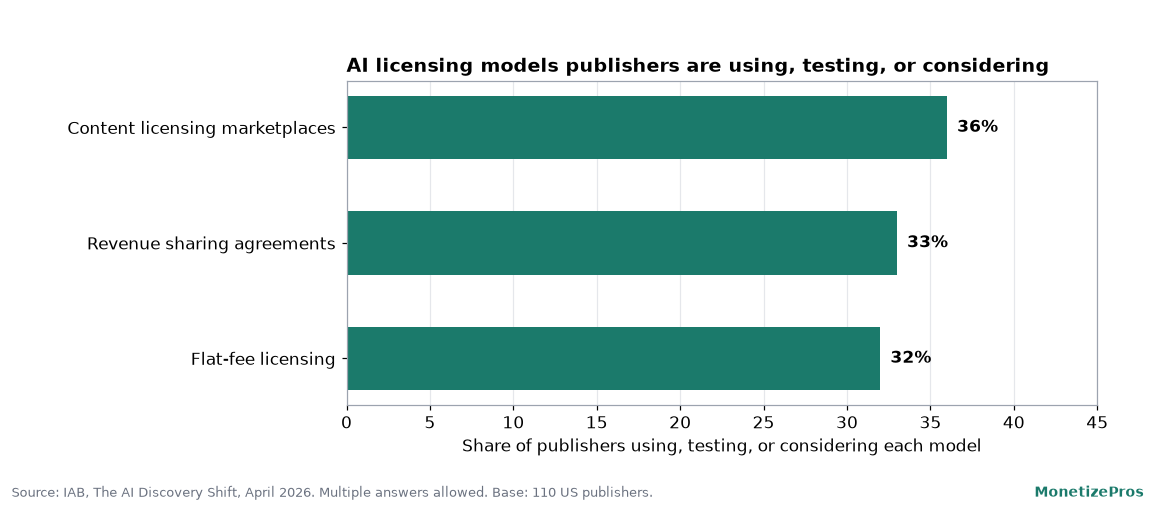
Content licensing marketplaces were the most common model in the IAB study, used, tested, or considered by 36 percent of publishers. These intermediaries sit between your site and AI companies, meter access, and pass payments back. Infrastructure providers are moving the same way. Cloudflare, for example, is building tools that let sites charge machine visitors, covered in the MonetizePros explainer on the Cloudflare Monetization Gateway.
3. Revenue share and flat fee deals
Revenue sharing agreements (33 percent) and flat fee licensing (32 percent) were close behind in the IAB data. Flat fees suit publishers with archives and brand value. Revenue share and usage based deals depend on measurement you may not control yet.
4. Collective standards
Publishers are also organizing. Reuters reported on October 12 that the SPUR coalition, short for Standards for Publisher Usage Rights, now has more than 80 members across more than 20 countries after The New York Times, AFP, and The Economist joined. SPUR is building standards to track how AI companies use content and to make licensing easier, including a Content Telemetry Standard for how AI agents record and report use. For a small site, standards like this matter because they could make licensing possible without negotiating one deal at a time.
Should You Block AI Crawlers or Stay Visible?
Many publishers already restrict access. In the IAB study, 51 percent had taken or considered blocking AI crawlers, and small and mid sized digital publishers were the most active, at 70 percent for blocking crawlers and 70 percent for monitoring usage. Blocking gives you leverage, but it has a cost if it also removes you from the AI features that still send some traffic.
Google now gives every site a clearer switch. Since August 31, 2026, the Search generative AI control in Search Console lets you include or exclude your site from AI Overviews, AI Mode, and generative AI features in Discover. Google’s help page is direct about the trade off: if you exclude your site, you will not receive traffic or impressions from those features, and the control does not affect AI training, which is managed separately with Google-Extended. The companion Generative AI performance report shows your impressions in AI Overviews and AI Mode, so you can see what you would be giving up before you change anything. For the crawler side of the decision, the MonetizePros guide on blocking LLM bots from scraping ad inventory covers the technical options.
A Licensing Readiness Checklist for Independent Publishers
- Measure your AI exposure. Open the Generative AI performance report in Search Console and note which pages get AI impressions. Check your server or CDN logs for AI crawler activity by operator. You cannot price what you have not measured.
- Confirm you own what you would license. Separate fully owned original content from syndicated articles, guest posts, freelance work with unclear rights, and licensed images. A buyer will ask.
- Identify your licensable assets. Original data, tested reviews, deep archives, and well structured explainers are more useful to an AI system than thin pages. List them by section.
- Set an access policy per use. Decide separately on training, search and retrieval, and agent access, rather than one blanket block or allow. Document the decision and the date.
- Join what you can, read every term. If you are invited to a platform pilot or accept a marketplace, check exclusivity, duration, opt out rights, and what reporting you receive. One publisher executive told Digiday that joining a low paying program could weaken a publisher’s leverage in later negotiations.
- Compare payouts with what you are losing. Put any licensing income next to the ad revenue on the same pages. If your traffic is falling, track that drop beside your RPM so you can see whether licensing is filling the gap or only a small part of it.
- Keep diversifying. Licensing is one line, not a rescue plan. The analyst quoted by Digiday, Luke Stillman of Madison and Wall, argued publishers should use licensing money to grow businesses less dependent on advertising, such as subscriptions and events.
If you want the bigger picture on how AI answers are changing discovery, read the MonetizePros analysis of the move from search engines to answer engines.
Quick Answers
What is AI content licensing?
It is a paid agreement that lets an AI company use your content for training, for grounding answers, or for specific AI features, in exchange for a fee, a revenue share, or usage based payments, often with attribution and reporting.
Can small publishers get AI licensing deals?
Some can, but fewer have so far. The IAB found 20 percent of small independent publishers had signed a deal, against 51 percent of all publishers surveyed. Marketplaces, platform pilots, and collective standards are the most realistic routes.
Does Google pay publishers for AI Overviews?
Only through pilots. Digiday reported that Google has approached at least dozens of publishers for a Search Console based AI contribution pilot that pays when content significantly contributes to AI answers.
Will blocking AI crawlers protect my revenue?
Not by itself. Blocking can protect your leverage, but excluding your site from Google’s AI features also removes the traffic and impressions those features send. Measure first, then decide.
Sources
External links are kept short on purpose. The claims above are drawn from these named sources, checked on October 17, 2026.
- IAB, The AI Discovery Shift: How Publishers Are Navigating LLM-Driven Content Discovery, April 2026. Read the IAB study
- Reach plc, Q3 trading update, October 13, 2026. Read the Reach update
- Google, 400 publications are now partnering with us on our News AI pilot program, October 15, 2026. Read the Google announcement
- Digiday, Google rolls out pay-per-value AI licensing program to publishers, September 14, 2026. Read the Digiday report
- Digiday, Reach CEO touts Google AI deal as a template, October 16, 2026. Read the Reach interview
- Reuters via Yahoo News, NYT, Economist among publishers joining coalition to curb unpaid AI use, October 12, 2026. Read the Reuters report
- Google Search Console Help, Search generative AI control. Read the Search Console help page