Publisher earnings from the first week of November 2026 show that some large news companies still grew digital revenue even as search referrals kept falling. The New York Times reported third-quarter digital advertising revenue of $109.9 million, up 12.0% year over year, after 20.7% growth in the second quarter. People Inc. said digital revenue rose 2% year over year while core sessions fell 26% year over year, and News Corp said Dow Jones revenue rose 8%, with digital advertising up 12%. These are company results, not a forecast of your site’s RPM.

This article reads those publisher earnings as a yield checklist for independent sites heading into the fourth quarter. It is not another explainer of the search-referral drop, and it is not a contract guide for licensing deals. It is a translation of what the latest filings and earnings calls actually reported.
Table of Contents
What the Latest Publisher Earnings Actually Reported
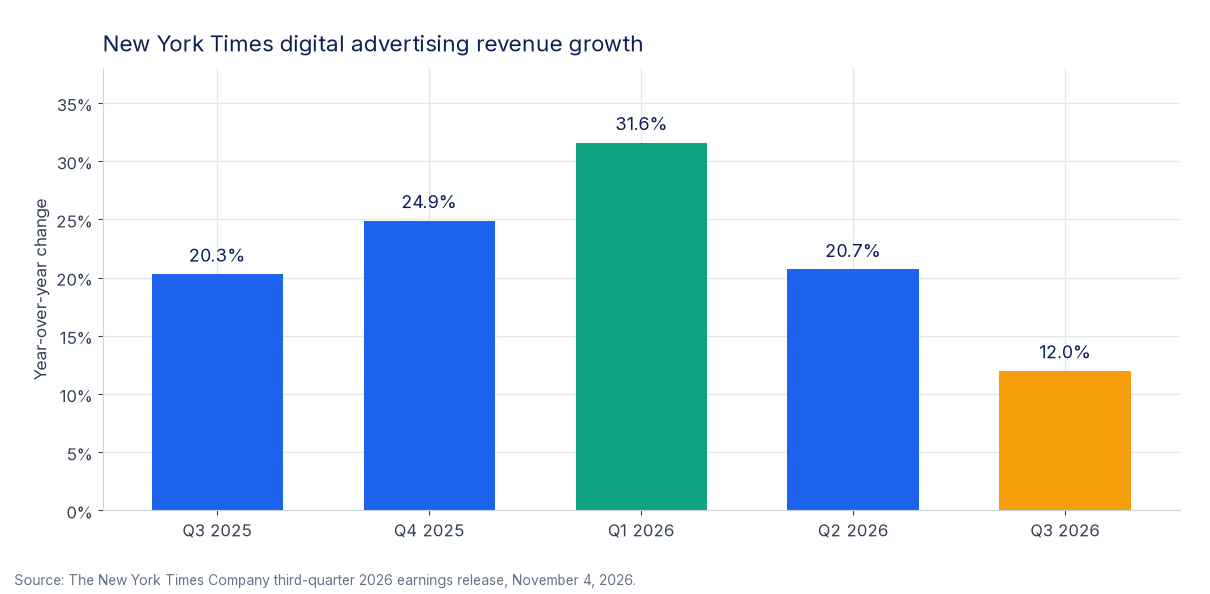
According to The New York Times Company’s November 4, 2026 earnings release, digital advertising revenue increased 12.0% to $109.9 million in the third quarter. The same table shows that growth rate slowing from 20.7% in the second quarter of 2026 and from 24.9% in the fourth quarter of 2025. Earlier quarters in the same table were 31.6% in the first quarter of 2026 and 20.3% in the third quarter of 2025.
The Times also reported about 13.76 million total subscribers at the end of the third quarter, including about 13.22 million digital-only subscribers. Digital-only net additions were about 420,000 compared with the end of the second quarter, and about 1,460,000 compared with the third quarter of 2025. Those subscriber figures sit beside the ad results. They do not prove that subscriptions offset every lost search session on a smaller site.
If you already cover the traffic side of that shift, keep that work in our publisher ad revenue after the search drop guide. The question in these publisher earnings is different: how revenue mix, pricing, and comparisons held up after the audience decline was already visible.
People Inc.: Sessions Fell Faster Than Session Revenue
On its November 3, 2026 earnings call, as transcribed by The Motley Fool, People Inc. said digital revenue grew 2% year over year and marked a twelfth straight quarter of digital revenue growth. Chief Executive Officer Neil Vogel said, “Our newer non-sessions-based revenues continued to grow at pace, while legacy sessions-based revenues were more of a drag than we expected.” Non-session revenue grew 15% year over year. Session-based revenue declined 6% year over year, after a 1% year-over-year decline in the second quarter. Digital advertising declined 8% year over year.
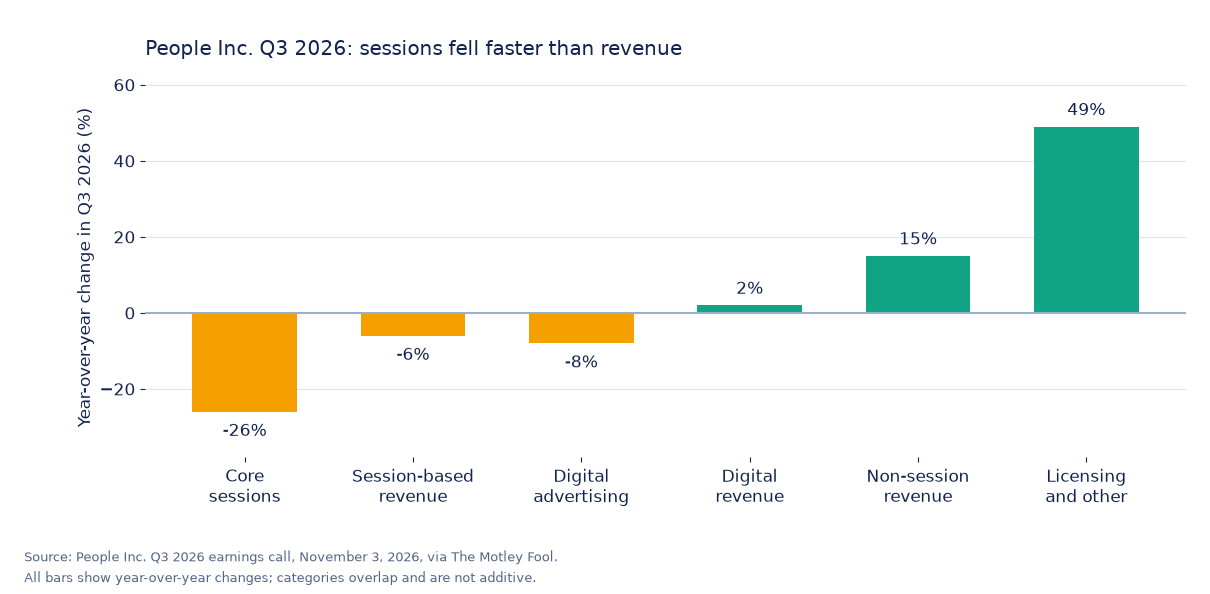
Core web sessions fell 26% year over year, after a 22% year-over-year decline in the prior quarter, “primarily due to declines in Google referrals,” Vogel said. Chief Financial Officer Tim Quinn said AI Overviews “are now found on over 90% of the searches we track.” Vogel separately said the company has lost “nearly 70% of our Google search traffic over the last few years.” Those are People Inc. measures of the queries and referrals it tracks, not a statement about every publisher or every Google search.
Licensing and other revenue grew 49% year over year in the quarter. Quinn said the majority of that licensing growth came from content licensing, including Apple News, and that AI licenses are a separate part of the same line. He said People Inc. expects “something roughly about 20% Q4 growth” in licensing as it laps the Meta deal announced in the fourth quarter of 2025. Vogel also said the company grew revenue associated with its Sexiest Man Alive franchise 50% this year, and that more than 6 million people have signed up for the MyRecipes and PEOPLE VIP apps. Those details sit inside the same publisher earnings call as the session decline.
Licensing mechanics are a separate playbook. See our guide to AI content licensing if you are negotiating crawl or training rights. The earnings lesson here is simpler: People Inc. used off-site and licensed demand to keep digital revenue slightly positive while sessions fell much faster.
News Corp: Two Publisher Models Inside One Company
The same week of publisher earnings included News Corporation’s fiscal 2027 first-quarter earnings release, dated November 4, 2026, covering the three months ended September 30, 2026. Dow Jones revenue rose 8% to $630 million from $586 million. Advertising revenue at Dow Jones increased 9%, “driven by a 12% increase in digital advertising revenues.” Digital advertising accounted for 70% of Dow Jones advertising revenue, compared with 68% a year earlier.
Dow Jones news products averaged over 6.9 million subscriptions, up 8%. Digital-only subscriptions to those news products grew 10% to nearly 6.5 million. The Wall Street Journal averaged 5.0 million total subscriptions, up 9%, including nearly 4.7 million digital-only subscriptions, up 11%. Dow Jones reported both advertising and circulation growth in the quarter; these subscription figures do not establish what caused the advertising growth.
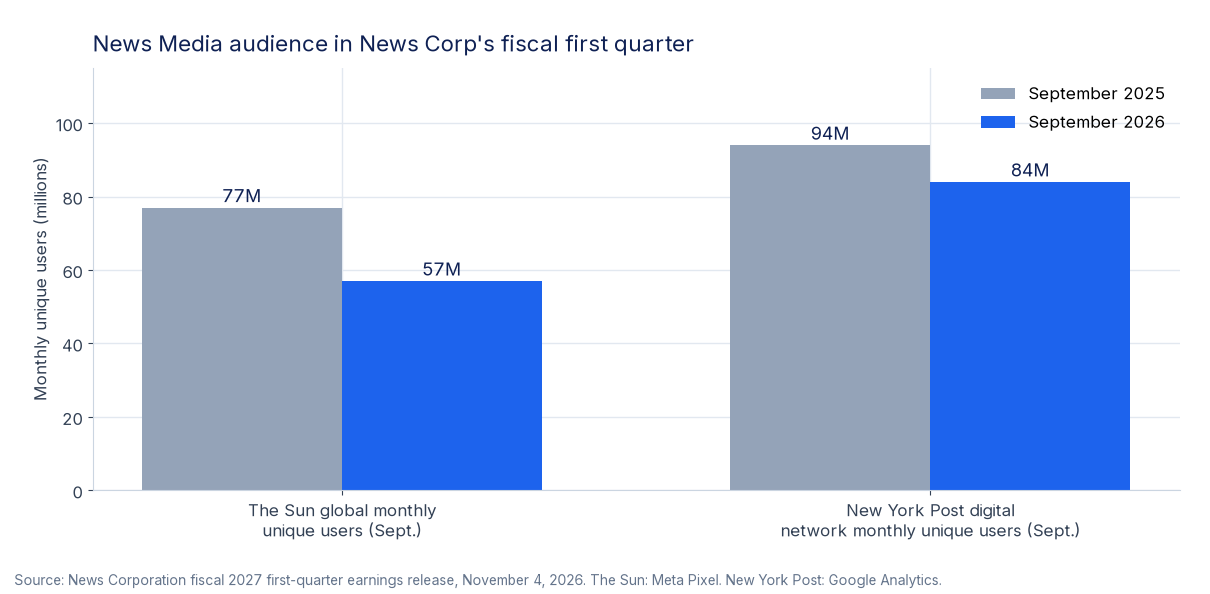
News Media, which includes The Sun, The Times of London, and the New York Post, was a different picture. Segment revenue was $540 million, down 1% from $545 million. Advertising revenue fell 2%. The Sun’s digital offering reached 57 million global monthly unique users in September 2026, compared with 77 million in September 2025, according to Meta Pixel figures in the release. The New York Post’s digital network reached 84 million monthly unique users, compared with 94 million, according to Google Analytics figures in the same release.
Why Q4 Comparisons Look Tougher
These publisher earnings also show why fourth-quarter comparisons look harder. The Times’ outlook table for the fourth quarter of 2026, compared with the fourth quarter of 2025, guides digital advertising revenue to “increase high-single-to-low-double-digits.” That sits against the 24.9% digital advertising growth the company posted in the fourth quarter of 2025. Digital-only subscription revenue is guided to increase 12% to 15%, and total advertising revenue to increase mid-single-digits.
People Inc. also warned that licensing growth will slow in the fourth quarter as it laps last year’s Meta deal, with Quinn pointing to roughly 20% growth after a 49% third-quarter gain. The comparison issue is not that holiday demand disappeared. It is that last year’s gains raise the baseline. Independent publishers should read Q4 targets against their own 2025 base, not against another company’s headline rate.
How AI systems pay for the pages they read is a separate question from these quarterly comparisons. Our AI payment models guide covers that track. Publisher earnings this week are about the mix you can still control: session yield, direct demand, and off-site revenue lines.
6 Smart Lessons From Publisher Earnings
1. Separate session yield from session volume
People Inc. reported a 26% year-over-year decline in core sessions and only a 6% year-over-year decline in session-based revenue. Vogel said the company continued to drive premium ad rates, “offsetting much of those declines on the web.” Quinn said direct-sold revenue and programmatic rates “are both growing really nicely.” Track RPM and revenue per session as their own lines so a traffic drop does not hide pricing power, or the lack of it.
2. Treat remaining search traffic as a smaller, more selective pool
Quinn said AI Overviews now appear on over 90% of the Google searches People Inc. tracks, and Vogel said the company has lost nearly 70% of its Google search traffic over the last few years. Package the pages that still earn clicks with clearer product, news, or utility value. Do not plan Q4 as if last year’s search volume will return.
3. Give licensing and off-site revenue their own scorecard
People Inc. reported 15% year-over-year growth in non-session revenue and 49% year-over-year growth in licensing and other revenue. The Times guided affiliate, licensing, and other revenues to increase low-single to mid-single digits in the fourth quarter. If you have syndication, newsletters, apps, events, or licensed content, report them separately from on-site display.
4. Do not copy last year’s Q4 ad growth rate
The Times’ digital advertising growth slowed from 24.9% in the fourth quarter of 2025 to 12.0% in the third quarter of 2026, and its fourth-quarter outlook is high-single to low-double digits. Set targets against your own 2025 base and against booked demand, not against another publisher’s prior-year spike.
5. Build a direct relationship that does not depend on one referrer
The Times ended the quarter with about 13.76 million subscribers, including about 13.22 million digital-only subscribers, and added about 420,000 digital-only subscribers in the quarter. People Inc. said more than 6 million people have signed up for its MyRecipes and PEOPLE VIP apps. A smaller publisher will not copy those totals, but the direction is the same: email, accounts, and apps make the next visit less dependent on search.
6. Watch which brands inside a portfolio still sell
Inside News Corp, Dow Jones grew revenue 8% and digital advertising 12%, while News Media revenue fell 1% and advertising fell 2%. The Sun and New York Post audience figures show the pressure on mass-reach news sites. If you run more than one property, compare yield by brand instead of averaging them into one blended RPM.
Publisher earnings from this week’s reports do not tell you what your November auction will pay. They do show a repeatable pattern: volume is weaker, priced inventory and off-site lines are doing more of the work, and fourth-quarter comparisons start from a higher 2025 base.
Frequently Asked Questions
What did The New York Times report for digital advertising in Q3 2026?
The New York Times Company reported digital advertising revenue of $109.9 million in the third quarter of 2026, up 12.0% year over year, after 20.7% growth in the second quarter and 24.9% growth in the fourth quarter of 2025.
How many subscribers did The New York Times report?
The Times ended the third quarter of 2026 with about 13.76 million total subscribers, including about 13.22 million digital-only subscribers, and added about 420,000 net digital-only subscribers compared with the end of the second quarter.
What did People Inc. say about sessions and digital revenue?
People Inc. said digital revenue grew 2% in the third quarter, marking a twelfth straight quarter of digital growth, while core sessions fell 26%, session-based revenue fell 6%, digital advertising fell 8%, non-session revenue rose 15%, and licensing and other revenue rose 49%, all year over year.
What Google search figures did People Inc. report?
Tim Quinn said AI Overviews are now found on over 90% of the Google searches People Inc. tracks. Neil Vogel said the company has lost nearly 70% of its Google search traffic over the last few years.
How did Dow Jones and News Media compare in News Corp’s results?
In News Corp’s fiscal 2027 first quarter, Dow Jones revenue rose 8% to $630 million and digital advertising rose 12%. News Media revenue fell 1% to $540 million and advertising fell 2%. The Sun had 57 million global monthly unique users in September 2026, compared with 77 million a year earlier, and the New York Post had 84 million, compared with 94 million.
What is The New York Times’ Q4 2026 digital advertising outlook?
The Times guided fourth-quarter 2026 digital advertising revenue to increase high-single to low-double digits compared with the fourth quarter of 2025, when digital advertising grew 24.9%. Digital-only subscription revenue is guided to increase 12% to 15%.