AI shopping traffic is reshaping how holiday buyers find products, and publishers with comparison, gift, and product content sit in the middle of that shift. Adobe’s September 28, 2026 holiday forecast expects AI traffic to U.S. retail sites, measured by shoppers clicking a link, to rise 130% year over year, with Thanksgiving up 159%, Black Friday up 95%, and Cyber Monday up 88%. These are projected growth rates, not AI’s share of all retail traffic or a forecast of publisher revenue.
This article translates Adobe Digital Insights into publisher moves for gift guides, affiliate yield, and contextual adjacency. It is not a general AI search affiliate explainer and not a licensing or payment model guide. It is a holiday yield checklist built only from Adobe’s published forecast numbers.
Table of Contents
What AI Shopping Traffic Means in Adobe’s Forecast
According to Adobe’s holiday forecast press release, Adobe expects another AI-powered holiday season. Adobe first observed an uptick in consumers using AI-powered chat and browser services for online shopping during the 2024 holiday season, from finding deals to locating products quickly. For 2026, Adobe expects AI traffic to U.S. retail sites this holiday season to rise 130% year over year when measured by shoppers clicking on a link.
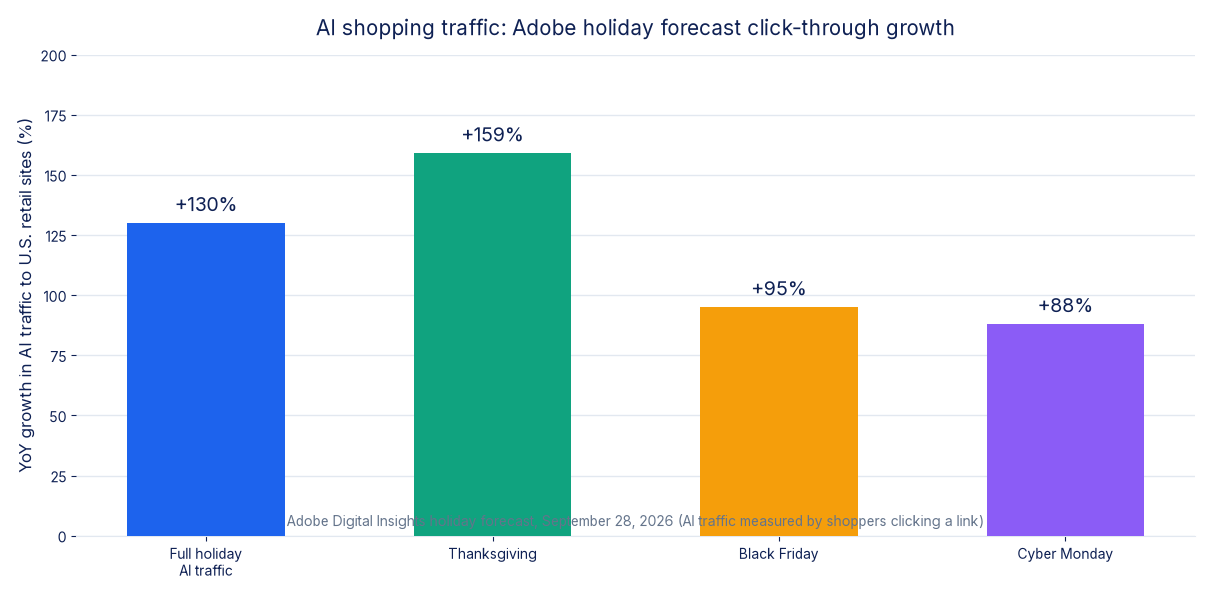
Adobe expects the largest year-over-year AI traffic increase on Thanksgiving (up 159%), followed by Black Friday (up 95%) and Cyber Monday (up 88%). These are growth rates, not necessarily the highest-volume days. For publishers, these are days when gift guides, deal roundups, and comparison pages need to be crawlable, citeable, and commercially structured so AI-assisted journeys can still send qualified clicks.
If you already cover broader AI search affiliate mechanics, keep that work in our affiliate revenue in AI search guide. This piece stays on Adobe’s holiday forecast and what it implies for November and December packaging.
Holiday Spend Scale Behind the AI Click Spike
Adobe expects U.S. online sales to hit $275.1 billion this holiday season (November 1 to December 31, 2026), growing 6.7% year over year. Cyber Week, the five-day period between Thanksgiving and Cyber Monday, is set to drive $47.5 billion online, up 7.4% year over year, representing 17.3% of the full holiday season spend.
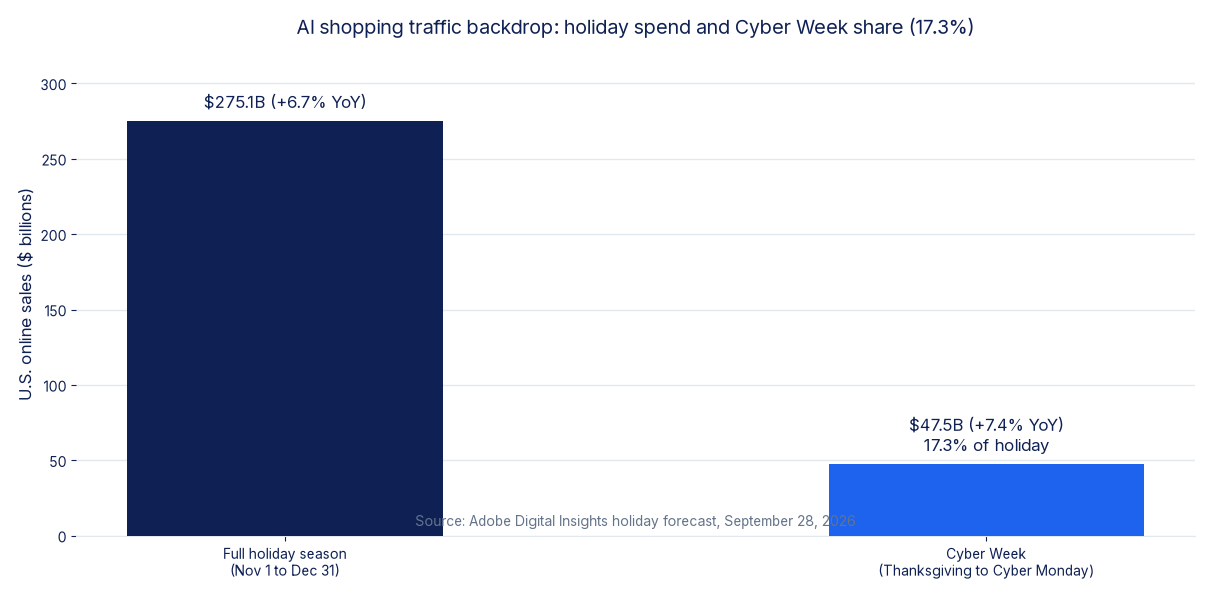
Cyber Monday (November 30) is expected to drive $15.1 billion online in a single day, up 6.2% year over year. Black Friday is forecast at $12.9 billion, up 9.2% year over year. Thanksgiving is set to drive $6.9 billion, up 8.5% year over year. Those dollar figures explain why Adobe’s AI traffic growth rates matter: the clicks sit on top of a record holiday commerce pool.
Display teams will chase auction peaks separately. Our Cyber Week eCPM checklist covers that auction window. Affiliate and content publishers should treat Adobe’s spend forecast as the demand map for gift and comparison pages that AI tools may surface.
Confidence, Returns, and Why Content Quality Matters
Adobe surveyed 5,000 consumers in July 2026. Among respondents who have used AI for online shopping, 77% report feeling more confident in their purchase, and 69% say they are less likely to return an item they bought. These are shoppers’ reported perceptions; the survey does not measure publisher content quality or actual return rates.
If AI tools pull incomplete specs, stale prices, or thin reviews from your pages, you still may get a citation without earning the click or the conversion. Clear product attributes, updated pricing windows, honest limitations, and structured comparison tables make it easier for AI assistants to recommend accurately and for shoppers to click through with confidence.
Payment and licensing models for AI training or crawling are a separate track. See AI payment models if you are negotiating crawl or license economics. Here the job is holiday commerce packaging for AI shopping traffic that Adobe already expects to surge.
Affiliates and Social Are Forecast to Gain Revenue Share
Adobe measures marketing contribution to holiday revenue. Affiliates and partners, which include social influencers, and social media overall are set to see the biggest gains in share of revenue, up 12% and 17% respectively. Paid search is expected to rise by 4%. Within affiliates and partners, cashback and rewards partners lead affiliate traffic with a 36% share, followed by influencers and creators at 22%.
Adobe reports affiliate traffic shares of 36% for cashback and rewards partners and 22% for influencers and creators. It separately forecasts a 4% increase in paid search’s share of revenue. These figures describe retailer acquisition channels. The 36% and 22% figures are shares of affiliate traffic, not evidence that those subgroups are gaining share. Publishers can test clearer product information and creator-friendly pages, but Adobe does not forecast the resulting publisher traffic or commissions.
For Black Friday commission mechanics and offer timing, use our Black Friday affiliate marketing playbook. Use that calendar to plan content refreshes before Thanksgiving; Adobe projects its largest year-over-year AI traffic increase that day.
6 Smart Moves for Strong Holiday Yield
1. Prepare gift pages for Thanksgiving’s projected growth
Adobe forecasts the largest year-over-year increase in AI retail-site click traffic on Thanksgiving, at 159%. That is not necessarily the highest traffic volume. Consider refreshing gift guides and comparison tables before Thursday, November 26.
2. Structure product data so AI assistants can cite you cleanly
Use consistent names, prices, categories, and caveat language. Adobe measures this traffic through shoppers clicking on a link to U.S. retail sites. Check product details for consistency before publishing. Adobe’s release does not test whether these publishing practices improve citations or clicks.
3. Protect affiliate deep links on AI-referred landing paths
Test that AI-referred sessions resolve correctly and that affiliate links retain their tracking. Adobe forecasts a 12% increase in affiliates and partners’ share of revenue, but does not isolate AI-referred publisher affiliate performance. That is not a forecast of publisher commissions or proof that tracking changes improve yield.
4. Match content to Cyber Week’s 17.3% spend concentration
Adobe forecasts Cyber Week at $47.5 billion, or 17.3% of holiday online spend. Concentrate refresh cycles, deal modules, and inventory checks on that five-day window rather than spreading effort evenly across December.
5. Build for confidence and lower returns, not only clicks
Among Adobe survey respondents who had used AI for online shopping, 77% reported greater purchase confidence and 69% said they were less likely to return an item. These are self-reports, not measured return rates. Accurate specifications and fit notes are practical editorial recommendations, not an effect demonstrated by this survey.
6. Track AI-referred sessions as their own yield cohort
Separate AI shopping traffic in analytics where you can identify referrers. Compare RPM, affiliate EPC, and conversion against search and social so you know whether Adobe’s forecast is showing up in your own stack.
Adobe forecasts 130% year-over-year growth in AI-referred retail-site clicks across the holiday season. Publishers can test gift content, affiliate tracking, and Cyber Week refreshes against their own results. The forecast does not establish how those choices will affect publisher traffic, commissions, or yield.
Frequently Asked Questions
What is AI shopping traffic in Adobe’s forecast?
Adobe defines the AI traffic metric as shoppers clicking on a link to U.S. retail sites after using AI-powered chat and browser services for online shopping.
How much will AI traffic grow this holiday season?
Adobe expects AI traffic to U.S. retail sites to rise 130% year over year for the holiday season, with Thanksgiving up 159%, Black Friday up 95%, and Cyber Monday up 88%.
How large is the 2026 U.S. online holiday market in Adobe’s forecast?
Adobe expects U.S. online sales of $275.1 billion from November 1 to December 31, 2026, up 6.7% year over year, with Cyber Week at $47.5 billion (17.3% of holiday spend).
Do AI shoppers feel more confident?
In Adobe’s July 2026 survey of 5,000 consumers, 77% of respondents who used AI for online shopping felt more confident in their purchase, and 69% said they were less likely to return the item.
How are affiliates performing in Adobe’s holiday outlook?
Adobe forecasts gains in share of retailer revenue of 12% for affiliates and partners, 17% for social media, and 4% for paid search. These are not percentage-point changes or publisher revenue forecasts. Within affiliate traffic, cashback and rewards account for 36%, and influencers and creators for 22%.
When is Cyber Monday 2026 in Adobe’s forecast?
Adobe’s forecast lists Cyber Monday on November 30, with expected online spend of $15.1 billion that day, up 6.2% year over year.
Related posts:

Insurance Affiliate Programs High Commission: 15 Best Picks (2026)

What is VAT registration for Affiliate Marketers?

How Affiliate Marketers Solve Their Time-Management Issue?

AI Affiliate Marketing Tools: The Ultimate 2026 Guide

5 Reasons You Haven't Made Any Money Online.