Made for advertising sites have always been a headache for legitimate publishers, because every dollar wasted on junk inventory makes advertisers more suspicious of the open web as a whole. Now generative AI is giving the old playbook a new engine. On October 20, AdExchanger reported on a DecryptAds study that found 2,116 AI-generated recipe sites using classic arbitrage tactics, with fabricated authors, low-effort content and overlapping ad placements, and with ads from major brands appearing on them.

For honest publishers, this is not just industry gossip. Buyers respond to stories like this by tightening inclusion lists, cutting long-tail domains and adding new content quality checks. If your site looks even a little like an MFA operation, you can get caught in that net. This guide explains what the latest data says, how AI slop differs from ordinary AI-assisted content, and seven practical ways to make sure buyers see your site as premium supply.
Table of Contents
What MFA Means in 2026
The industry definition dates back to September 2023, when the ANA, the 4A’s, the World Federation of Advertisers and ISBA published a shared description of made for advertising websites, now widely shortened to MFA. These are sites built mainly to buy cheap traffic and resell it as ad impressions, so the 4A’s also call them “made for arbitrage” sites. They typically rely on sensational headlines, clickbait and low-quality content to generate page views.
The trade groups listed several common traits. MFA sites usually show some combination of the following:
- High ad-to-content ratio: usually at least twice the internet average, such as 30% or more on desktop.
- Rapidly refreshing ads: numerous refreshing banners, autoplay video and slideshows that force extra clicks.
- Paid traffic dependence: little organic audience, with visits bought from clickbait ads on social networks and content recommendation platforms.
- Generic content: syndicated, dated or templated articles.
- Templated design: poorly designed, cookie-cutter site layouts.
The tricky part is that these sites are built to look good on paper. The ANA noted that MFA sites usually show high measurability, good viewability, low invalid traffic and brand-safe environments. In other words, they pass the checks buyers use most, which is exactly why they absorbed so much budget before the industry started measuring them directly.
How Big the MFA Problem Was, and Is
The wake-up call came from the ANA’s 2023 Programmatic Media Supply Chain Transparency Study. It analyzed $123 million in spend and 35.5 billion impressions from 21 advertisers between September 2022 and January 2023. MFA sites accounted for 21% of impressions and 15% of spend, and the average campaign ran on 44,000 websites.
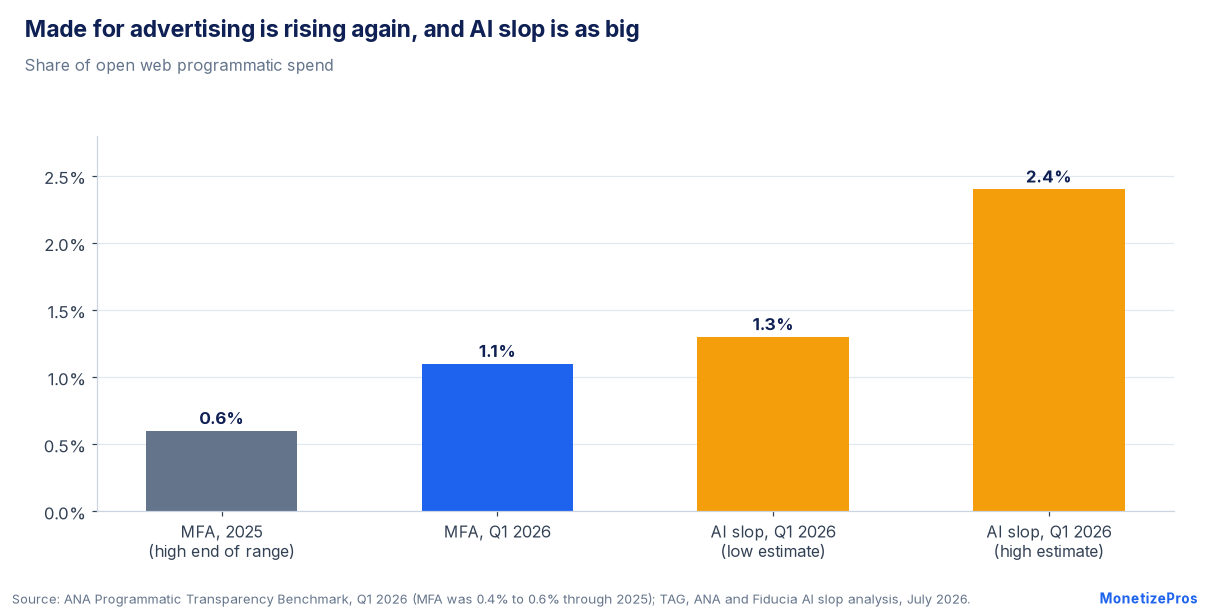
Since then, buyers have cleaned up dramatically. The ANA’s quarterly Programmatic Transparency Benchmark, run with TAG TrustNet and Fiducia, measured MFA exposure between 0.4% and 0.6% throughout 2025. The two studies use different methods, so the numbers are not a perfect like-for-like trend, but the direction is obvious: advertisers learned to spot classic MFA sites and steer money away from them.
Then the number moved back up. In its Q1 2026 benchmark, released on May 27, 2026, the ANA said MFA exposure increased to 1.1%, and it identified AI slop as an emerging subtype that requires ongoing mitigation. That is still a small share of spend, but it ended a long run of improvement, and the cause was new.
AI Slop: The New Face of MFA
In July 2026, TAG, the ANA and Fiducia released what they called the first statistically rigorous sizing of AI slop in programmatic media. Using Q1 2026 benchmark data, they found AI slop accounted for between 1.3% and 2.4% of open web programmatic spend, on par with the 1.1% MFA level.
The overlap is large. The analysis found that 88% of AI slop inventory also qualified as MFA. The remaining 12% falls outside existing frameworks, escapes current tools and costs more per verified impression than clean supply. That missing slice is what worries buyers most, because their existing MFA filters do not catch it.
The definition matters for publishers who use AI responsibly. The analysis described AI slop as low-value, mass-produced content generated primarily by AI for monetization with little or no human input, originality or audience value. It was explicit that content quality, not AI use, is the defining trait. AI-generated data summaries, AI-supported editorial content with human edits and original perspective, and transparent AI aggregators were not treated as slop.
Why AI Slop Fools Buyers
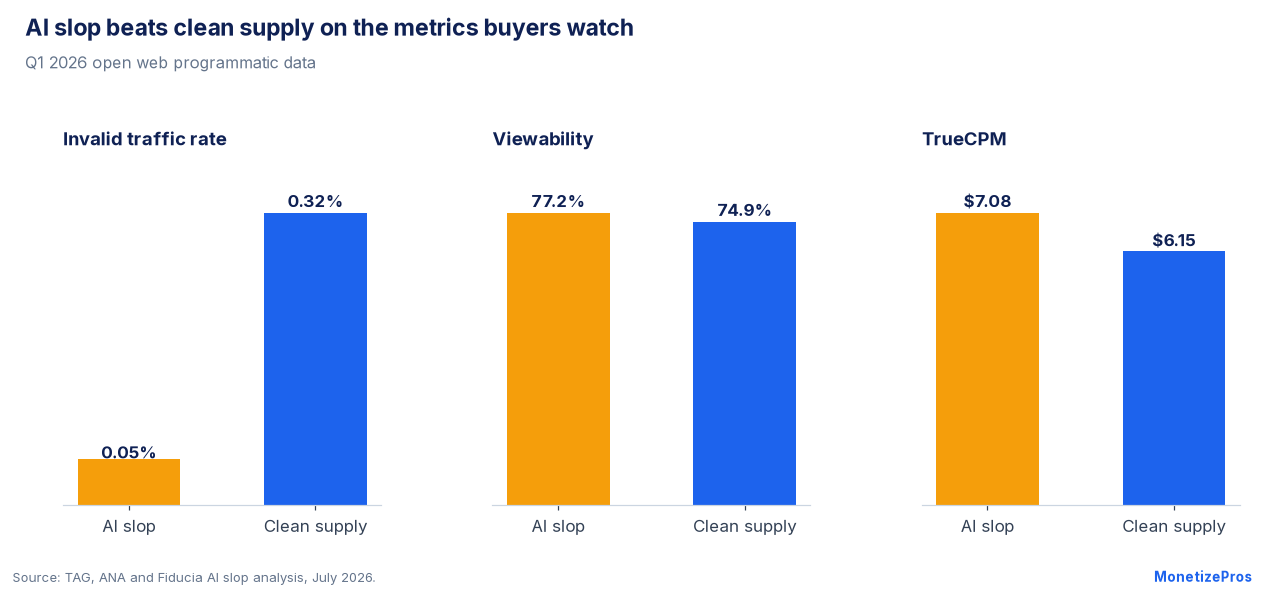
The most striking finding is that AI slop often beats real content on the metrics buyers watch. In the TAG, ANA and Fiducia analysis, AI slop had an invalid traffic rate of just 0.05%, compared with 0.32% for clean supply. Its viewability was higher, at 77.2% versus 74.9%. After measurability was factored in, it graded as premium more than 70% of the time.
Because of those scores, AI slop also cost more. Its TrueCPM, the benchmark’s quality-adjusted cost measure, was $7.08 versus $6.15 for clean inventory. Advertisers were paying a premium for content nobody would choose to read.
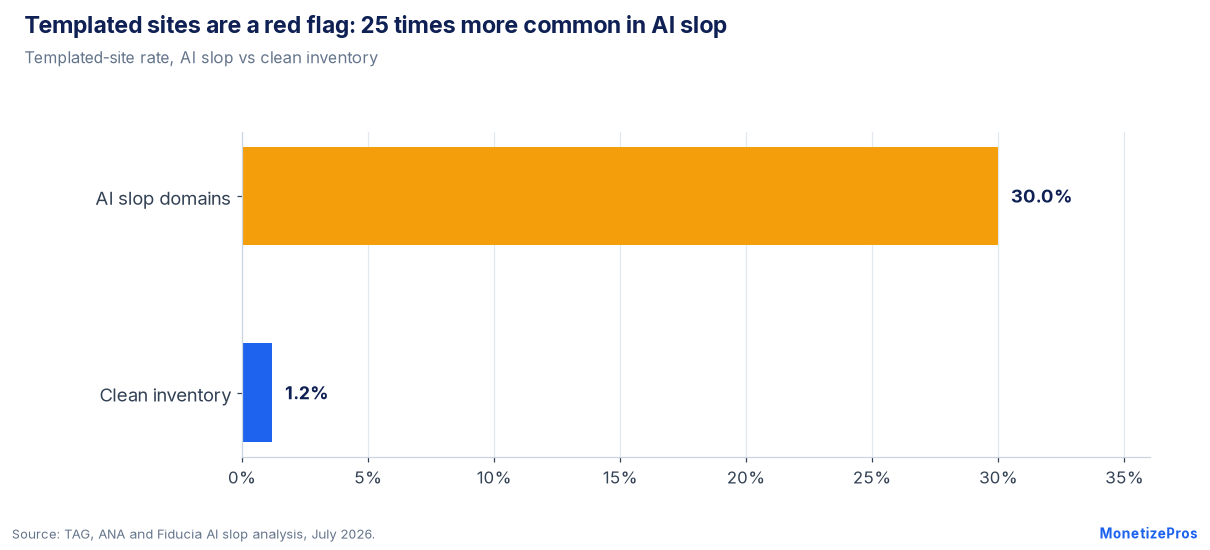
This is the same trap MFA sites set years ago, only cheaper to build. AI makes it possible to launch hundreds of templated domains in the time it once took to staff one. The analysis found AI slop could be flagged through a 30.0% templated-site rate, which was 25 times the 1.2% rate for clean inventory. Across 11,552 AI slop domains, topics followed a classic content farm pattern: parenting, travel, recipes, hairstyles, personal finance and how-to content.
Inside the DecryptAds Recipe Site Study
The DecryptAds report shows how these networks look up close. According to AdExchanger, the team began by examining the supply chains of about 300 ad tech companies based in what it calls risky geographies, then used food-related keywords to build an initial list of 400 suspicious recipe sites. It manually confirmed that each used AI-generated avatars while hiding true authorship.
From there, DecryptAds built more than 190 technical footprints to find other sites run by the same owners, ending with 2,116 sites that had entered the programmatic supply chain through reseller relationships. It used ads.txt files, sellers.json files, DNS records, SSL certificates and analytics data to map those connections. The sites copied viral recipe trends or popular pages from other cooking sites, and their about pages featured AI-generated faces, stock photos or altered images of real people.
Two caveats are important. DecryptAds said it found no evidence of crimes by the sites or their ad tech partners. And ads.txt and sellers.json files are imperfect, because they are rarely updated and can contain errors, so a technical link is not always a live business relationship. Several companies named in the coverage disputed parts of the attribution. The bigger point stands: buyers can now map these networks, and they are paying attention.
Google’s New Rule on Fake Authors
There is another reason this matters now. Google’s guidance on creating helpful, reliable, people-first content now states that fabricating creator profiles, such as by using AI-generated headshots, made-up names or false credentials to make content appear as if it was written by human experts, is a form of deception. Google says any form of deception makes a page untrustworthy to users and its automated systems and signals a low-quality page.
That guidance applies to Google Search, and an SSP source told AdExchanger it applies only to Google’s search business and should be treated separately from Google Ads best practices. Still, DecryptAds co-founder Zach Edwards argued that sites hiding AI authors risk being classified as low quality and unfit for monetization. For real publishers, the safest assumption is that search quality signals and ad buyer quality signals are converging.
7 Proven Ways to Stay Off Made for Advertising Lists
If you run a real site, the goal is to make your quality obvious to the tools and people that evaluate supply. Here is a practical checklist built from the industry definition and the latest research.
1. Keep your ad-to-content ratio reasonable
The trade group definition flags ad-to-content ratios of 30% or more on desktop. Audit your heaviest templates, especially mobile article pages and long recipe or list posts. Fewer, better placements often earn higher CPMs and protect your reputation with buyers at the same time. Our guide on how to increase your website RPM covers ways to grow revenue without stacking more units.
2. Use ad refresh carefully
Rapidly refreshing ads are one of the clearest MFA signals. If you use refresh, tie it to real user engagement and viewability, set sensible time limits and disclose it to your demand partners. Avoid forced slideshows and pagination that exist only to multiply ad calls.
3. Show real authors
Use real names, real photos and real credentials. Give each author a genuine bio page that links to their work. Google now calls fabricated creator profiles deceptive, and the DecryptAds study shows fake authors are one of the easiest red flags to spot.
4. Use AI as a tool, not a factory
The AI slop analysis was clear that AI use alone is not the problem. Human editing, original perspective, first-hand testing and accurate facts are what separate real content from slop. A clear editorial policy that explains how you use AI is an easy trust signal to add.
5. Build organic audiences, not just bought clicks
Heavy dependence on paid traffic is a core MFA trait. If you buy traffic, keep it a small and transparent share of your mix, and invest in search, newsletters, social followings and direct visits that prove people choose your site.
6. Keep ads.txt and sellers.json relationships clean
Researchers now use these files to map supply chains, and errors can link you to partners you never worked with. Remove old entries, list only active partners and review the sellers you authorize at least once a quarter. Clean files also support the shorter supply paths buyers prefer, as we explain in our breakdown of programmatic ad fees.
7. Make your site look and feel unique
AI slop domains used templated designs at a 30.0% rate versus 1.2% for clean inventory. A distinctive design, clear navigation, a real about page and original images help human reviewers and classification tools see a genuine publication.
What Buyers Are Doing Next
Advertisers are already moving. The TAG, ANA and Fiducia analysis recommended that buyers review whether their verification partners can distinguish AI-generated content from AI slop, take a closer look at smaller and native-format exchanges, and examine their use of suppression lists to limit long-tail risk. Large established exchanges ran single-digit slop rates, while smaller and native-format exchanges reached 4% to 8%.
Supply concentration is part of the same trend. In the ANA’s Q2 2026 benchmark, higher-performing advertisers operated across approximately 19,000 fewer domains and apps than lower performers, and market-level TrueAdSpend reached a record 45.1%. Fewer domains means tougher competition for every remaining spot on an inclusion list.
The good news for real publishers is in the same data. Roughly 1 in 27 impressions, or 3.7%, on unknown domains was classified as slop, while known publishers showed effectively zero AI slop. Being known, transparent and consistent is now a commercial advantage, not just a brand value.
What This Means for Your Ad Revenue
MFA cleanups can feel like a threat to smaller sites, because buyers sometimes cut the long tail with a blunt instrument. The answer is to make your site easy to trust. For publishers, the TAG, ANA and Fiducia analysis recommended broad transparency, responsible AI use and independent validation of practices through certification.
Practically, that means being ready to show demand partners who you are, how your content is made, where your traffic comes from and how your ads behave. Ask your partners which quality vendors they use and whether your domain is classified correctly. If you are flagged by mistake, a clean ads.txt file, real author pages and a reasonable ad layout give you a strong case for review.
It also means protecting the user experience your revenue depends on. Bad supply chains bring more than low CPMs. Our guide to protecting readers from malvertising covers the security side of the same problem.
Made for Advertising FAQ
What is a made for advertising site?
A made for advertising site is built mainly to buy cheap traffic and resell it as ad impressions. The ANA, the 4A’s, WFA and ISBA defined common traits in September 2023, including a high ad-to-content ratio, rapidly refreshing ads, heavy paid traffic, generic content and templated design.
How much programmatic spend goes to made for advertising sites today?
The ANA Programmatic Transparency Benchmark measured MFA exposure at 1.1% of spend in Q1 2026, up from between 0.4% and 0.6% throughout 2025. That is far below the 15% of spend the ANA’s 2023 transparency study found, although the two studies use different methods.
What is AI slop in advertising?
TAG, the ANA and Fiducia define AI slop as low-value, mass-produced content generated primarily by AI for monetization with little or no human input, originality or audience value. Their July 2026 analysis found it made up between 1.3% and 2.4% of open web programmatic spend, and 88% of it also qualified as MFA.
Is all AI-generated content treated as MFA?
No. The AI slop analysis said content quality, not AI use, is the defining trait. AI-generated data summaries, AI-supported editorial content with human edits and original perspective, and transparent AI aggregators were not classified as slop.
Why do AI slop sites get high CPMs?
They score well on standard buying metrics. AI slop had an invalid traffic rate of 0.05% versus 0.32% for clean supply and viewability of 77.2% versus 74.9%, so it graded as premium more than 70% of the time and earned a TrueCPM of $7.08 versus $6.15 for clean inventory.
How can a real publisher avoid being flagged as made for advertising?
Keep your ad-to-content ratio reasonable, use ad refresh carefully, show real authors, use AI with human editing, build organic audiences, keep ads.txt and sellers.json files accurate, and use a distinctive site design. Known publishers showed effectively zero AI slop in the TAG, ANA and Fiducia data.
The Bottom Line
The MFA model never went away. It shrank under pressure from buyers, then came back in a cheaper, AI-powered form that often beats real content on viewability and fraud metrics. Buyers are responding with tighter supply paths, new content quality checks and closer scrutiny of authorship. Real publishers who keep ad layouts sensible, show real people behind the work and keep their supply chain files clean will be on the right side of that cleanup, and in a better position to win the budgets that move away from slop.
Related posts:

Three Lessons From Our Ad Network Experiment

Three Easy Ways To Make More Money With AdSense

Ideas for Improving Display Ad Monetization: 5 Case Studies

Retargeting Ads: Everything You Need to Know

Display Ad Benchmarks 2026: A Guide for Growth & Revenue