Google Discover has quietly become the biggest Google traffic source for many news and content publishers, and this week we finally learned more about how it decides what to show. As Search Engine Journal reported on October 21, a Google research paper describes a system called SDF that removes stale articles from the Discover feed before ranking even starts. If your content plan treats Discover as a lottery, this paper shows the rules are more predictable than they look.
The timing matters. NewzDash data shared by its CEO John Shehata shows Discover grew from 36.66% of Google traffic to news publishers in 2023 to 75.25% in Q2 2026, while traditional web search fell from 51% to 21.35%. When one feed carries that much of your Google traffic, a filter that silently drops “stale” stories is a revenue issue, not just an SEO curiosity. This guide explains how the filter works, what Google officially recommends, and seven practical ways to earn and keep Discover visits.
Table of Contents
Why the Discover Feed Matters More Than Ever
For years, publishers treated Discover as a bonus. Search was the dependable channel, and Discover was the unpredictable spike that made a good month great. That balance has flipped for news sites. The NewzDash analysis covers more than 400 news publishers, and it shows Google News, the News tab, Image and Video results combined now account for less than 4% of Google traffic to those sites. Discover is where the volume is.
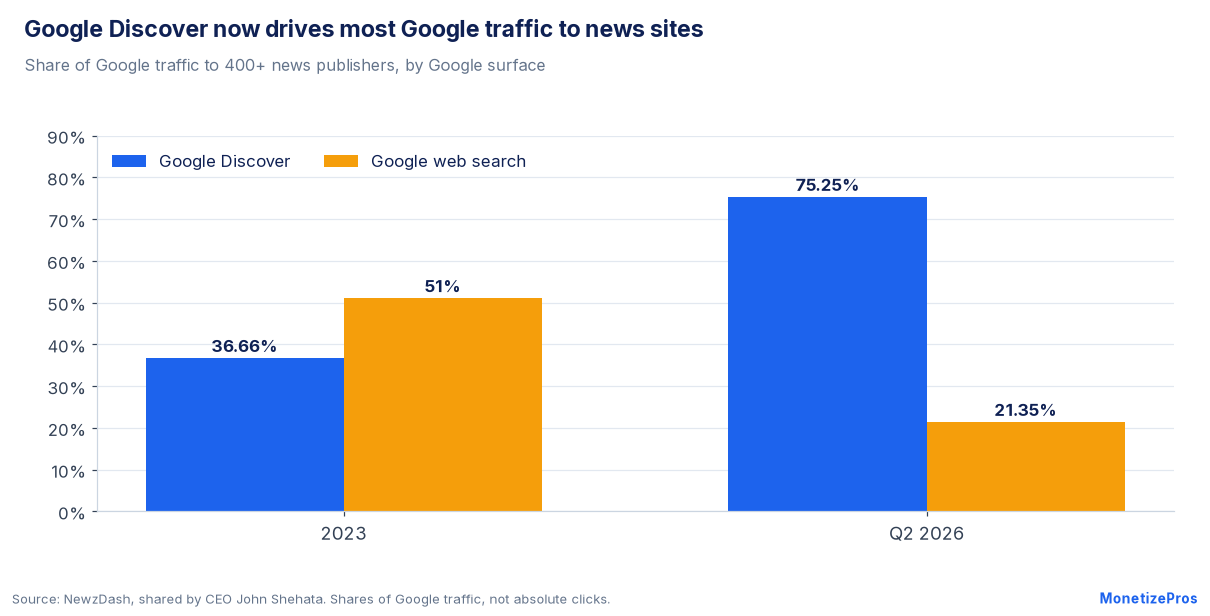
There is an important caveat. NewzDash has said its figures describe each surface’s share of Google traffic, not absolute click volume. A rising Discover share can partly reflect search clicks shrinking as AI Overviews answer more queries on the results page. We covered that shift in our look at how AI search is changing publisher traffic. Either way, the practical conclusion is the same: the feed now deserves its own strategy, budget and reporting.
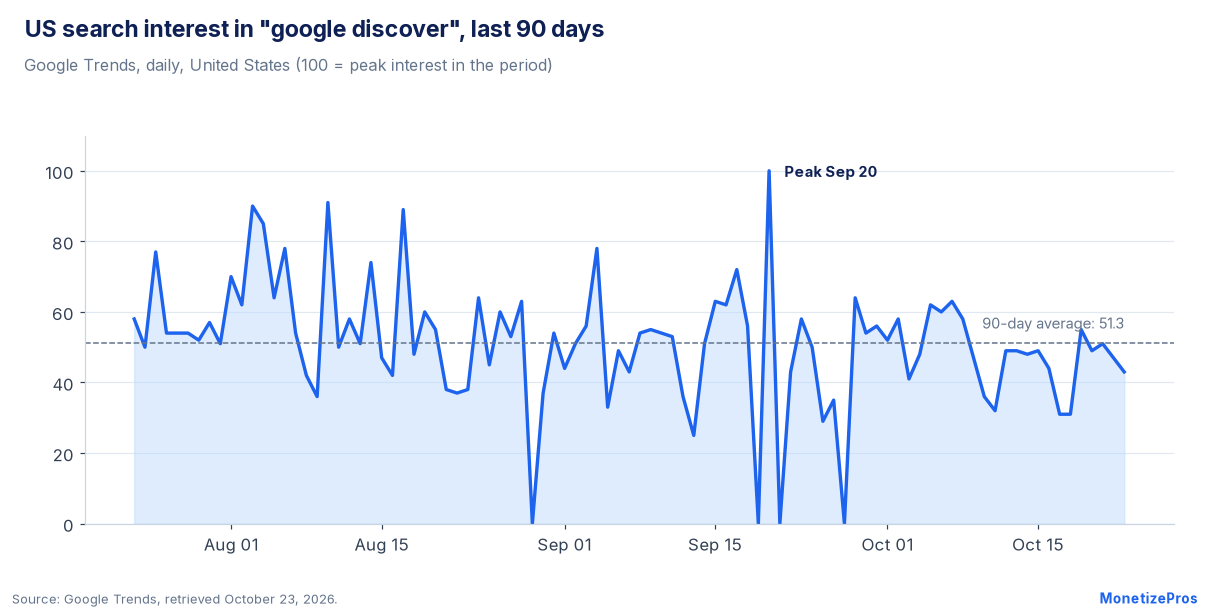
Interest is also climbing outside newsrooms. Google Trends shows steady US search interest in “google discover” over the last 90 days, peaking on September 20, 2026, and our count of public X posts found 122 original posts mentioning “google discover” between October 16 and October 23, with the busiest day on October 19.
How SDF Decides What Is Stale
The paper behind this week’s news is titled “Decomposing Staleness in Recommender Systems: A Dual-Filter Framework for Supersession and Decay.” It was written by six Google researchers, posted to arXiv on August 16, 2026, and is scheduled for the CIKM 2026 conference in Rome in November. It describes SDF, short for Supersession-Decay Filtering, as fully deployed in Discover, a feed with hundreds of millions of daily and billions of monthly active users.
The key design choice is where SDF sits. It runs upstream of ranking. Every candidate article passes through two filters, and if either filter flags it as stale, the article is removed from the candidate set and is never served. The ranking systems that come afterward are still engagement-based and trend-aware, but stale items do not get a chance to compete. Google says this also cuts serving costs, because the expensive ranking stage processes fewer items.
That is a different mental model from the one most publishers use. Many assume an older article slowly slides down the feed. According to the paper, time-based ranking only demotes stale items, which still forces users to scroll past them, so Google built a system that removes them instead. In Discover, an article that is judged stale is not ranked lower. It is simply gone.
The researchers also explain why simpler fixes failed. Hand-tuned age cutoffs rely heavily on publication time. A long cutoff still serves stale items, while a short one drops useful evergreen content. Engagement heuristics such as click-through rate floors have a built-in lag, because the system only learns an item is stale after showing it to many people. SDF tries to predict staleness before that damage happens.
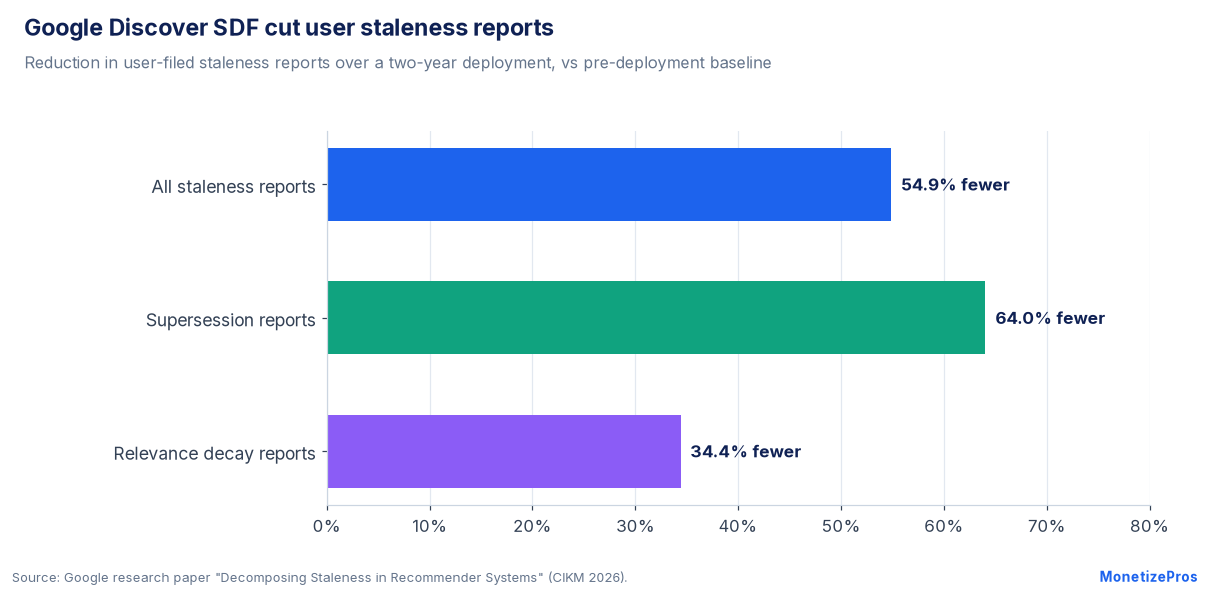
The results are significant. Over a two-year production deployment, user-filed staleness reports fell 54.9% compared with the pre-deployment baseline. Reports tied to supersession fell 64.0%, and reports tied to relevance decay fell 34.4%. In online experiments, the paper says SDF reduced the user dismissal rate and lifted both feed diversity and positive engagement.
Supersession: When Newer Coverage Replaces Yours
The first filter handles supersession. An article becomes stale the moment newer information moves the story forward. The paper’s examples are clear: an early bulletin saying Queen Elizabeth II was under medical supervision was superseded within hours by the announcement of her passing, and reports that Shohei Ohtani was weighing offers became stale once his signing with the Dodgers was announced.
The signal here is relational. Google compares pairs of items on the same topic and asks whether the new one makes the old one outdated. Pairs that are nearly identical carry the same information, and pairs that are unrelated tell the model nothing, so training focuses on a middle band of related articles. Google used a large language model to generate labeled training pairs and then distilled that knowledge into a smaller model that can run at Discover’s scale.
For publishers, the lesson is uncomfortable but useful. If you publish a fast take on a developing story and a competitor, or you, publishes a more complete update, your first version can drop out of Discover entirely. Freshness in this system is about whether your page still reflects the current state of the story, not the date in your byline.
Relevance Decay: Every Article Has a Lifespan
The second filter handles relevance decay. Some content simply stops being useful even if nothing replaces it. The paper’s example is a guide to “tonight’s meteor shower,” which is valuable for one evening and then quickly loses relevance. A heartwarming local video clip fades on its own, with no follow-up needed.
To catch this, Google built a predicted traffic ratio model, or PTR. It looks at an item’s text, images and video and forecasts what share of its lifetime traffic it will have collected at different points in time. When the model predicts an article has already earned most of its lifetime traffic, the article is removed. In plain terms, Google estimates the expected lifespan of your page from the content itself, before engagement data arrives.
This has two implications. First, content built around a single moment will have a short Discover window, no matter how well it performs early. Second, content with a longer natural shelf life, such as practical guides, explainers and analysis, can stay eligible longer. Google’s own documentation agrees, noting that older content may appear in Discover if it remains helpful and relevant to a person’s interests.
What Google Officially Recommends for Discover
SDF explains how stale content is removed, but Google’s Discover documentation sets the baseline for getting in. Content is automatically eligible if it is indexed and meets Discover’s content policies, with no special tags or structured data required. Eligibility is not a guarantee, and Google describes Discover as an extension of Search, so Search updates can also move Discover traffic.
Google’s guidance can be grouped into four areas:
- Honest previews: avoid clickbait, exaggerated details or withheld information in titles, snippets and images, and use headlines that capture the essence of the content.
- No sensationalism: avoid content that manipulates appeal through morbid curiosity, titillation or outrage.
- Timely, original value: provide content that is timely for current interests, tells a story well or offers unique insights.
- Large, relevant images: use images at least 1200 px wide, with more than 300,000 total pixels and ideally a 16×9 ratio, enabled through the max-image-preview:large setting or AMP.
Google also asks publishers to specify a large, representative image through schema.org markup or the og:image meta tag, and to avoid generic images such as a site logo or text-heavy images. One new detail matters here. Search Engine Journal reported that Google’s John Mueller said on October 15 that JPEG XL images are not currently supported in Google Images or as Discover previews, even though Chrome 155 and Firefox 158 now display the format. Google Search supports BMP, GIF, JPEG, PNG, WebP, SVG and AVIF.
Finally, Google is candid that Discover traffic is less predictable than keyword-driven search visits, and recommends treating it as supplemental. Traffic can shift because interests change, because Discover adjusts the types of content it shows, or because of Search updates. The February 2026 Discover core update is a good example: it started on February 5 and took about 22 days to finish rolling out on February 27.
7 Proven Ways to Earn and Keep Google Discover Traffic
Putting the paper and the documentation together, here is a practical playbook for publishers who want steady Discover traffic rather than random spikes.
1. Update the original story instead of scattering new ones
Because supersession compares related items, a stream of thin follow-ups can make your own earlier pieces stale. When a story develops, consider updating your main article with the new facts and a clear update note, and publish a separate piece only when the development deserves its own angle. That keeps your most complete page eligible.
2. Be the article that supersedes, not the one superseded
If newer coverage replaces older coverage, aim to publish the most current and complete version of a topic. Add the latest numbers, confirmed outcomes and what happens next. Pages that move a story forward are, by design, the ones the supersession filter keeps.
3. Plan the lifespan of every piece
Before publishing, decide whether a piece is a moment, a cycle or an evergreen asset. Moment content should go out fast and be promoted hard while its window is open. Evergreen guides should be written to stay true for months, with dates and figures you can refresh. The PTR model estimates lifespan from content, so make the long shelf life obvious in the writing itself.
4. Write headlines that describe, not tease
Google asks for titles that capture the essence of the content and warns against withholding crucial information. Honest, specific headlines also help a system that compares related items understand what your article actually covers, so a clear headline does double duty.
5. Treat your featured image as a ranking asset
Use a large, original, landscape image at least 1200 px wide, set max-image-preview:large, and declare it in og:image or schema markup. Serve WebP, JPEG, PNG or AVIF in the img src, keep JPEG XL as an optional picture source only, and avoid logos or text-heavy images as the preview.
6. Build a balanced content mix
The SEJ write-up framed the paper as a guide to planning the right mix of content. A healthy Discover program blends breaking coverage, which earns fast spikes, with durable explainers and analysis that stay eligible longer. Relying only on quick hits means your traffic resets to zero every time the decay filter catches up.
7. Earn trust beyond one article
Google calls Discover an extension of Search, and Search updates aimed at surfacing helpful content can change Discover traffic too. Clear authorship, accurate facts and consistent quality across your site matter. Our guide to maintaining content quality with AI writing tools covers practical checks if you use AI in your workflow.
How to Monetize Discover Traffic Without Overreliance
Discover visitors behave differently from search visitors. They did not type a query, so they arrive curious rather than intent-driven, and because Discover is a feed in the Google Search app, many arrive on phones. That makes page experience and ad layout especially important. Heavy, slow pages waste the short attention window Discover provides.
For monetization, the goal is to turn spiky visits into lasting value. Use strong related-content modules to encourage a second pageview, offer a newsletter signup on high-performing Discover articles, and make sure ad density on mobile does not crowd out the content. Our breakdown of publisher ad revenue after the search drop covers the revenue levers that work when search clicks shrink.
Diversification is just as important. Google itself describes Discover traffic as supplemental, and the February 2026 core update showed how quickly a single algorithm change can move the numbers. Treat Discover as a growth channel, but keep investing in search, email and direct audiences so one feed never controls your revenue.
How to Measure Your Discover Performance
You cannot manage what you cannot see. Google Search Console includes a Performance report for Discover that shows impressions, clicks and click-through rate for content that has appeared in Discover over the last 16 months, as long as your data meets a minimum impression threshold. Google says the report includes traffic from Chrome and tracks Discover traffic across all surfaces.
Use that report to answer a few practical questions each month. Which content types earn repeat Discover appearances? How long does a typical article keep getting Discover impressions before it drops off? Do updated articles regain visibility? Mapping those patterns against the two SDF filters will show you whether your traffic losses come from being superseded or from natural decay.
Finally, compare Discover revenue per session with search revenue per session. If Discover visitors bounce faster, optimize the first screen and the related content path. If they earn similar revenue, Discover may deserve more editorial investment. Either way, separate reporting turns a mysterious traffic source into one you can plan around.
Google Discover FAQ
What is SDF in Google Discover?
SDF stands for Supersession-Decay Filtering. According to a Google research paper reported by Search Engine Journal on October 21, 2026, it is a staleness filter fully deployed in Google Discover that removes stale articles before ranking starts, using one filter for supersession and another for relevance decay.
Does Google Discover use publication date to decide freshness?
Not mainly. The Google paper says hand-tuned age cutoffs rely heavily on publication time and poorly reflect real relevance loss. SDF instead checks whether newer related content has superseded an article and predicts how much of its lifetime traffic an article has already earned.
How much traffic does Google Discover send to news publishers?
NewzDash data shared by CEO John Shehata shows Google Discover accounted for 75.25% of Google traffic to news publishers in Q2 2026, up from 36.66% in 2023, while web search fell from 51% to 21.35%. NewzDash notes these are shares of Google traffic, not absolute click volumes.
Can older articles still appear in Google Discover?
Yes. Google’s documentation says older content may appear if it is helpful and relevant to a person’s interests. Evergreen guides and analysis tend to have a longer natural lifespan, so they are less likely to be removed by the relevance decay filter than content tied to a single moment.
What image size does Google Discover recommend?
Google recommends large images at least 1200 px wide, with more than 300,000 total pixels and a 16×9 aspect ratio, enabled with the max-image-preview:large setting or AMP. JPEG XL is not currently supported for Discover previews, so use formats such as WebP, JPEG, PNG or AVIF.
How do I track Google Discover traffic?
Use the Discover Performance report in Google Search Console. It shows impressions, clicks and click-through rate for content that appeared in Discover over the last 16 months, as long as your site meets a minimum impression threshold, and it includes traffic from Chrome.
The Bottom Line
Discover is no longer a side channel for many publishers, and SDF shows it is not random either. Stale content is removed before ranking, through supersession when newer coverage moves a story forward and through decay when a piece reaches the end of its useful life. Publish the most complete version of a story, plan each article’s lifespan, use strong images and honest headlines, and measure Discover on its own. That is how you turn unpredictable spikes into a dependable share of your traffic.
Related posts:

Top 7 Steps To Create a Perfect Logo for Your Company

How To Manage Remote Content Writers For A Company Blog

Enterprise SEO Tracking Keywords: Scaling Your Search Strategy

A Simple Guide to Optimize Your Site and Gain More Traffic

How To Market Your Online Training Course