

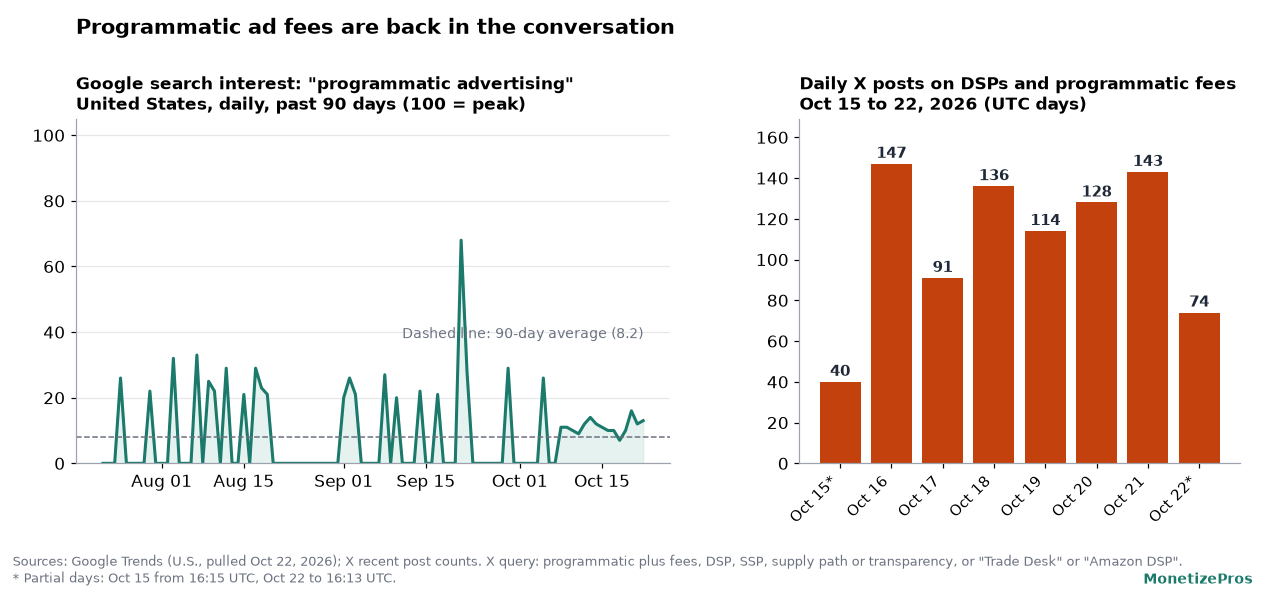
Programmatic ad fees decide how much of an advertiser’s budget ever turns into revenue for your site, and the latest numbers show that a large share never arrives. In its Q2 2026 Programmatic Transparency Benchmark, the Association of National Advertisers (ANA) found that only 45.1% of programmatic spend reached measurable, viewable, fraud-free impressions on quality inventory, while transaction costs took 27.2%. This week, Digiday reported that small agencies buying through resellers pay 25% to 29% in buy-side platform fees before a bid even reaches an SSP.
Publishers cannot set the fees a DSP charges an agency. What you can control is whether your inventory sits on the side of the ledger buyers are trying to protect, or on the side they are trying to cut. This guide breaks down where the money goes, what the 2026 data says buyers are doing about it, and seven practical moves that help more of each dollar land on your pages.
What Are Programmatic Ad Fees?
Programmatic ad fees are the cuts taken by every platform that sits between an advertiser’s budget and the impression served on your site. A typical open auction path includes a demand-side platform (DSP) used by the buyer, sometimes a reseller or managed service layer on top of that DSP, data and verification vendors, and a supply-side platform (SSP) or ad exchange on the publisher side. Each takes a percentage or a flat CPM fee.
The ANA groups these costs under one label, transaction costs, and measures them alongside a second category of loss that matters even more to publishers: media productivity. That covers spend that went to impressions that were not viewable, could not be measured, were invalid traffic, or ran on made-for-advertising (MFA) sites. Fees and waste together explain why an advertiser can spend $100 and your SSP report shows a small fraction of that.
Where the Programmatic Dollar Went in 2026
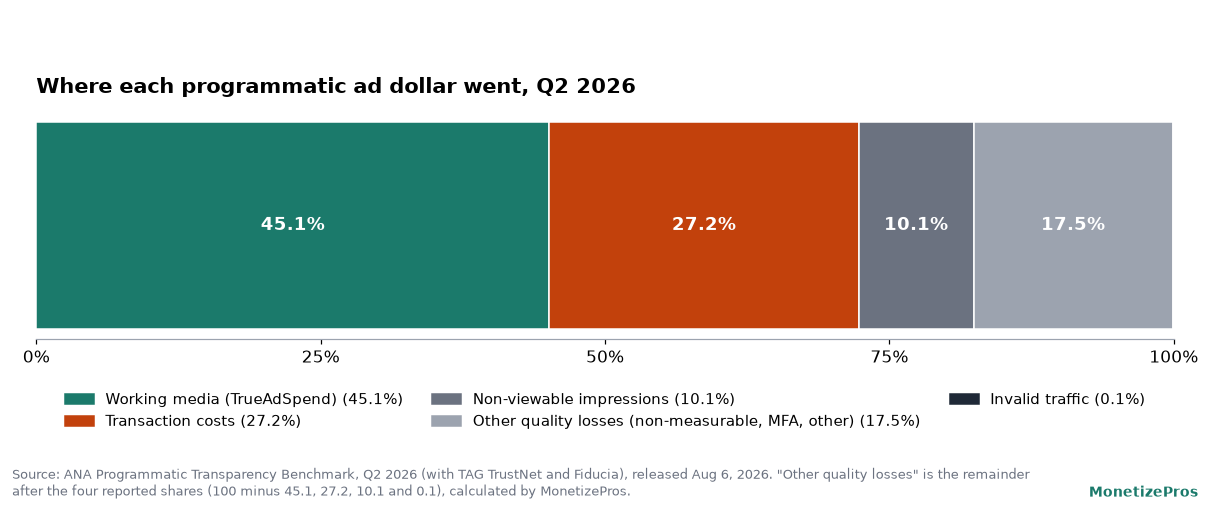
The ANA benchmark, built with TAG TrustNet and Fiducia from impression-level log data, is the most detailed public view of the supply chain right now. Its Q2 2026 results, released in August, look like this:
- 45.1% of spend reached what the ANA calls TrueImpressions: measurable, viewable, fraud-free and non-MFA. That is a record, up from 43.3% in Q1 2026.
- 27.2% went to transaction costs, which rose during the quarter and partly offset the quality gains.
- 10.1% was lost to non-viewable impressions, down from 13.3% in Q1.
- 0.1% was lost to invalid traffic, which has stayed close to zero.
The remaining 17.5% is not broken out in the public release, but it is the gap left after those four shares and covers other quality losses such as non-measurable inventory and MFA exposure.
For context, the long-running concern is not new. A 2020 study by ISBA and PwC in the UK found that publishers received about 51% of advertiser spend, with roughly 15% of the money impossible to trace at all. The 2026 benchmark shows real progress on quality, but fees have not fallen in step.
Why Buy-Side Fees Are Rising Again
Digiday spoke to ten media buyers at independent agencies for an October 21, 2026 report. One 15-person New York agency cleared The Trade Desk’s $100,000 monthly spend bar and still pays 17% to the DSP plus 12% to Mogl, the reseller it used to get access. A Washington state agency described paying a 10% reseller fee on top of Amazon DSP’s 15%. Both platforms told Digiday their tools are available to all advertisers, and The Trade Desk said direct seats come with commitment levels agreed with each client.
AdExchanger’s October 22 newsletter pointed to the underlying cash flow problem: DSPs often pay upfront while agencies and brands pay months later, which is one reason platforms are slow to cut fees for smaller buyers.
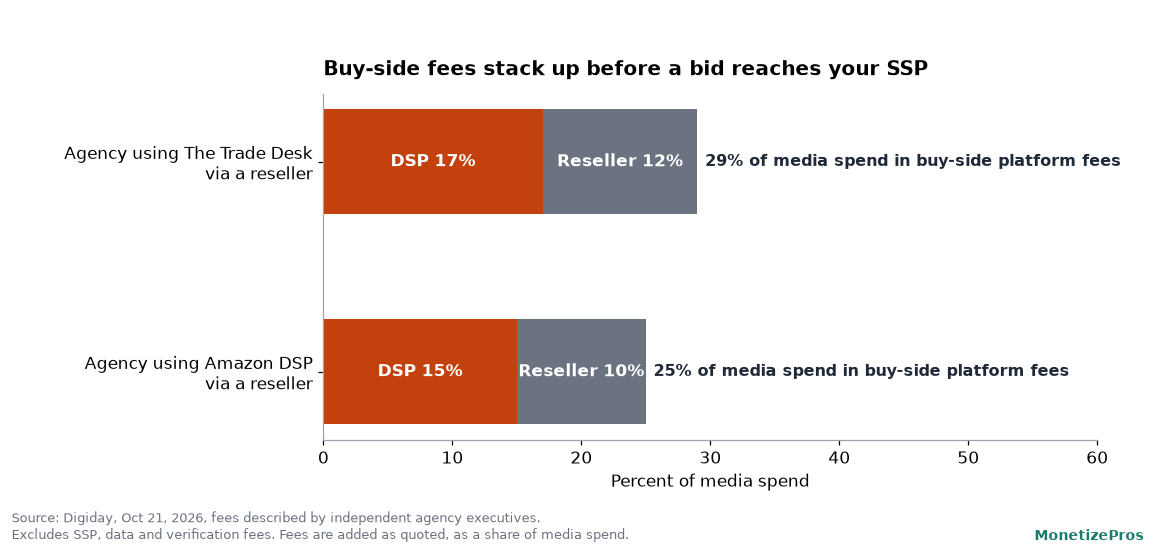
Why does this matter to you? Every point of fee taken before the auction lowers the bid that reaches your SSP. When an agency is paying 29% before your exchange takes its own cut, the price it can afford to bid for your impression is lower, even if its client’s CPM goal never changed.
How Buyers Are Responding: Fewer, Cleaner Paths
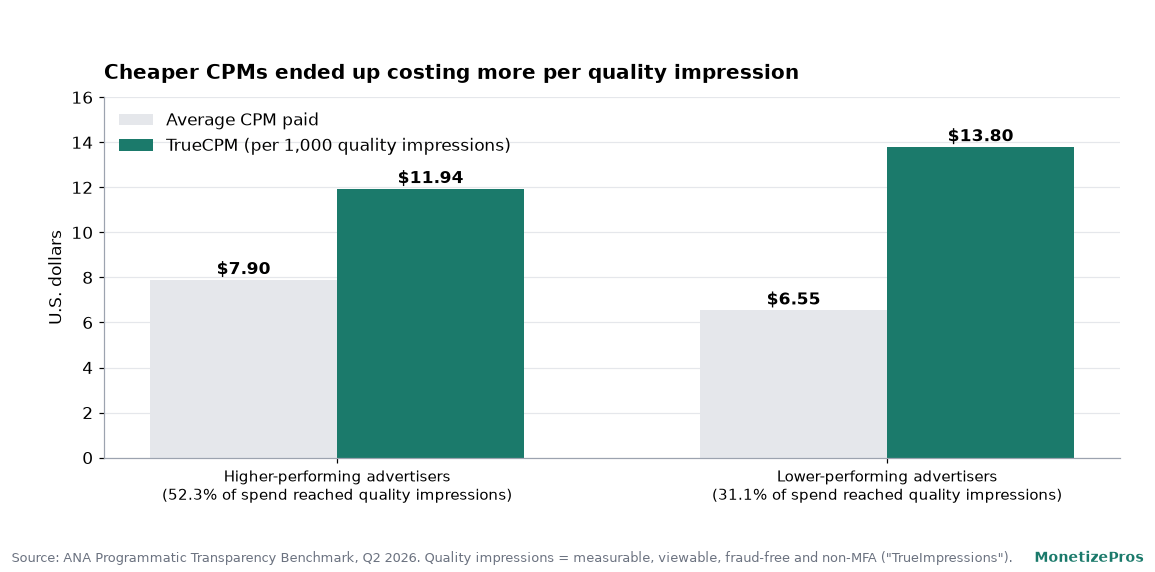
The most important finding for publishers is how the best advertisers are cutting waste. In Q2 2026, higher-performing advertisers converted 52.3% of spend into quality impressions, against 31.1% for lower performers. The higher performers did it by:
- Running across roughly 19,000 fewer domains and apps, with a more concentrated, curated supply list.
- Losing 10.4% of spend to non-measurable inventory, compared with 22.7% for lower performers.
- Paying a higher average CPM ($7.90 versus $6.55) but a lower cost per quality impression.
That last point is the one to remember. Lower performers bought cheaper inventory, but once the ANA adjusted for quality, their effective price was $13.80 per thousand good impressions, compared with $11.94 for the higher performers. Cheap supply turned out to be expensive.
Two other data points from the ANA’s Q1 2026 report sharpen the picture. Overall CPMs fell from $5.55 in Q4 2025 to $4.42 in Q1 2026 after a volatile end to last year, and MFA exposure rose to 1.1%, with the report naming AI slop as an emerging subtype. Buyers are pruning hard, and sites that look like low-quality supply are the first to go.
What Programmatic Ad Fees Mean for Your Revenue
The practical takeaway is that programmatic ad fees and supply quality are linked. Buyers who are squeezed on fees protect their margins by concentrating spend on fewer, more efficient paths. If your inventory is hard to measure, low in viewability, or reachable only through a long chain of resellers, you are exactly the kind of supply that gets cut when a buyer trims 19,000 domains.
The opposite is also true. A site with clean, measurable, viewable inventory and short supply paths becomes part of the curated list, and those buyers are willing to pay higher CPMs because their effective cost is lower. Connected TV also took 41.6% of the spend tracked in Q2, so web publishers are competing for a smaller share of the programmatic pie and need to be on the shortlist.
7 Ways to Keep More of Each Ad Dollar
- Audit your ads.txt and sellers.json. Remove resellers you no longer work with and make sure every authorized seller matches a real relationship. Every extra hop is another fee and another reason for a buyer’s supply path optimization (SPO) tool to drop you.
- Consolidate SSPs. Running many exchanges that resell the same impression creates duplicate bid requests that buyers increasingly filter out. Keep the partners that bring unique demand and win rate. Our guide to the best SSPs for publishers covers how to compare them.
- Fix viewability before adding units. Non-viewable impressions were 10.1% of spend in Q2. Lazy load below the fold ads, avoid stacking units, and track viewability per placement. One highly viewable unit usually earns more than two poor ones.
- Make every impression measurable. Non-measurable inventory was the single biggest source of loss for lower-performing advertisers. Allow standard verification tags, avoid setups that block measurement scripts, and test that your pages render ads correctly for verification vendors.
- Stay far away from MFA patterns. Aggressive refresh, slideshow pagination built for ad loads, and arbitrage traffic all look like MFA to buyers. With AI slop now named as an MFA subtype, thin AI-generated pages carry the same risk.
- Open direct and curated paths. Private marketplace deals, programmatic guaranteed and curated packages give buyers a shorter path with fewer fees. See our comparison of programmatic direct vs open auction to decide what mix fits your traffic.
- Track your take rate. Compare the gross bid in your SSP or ad server logs with what you are paid. If one partner’s net payout is consistently lower for the same demand, raise it with them or shift volume. If you are new to how bids flow, start with programmatic buying explained.
Quick Answers
How much do programmatic ad fees take from ad spend?
In the ANA’s Q2 2026 benchmark, transaction costs were 27.2% of programmatic spend. Small agencies buying through DSP resellers reported 25% to 29% in buy-side platform fees alone in October 2026, before SSP fees.
What share of programmatic spend reaches quality publisher inventory?
45.1% in Q2 2026, a record for the ANA benchmark. Higher-performing advertisers reached 52.3% and lower performers 31.1%.
Can publishers reduce programmatic ad fees?
Not directly on the buy side, but you can shorten your supply path, consolidate SSPs, offer direct deals and improve viewability and measurability. Those steps make your inventory cheaper for buyers to reach, which supports higher bids.
Is supply path optimization bad for small publishers?
It can be if your inventory is only available through many resellers. Publishers with clean ads.txt files, direct SSP relationships and measurable, viewable placements tend to stay on buyers’ curated lists.
The Bottom Line
The programmatic market is getting cleaner, but it is not getting cheaper to operate. Fees still take more than a quarter of spend, and buyers are protecting their budgets by sending more money to fewer, better paths. Programmatic ad fees are not a line you control, but your place on those shorter paths is. Clean up your sellers, make every impression count, and give buyers a direct way in.
Sources
ANA, Programmatic Transparency Benchmark Q2 2026 release (August 6, 2026) and Q1 2026 release (May 27, 2026); Digiday, indie agencies and DSP fees (October 21, 2026); AdExchanger daily news roundup (October 22, 2026); ISBA and PwC, Programmatic Supply Chain Transparency Study (2020).