Substack for publishers used to sound like a contradiction. The platform built its name on independent writers leaving newsrooms, not on newsrooms moving in. That changed this month when The Ringer, the Spotify owned sports and culture brand, put four of its best known writers on Substack instead of on its own website. The move set off a loud debate about whether a publisher should build its reader relationship on someone else’s network.
This guide breaks down what The Ringer actually did, the numbers Substack and Chartbeat have shared, where the economics work, where they break, and seven smart moves for any publisher weighing the platform. Every figure here comes from a named source, and where a company declined to share data, we say so.
Table of Contents
What The Ringer Did on Substack
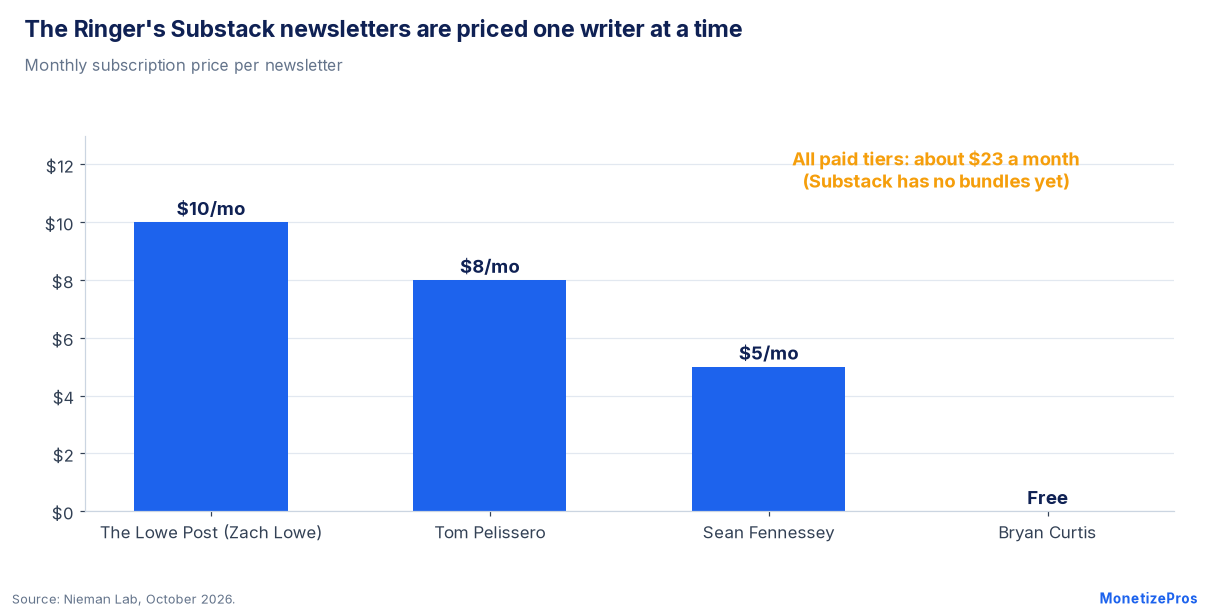
The trigger was Zach Lowe’s new NBA newsletter, The Lowe Post. As Nieman Lab reported, it costs $10 a month and has already become one of Substack’s bestselling sports newsletters. It joins Ringer newsletters from Sean Fennessey at $5 a month, Tom Pelissero at $8 a month and Bryan Curtis, whose newsletter is free.
These are not side projects. Each newsletter carries Spotify and Ringer branding. The Ringer declined to comment on its strategy or say whether writers share subscription revenue. Substack confirmed there is no separate financial relationship between the two companies, even though The Ringer has described the launches as a partnership.
The company has a long record of being flexible about distribution. It launched on Medium in 2016, moved to an ad and technology partnership with Vox in 2017, was acquired by Spotify for $250 million in 2020 and, five years later, signed a deal to bring some of its video podcasts to Netflix. The website has always been free to read.
Look at The Ringer’s homepage today and most links send you somewhere else. Many go to Spotify for podcasts, and several now go to Substack. Nieman Lab described the homepage as closer to a landing page than a news site. For a brand whose main business is podcasts, that is a logical choice. For a text first publisher, the same move carries more risk.
Why Substack for Publishers Is Trending Now
The Ringer is not alone. Nieman Lab noted that established outlets are arriving in two ways. Some, like The Ringer, publish Substack exclusive content. Others, including New York magazine and The Wall Street Journal, redistribute work that already exists elsewhere on the web. Both groups want access to an audience that already pays for writing.
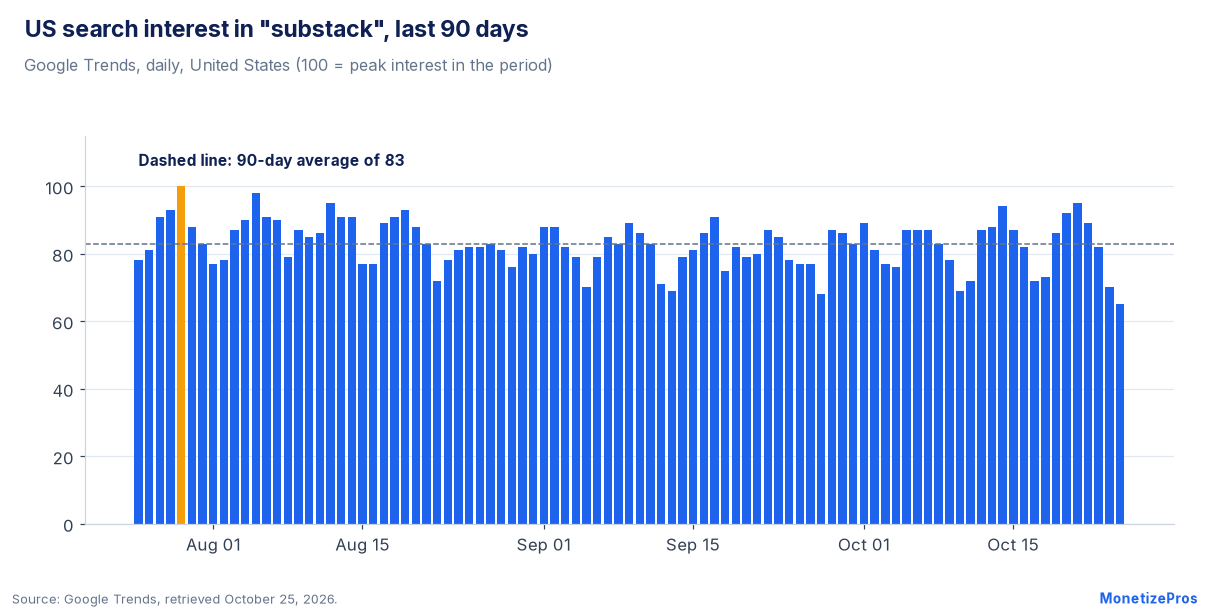
The conversation is loud. Our count of original public posts on X that mention Substack alongside publishers, newsletters, creators, networks or The Ringer found 881 posts in the seven days to the morning of October 25, 2026, with a peak of 193 on October 20. Google Trends shows US search interest in “substack” holding near the top of its range over the last 90 days, with a 90 day average of 83 on a scale where 100 is peak interest.
Scale explains part of the pull. According to Press Gazette’s ranking of subscription news sites, Substack announced in March 2025 that it had reached 5 million paid subscriptions, less than four months after crossing 4 million. Substack declined to share a newer figure with Press Gazette in February 2026, so 5 million remains the latest official total.
Reuters Breakingviews put that figure in context in January 2026, noting that Substack’s roughly 5 million revenue generating subscriptions in 2025 were more than double its 2023 count and approaching half of the 12 million people who pay for The New York Times digitally.
The Network Effect in Numbers
The strongest argument for Substack for publishers is discovery. Substack has grown into a social platform, and its Notes feed works much like a timeline. Publishers can monetize directly on it and still capture email addresses for themselves, which is not true of most social networks.
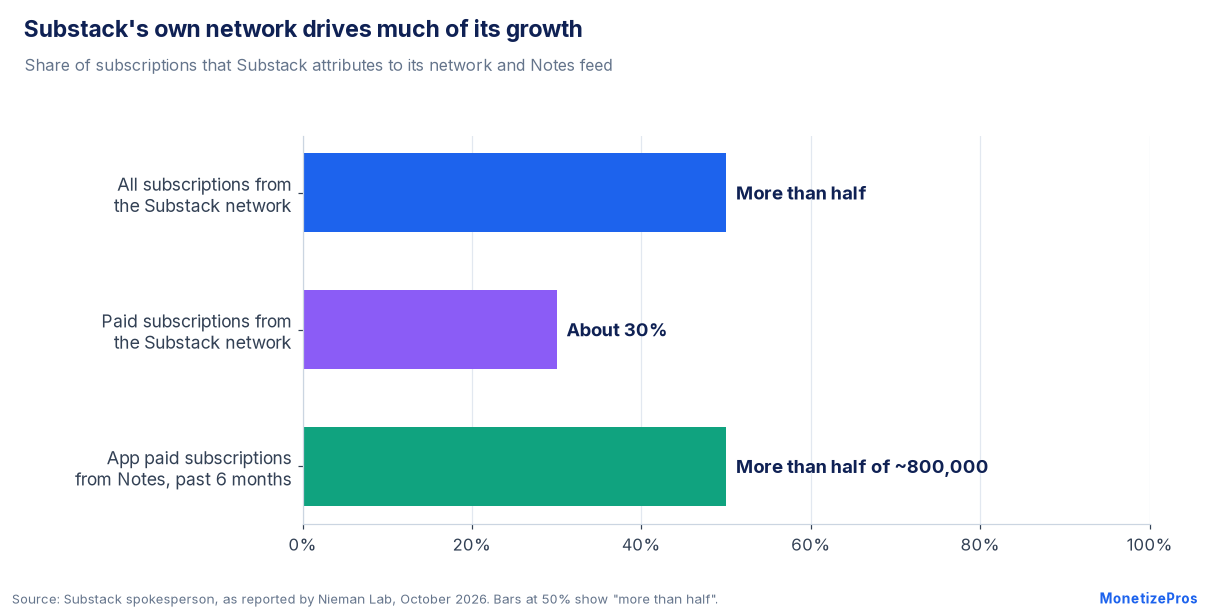
Substack gave Nieman Lab several numbers. In the past six months, the app generated nearly 800,000 paid subscriptions, and more than half of those came directly from Notes. Across the platform, a spokesperson said network effects account for more than half of all subscriptions and about 30% of paid subscriptions.
Friction matters as much as reach. Nieman Lab’s reporter subscribed to The Lowe Post with a single click. Because she already paid for other Substacks, she did not need to enter card details or even an email address. On a typical publisher website, the same purchase means a signup form, a payment page and a confirmation email, and each step loses readers.
Media analyst Simon Owens compared The Ringer’s approach to publishers making native content for YouTube. In his view, Substack has its own audience ecosystem, and it may be easier to convert readers there than to persuade them to visit the publisher’s site. That is the core trade: you rent reach and checkout convenience in exchange for some control over the reader experience.
The Search Traffic Backdrop
None of this would matter as much if search were still reliable. It is not. Chartbeat’s 2026 Publisher Playbook, covered by Search Engine Journal, found Google Search referrals across its publisher network fell 40.2% year over year from July 2025 to July 2026, after a 21.9% decline the year before. Google Discover’s decline grew from 6.6% to 34.3% over the same two years.
Search made up about 9% of network pageviews in July 2024 and 5% by July 2026. AI referrals grew 8x over two years but still made up just 0.01% of traffic. Meanwhile, the channels publishers control grew. Dark social, meaning links shared in texts and private messages, rose from 7.1% to 11.3% of pageviews, direct traffic from 13.5% to 15.9% and internal traffic from 37.9% to 40.4%.
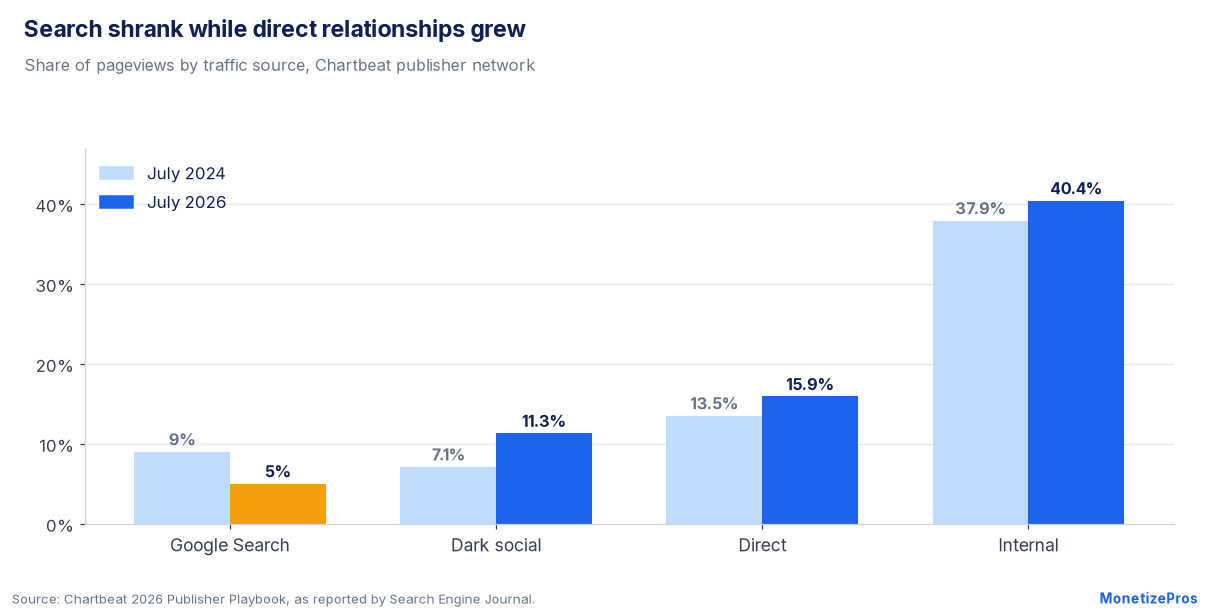
Loyal readers held steady. Chartbeat’s loyal visitors, people who visited a site on at least eight of the last 16 days, produced slightly more monthly pageviews in 2026 than in 2024, while returning readers fell 8% and new readers fell 14%. The lesson is clear: direct relationships are carrying publishers, and anything that builds them deserves attention.
We covered the advertising side of this shift in our guide to publisher ad revenue after the search drop. Substack is one answer to the same problem, a way to reach readers without waiting for a search engine to send them.
Sports newsletter writer Kendall Baker summed up the audience side in the Nieman Lab piece. Most people open their phone, go straight to a social app and start scrolling, he said, so relying on readers to come find you is becoming “more and more silly.” Newsletters are an obvious way to go to them instead.
The Economics: Fees, Pricing and Conversion
The fee model behind Substack for publishers is simple. Substack keeps 10% of subscription revenue paid to publications, according to Press Gazette, and payment processing fees from Stripe come on top. Payments for The Ringer’s newsletters run through The Ringer’s own Stripe account, Owens noted, which matters for portability. We compared the fee structure with a rival platform in detail in our Substack vs Beehiiv breakdown.
Conversion is the number that makes or breaks the plan. Reuters Breakingviews cited a rule of thumb that paid conversions represent about 3% to 5% of a total audience. Its back of the envelope example: 2,000 subscribers paying $10 a month would let a writer keep more than $200,000 a year after Substack and Stripe take their cuts.
That math is attractive for one writer. It looks different for a brand with many writers. Substack does not yet offer bundles, so a reader who wants all of The Ringer’s paid newsletters pays about $23 a month. Nieman Lab pointed out that this is more than a New York magazine or Apple News subscription and a little less than a full New York Times bundle. Pricing was a common complaint online.
A whole site subscription also helps readers discover more of your work. Selling single writers can cannibalize a pricier subscription and narrow what readers see. Bill Simmons named the challenge himself: in the Substack era, he said, you are writing for people who really like you, and the big question is how you pull other people in.
The Risks Publishers Should Weigh
The first risk of Substack for publishers is the one the industry learned from Facebook. Burned by shifting algorithms, many spent recent years building their own newsletters, apps and events so a platform change could not cut them off. Moving the most valuable writing onto another company’s feed partly reverses that strategy, even if the email list stays yours.
The second risk is your own website. If your best writing lives on Substack, your site loses pageviews, ad impressions and the internal traffic that Chartbeat shows is growing. For an ad supported publisher, that is real revenue, and it should be modeled before launch, not after.
The third risk is talent. A newsletter tied to one personality builds a direct bond between that writer and readers. If the writer leaves, the audience may follow them. Contracts, branding and who owns the subscriber list need to be settled up front.
There is also a mitigation. Owens argued that because payments run through the publisher’s own Stripe account, The Ringer could move its subscribers to its own site if it ever left Substack, so the downside is limited. Make sure your setup gives you the same exit.
7 Smart Moves Before You Launch
If you are evaluating Substack for publishers, these steps keep the experiment measurable and reversible.
1. Start with one writer, not the whole brand
Pick a writer with a loyal following and a clear beat. The Ringer’s strongest launch was built around a writer whose fans already knew him. A single test shows you real conversion before you commit a full newsroom.
2. Decide what is exclusive and what is redistributed
The Ringer publishes Substack exclusive work, while New York magazine and the Journal redistribute existing stories. Redistribution protects your site traffic. Exclusives give readers a reason to pay. Choose one model per newsletter and document why.
3. Connect your own payment account
Run payments through your own Stripe account so subscriber billing stays portable. Owens identified this as the feature that limits the downside for The Ringer. Confirm export rights for both emails and payment records.
4. Price with your existing subscription in mind
If you already sell a site subscription, a cheap single writer tier can undercut it. Compare your Substack price with your main offer and test whether readers see the newsletter as an add on or a replacement.
5. Use Notes as a funnel, not an afterthought
Substack says more than half of app paid subscriptions in the last six months came from Notes. Treat Notes like a social channel with a posting schedule, and track which posts lead to signups.
6. Link back to your site with purpose
Every newsletter should point readers to deeper coverage, archives and tools on your own domain. That keeps internal traffic and ad impressions flowing. Our guide on monetizing an editorial newsletter without burning reader trust covers how to add sponsors without hurting engagement.
7. Set a 90 day scorecard
Track free signups, paid conversion against the 3% to 5% benchmark, churn, revenue after fees and any change in site traffic from the writer’s audience. If the numbers do not justify the lost pageviews, Substack for publishers is not the right channel for you yet, and you can move subscribers home.
Who Should and Should Not Do This
Substack for publishers makes the most sense for brands like The Ringer: personality led, already less reliant on search, and selling something other than display ads as their main product. Writers with loyal followings and a clear niche are the best candidates, and the platform’s one click checkout helps them convert readers who already pay for other newsletters.
It makes less sense for publishers whose revenue depends on site pageviews, who sell a bundled subscription, or who cannot afford to train readers to look elsewhere. For them, Substack works better as a redistribution channel that sends readers back home than as the main destination.
Either way, the logic behind The Ringer’s choice applies to everyone. Search referrals fell sharply, AI referrals are tiny, and loyal readers held up. The publishers that do best will be the ones that own direct relationships, whether those start on Substack or on their own site. Choose the platform that gets you there with the least loss of control.
Substack for Publishers FAQ
Why did The Ringer launch newsletters on Substack?
The Ringer declined to explain its strategy. Nieman Lab reported that Substack offers a built in audience, a Notes feed that drives subscriptions and one click checkout for readers who already pay for other Substacks. The Ringer’s main business is podcasts, so it relies less on search than text first publishers.
How many paid subscriptions does Substack have?
Substack announced 5 million paid subscriptions in March 2025, less than four months after reaching 4 million. It declined to share a newer figure with Press Gazette in February 2026. Substack told Nieman Lab its app generated nearly 800,000 paid subscriptions in the past six months.
How much does Substack take from publishers?
Substack keeps 10% of subscription revenue paid to publications, according to Press Gazette. Payment processing fees from Stripe are charged on top of that cut.
What paid conversion rate should publishers expect on Substack?
Reuters Breakingviews cited a rule of thumb that paid conversions represent about 3% to 5% of a total audience. In its example, 2,000 subscribers paying $10 a month would let a writer keep more than $200,000 a year after Substack and Stripe take their cuts.
Does Substack really help publishers find new readers?
Substack says network effects account for more than half of all subscriptions on the platform and about 30% of paid subscriptions. More than half of the nearly 800,000 paid subscriptions its app generated in the past six months came from the Notes feed.
Can a publisher move subscribers off Substack later?
Media analyst Simon Owens noted that The Ringer’s payments run through its own Stripe account, so it could move subscribers to its own website if it left Substack. Publishers should confirm export rights for emails and payment records before launch.
Related posts:

Monetizing a Newsletter: 4 Advanced Revenue Models for 5,000+ Subscribers

The Beginner's Guide to Email Monetization: 10 Essential Resources

5 Important Things Before Starting Email Marketing For Your Business

The Professional Email Address as a Business Asset: Deliverability and Credibility

Why Is Segmentation Important in Email Marketing? The Key to Higher Engagement and Conversions