

Choosing the wrong newsletter platform can cost you way more money than you think. That’s why the Substack vs Beehiiv debate is such a big deal for creators in 2026.
Substack is great if you just want to write. Beehiiv is built for people who want to grow a real newsletter business. Both can make you money, but they do it in very different ways.
This guide compares platform fees, ads, sponsorships, and other income sources so you can see which one puts more money in your pocket.
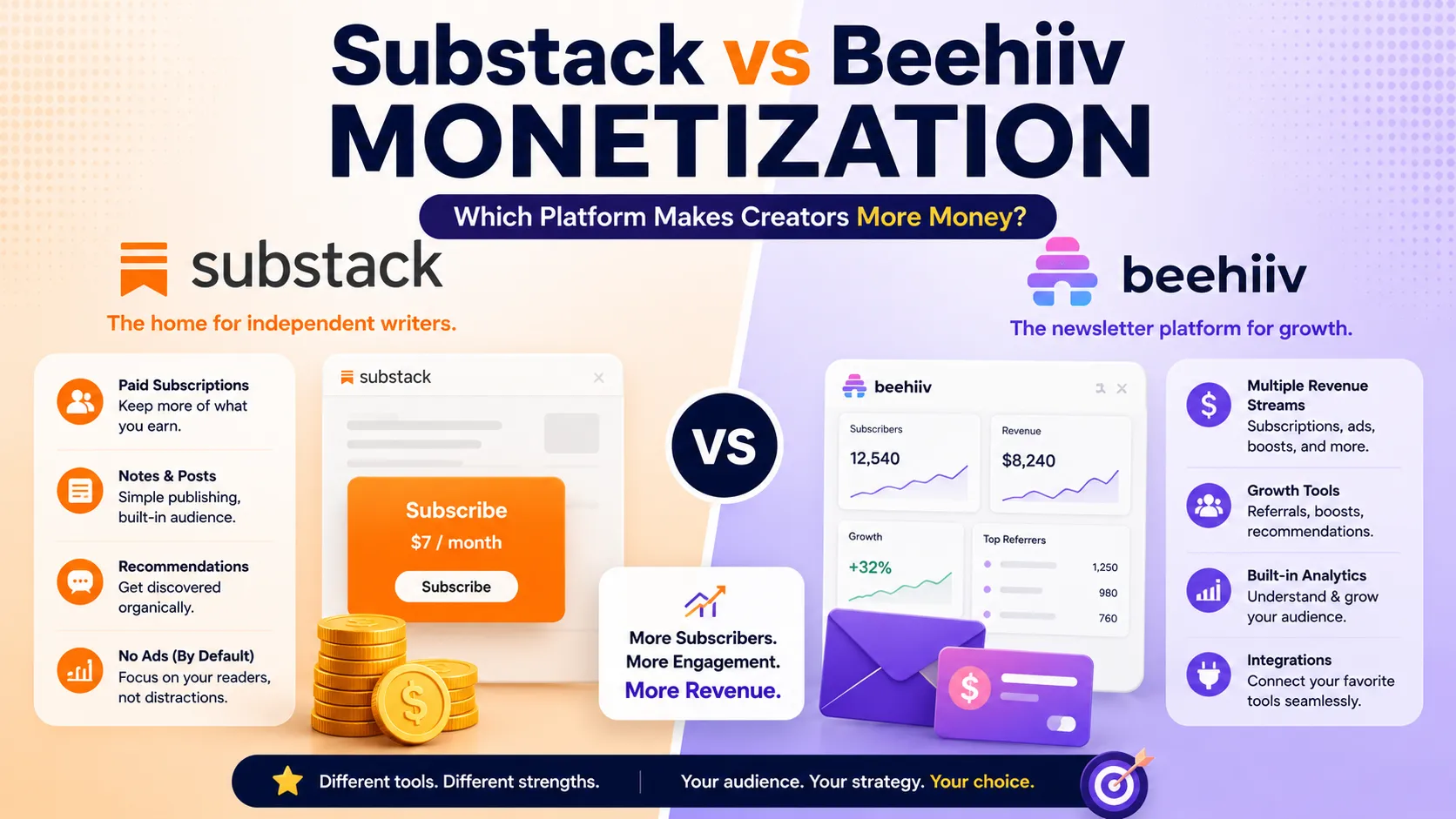
How Do Substack and Beehiiv Actually Make Money From You?
Substack
Substack’s business model is simple: it’s free to publish, and if you turn on paid subscriptions, Substack takes 10% of that revenue. Stripe then takes its standard processing cut on top, typically around 2.9% plus $0.30 per transaction. There’s no separate platform fee for anything else because there isn’t much else. Subscriptions are close to the only lever Substack gives you.
Beehiiv
Beehiiv flips that structure. Subscription revenue keeps a 0% platform cut, but you pay a flat monthly subscription fee once your list outgrows the free tier (capped at 2,500 subscribers). In exchange, Beehiiv adds several revenue streams Substack doesn’t offer at all: a built-in ad network, a boosts marketplace for cross-promotion, referral programs, and (as of a November 2025 launch) commission-free digital product sales.
| Revenue Stream | Substack | Beehiiv |
| Paid subscriptions | 10% platform fee | 0% platform fee (flat monthly plan) |
| Sponsored ads | Not available natively | Built-in ad network |
| Referral/boosts payouts | Not available | Yes, per-subscriber payouts |
| Digital products | Not supported | 0% commission (since Nov. 2025) |
| Free tier limit | Unlimited subscribers | 2,500 subscribers |
Where Does the 10% Fee Actually Start to Hurt?
Do the math on a mid-size list and the fee stops looking small fast. On $5,000 a month in paid subscriptions, Substack’s cut runs about $500, plus roughly $145 in Stripe fees, leaving the creator with something like $4,355. Scale that to $20,000 a month in gross revenue and the annual gap between the two platforms climbs into five figures.
Here’s the rule of thumb worth remembering: a flat-fee Beehiiv plan becomes cheaper than Substack’s percentage cut once 10% of your monthly subscription revenue equals your Beehiiv plan cost. A $79-a-month plan, for instance, breaks even around $790 in monthly subscription revenue. Past that point, every additional dollar in subscriptions is pure margin on Beehiiv, while Substack keeps taking its slice forever.
None of this touches Stripe’s cut, which applies on both platforms regardless of what you pick.
What Can You Monetize Beyond Subscriptions?
This is where the two platforms stop looking like variations on the same idea. Substack was built around one revenue stream, and it shows: no ad network, no referral payouts, no built-in way to sell products. Affiliate links technically work, but they’re bolted on rather than supported.
Beehiiv treats subscriptions as one option among several:
- Ad network payouts. RPMs (revenue per 1,000 sends) typically land between $20 and $100+ depending on niche and engagement, and it runs largely on autopilot once set up.
- Boosts marketplace. Cross-promote with other newsletters and get paid $1–5 per subscriber referred.
- Digital products. Sell ebooks, templates, or coaching sessions directly through the platform with no commission taken.
- Referral programs. Reward existing subscribers for bringing in new ones, which compounds growth without ad spend.
A publisher running a niche list of 1,500 subscribers can realistically pull $40–80 a month from the ad network alone, on top of whatever subscriptions bring in. Substack simply has no mechanism to generate that money.
Does Audience Size or Niche Change Which Platform Wins?
Yes, and this is where a lot of comparisons oversimplify. If you’re a well-known writer with an established personal brand (the kind of creator Substack’s Notes and Recommendations features were built to amplify), the platform’s discovery tools can bring in subscribers you’d otherwise have to pay to acquire. That in-platform network effect has real value for people already famous enough to benefit from it.
For everyone still building an audience from zero, Beehiiv’s tool-driven growth (segmentation, automations, referral programs) tends to outperform waiting on organic discovery.
And for niches with strong advertiser demand (finance, business, tech, health), the ad network math tilts even further toward Beehiiv, since higher RPM niches make that revenue stream worth more per subscriber.
Publishers monetizing primarily through display advertising elsewhere on their site will recognize this pattern: RPM (revenue per mille) measures how much a site earns per thousand pageviews, and the same logic applies to newsletter ad networks: a bigger, more engaged list simply commands a higher rate. For a deeper look at how that metric works across ad formats, see our breakdown of RPM.
Which Platform Handles Data and Segmentation Better?
Substack’s dashboard covers the basics: opens, clicks, subscriber counts. That’s genuinely fine if your only question is “are people reading this.” It’s a dead end if you want to act on the answer, since Substack doesn’t let you segment a superfan who opens every email differently from someone who signed up six months ago and forgot why.
Beehiiv’s analytics go considerably further: traffic sources, conversion by channel, referral tracking, cohort retention, and revenue dashboards. That depth matters most once you’re trying to optimize rather than just publish. Knowing which acquisition channel actually converts to paying subscribers changes where you spend your time and, eventually, your ad budget.
If your newsletter is one piece of a broader monetization strategy, say, alongside display ads or affiliate links on a companion website, our guide to email monetization walks through how dedicated sends, co-registration, and banner ads fit into that mix, and our comparison of email ad networks covers options beyond Beehiiv’s built-in marketplace.
Should You Migrate an Existing Substack List to Beehiiv?
Migration is close to friction-free on paper. Export your Substack subscriber list as a CSV, and Beehiiv’s import tool pulls it in, including paid subscribers, without notifying readers or changing their billing cycle. The only thing that changes for them is invisible: you keep 100% of the revenue instead of 90%.
The friction shows up elsewhere, in habit rather than mechanics. If you’ve built workflows, templates, and a publishing rhythm around Substack’s editor, relearning Beehiiv’s more feature-dense interface takes real time, even if the payout math favors the switch.
Weigh that against how close you are to a revenue level where the 10% fee genuinely outweighs the hassle of switching.
FAQ
Does Beehiiv really take 0% of subscription revenue?
Yes, on subscription payments specifically. You still pay Stripe’s standard processing fee, and once your list exceeds the free tier’s 2,500-subscriber cap, you’re paying for a monthly plan regardless of whether you monetize.
Is Substack completely free if I never charge subscribers?
Yes. Substack’s free tier has no subscriber cap and no plan upgrade requirement if you never turn on paid subscriptions. You could run a 50,000-subscriber free list and never owe Substack anything.
Can I run ads on Substack the way I can on Beehiiv?
Not natively. Substack has no built-in ad network or sponsorship marketplace; any sponsorship deals have to be arranged and inserted manually. Beehiiv’s ad network matches you with advertisers automatically once you’re approved.
What’s the breakeven point where Beehiiv’s flat fee beats Substack’s 10% cut?
Roughly when 10% of your monthly subscription revenue equals your Beehiiv plan’s monthly cost. For a $79/month plan, that’s around $790 in monthly subscription revenue.
Can I move my paid subscribers from Substack to Beehiiv without disrupting them?
Yes. Migration tools import your list, including active paid subscriptions, and readers keep their existing billing terms. They won’t notice a change other than who’s ultimately getting paid.
The Bottom Line
If subscriptions are your only monetization plan and you already have (or expect) a loyal, discovery-driven audience, Substack’s simplicity and 10%-only cost structure are hard to argue with at low revenue.
But the moment you want to diversify (ads, sponsorships, referrals, digital products) or your subscription revenue climbs past a few hundred dollars a month, Beehiiv’s flat-fee model and built-in monetization tools start paying for themselves.
Run your own numbers against the breakeven math above before you commit to either one.