

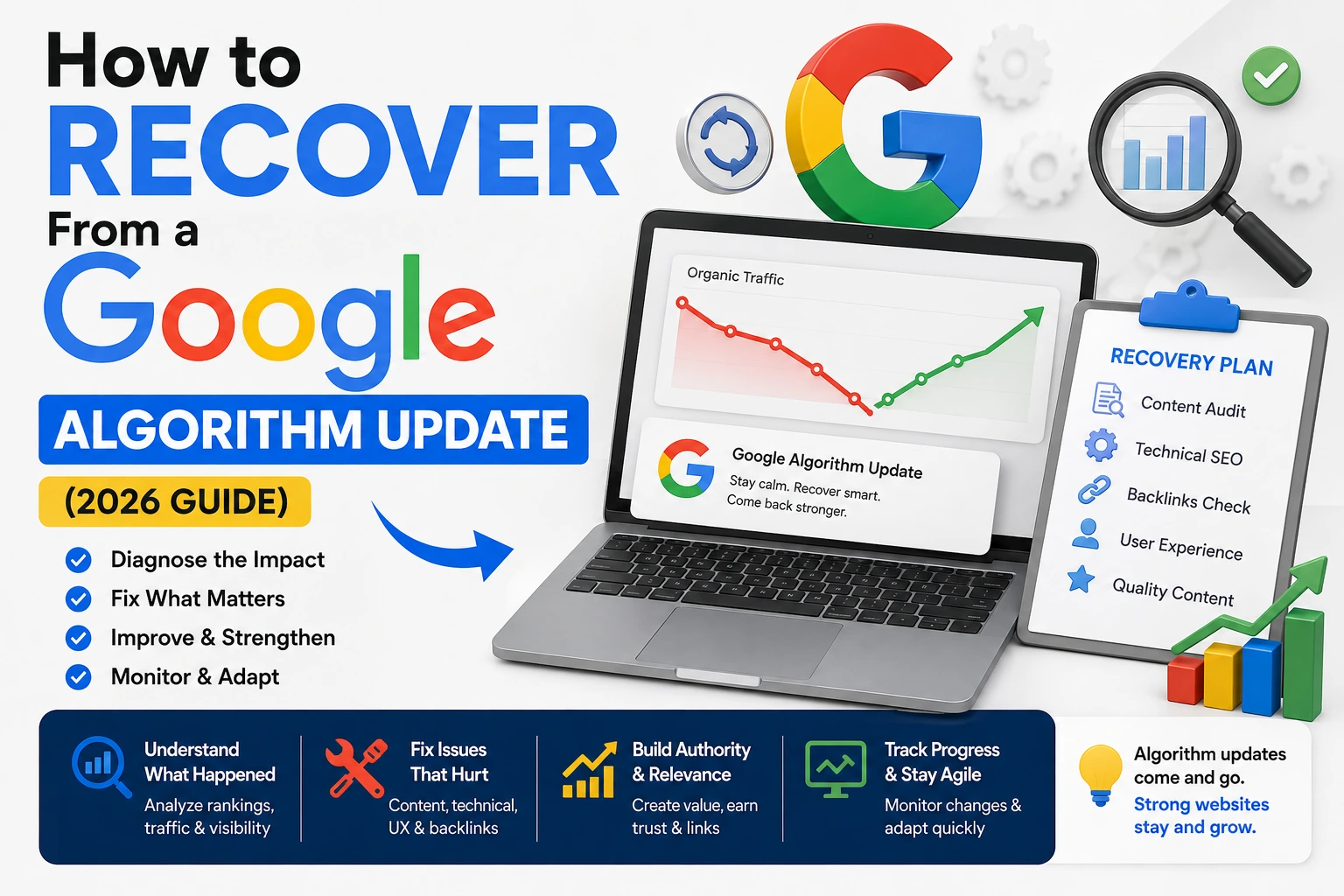
Watching your traffic fall off a cliff is one of the worst feelings in publishing — and figuring out how to recover from a Google algorithm update is often the first real SEO crisis a site owner faces. The good news is that recovery is possible. The better news is that it follows a predictable process: confirm the cause, diagnose the affected pages, fix the right problems in the right order, and give Google time to reassess your site.
This guide Recover From a Google Algorithm Update walks through exactly how to recover from a Google algorithm update, step by step, along with what not to do while you wait.
Step 1: Confirm it was actually an algorithm update
Before you touch a single page, confirm that an update actually caused your drop. Not every traffic dip is algorithmic — technical issues, seasonal demand shifts, and even Google Analytics tracking errors can look identical to an update-driven decline at first glance.
Cross-reference the date your traffic dropped against Google’s own list of confirmed rollouts on the Search Central updates page and the Search Status Dashboard. If your decline lines up precisely with a confirmed rollout window, an algorithm update is the likely cause. If the drop happened on a random day with no update running, keep investigating technical or tracking issues before assuming it’s algorithmic — this is one of the most common misdiagnoses in the recovery process.
Step 2: Identify which pages and topics were hit
Google rarely penalizes an entire site outright. Losses typically cluster around specific content types, topics, or formats. Pull your Search Console data and export impressions and clicks for the weeks before and after the update, then group the affected URLs by topic cluster, content format, or template rather than looking at individual pages in isolation.
Patterns tend to emerge quickly — thin informational pages losing visibility after a helpful content-focused update, or product review pages dropping after an update targeting review quality, for example.
Understanding the pattern is the difference between a recovery plan that works and months of guesswork. If you haven’t already built a habit of monitoring where your traffic actually comes from, MonetizePros’ guide on tracking competitor website traffic is a useful companion resource for benchmarking your own performance against sites that gained ground during the same update.
Step 3: Diagnose the real problem
Once you know which pages dropped, compare them honestly against what’s now outranking you. Ask what the new top-ranking pages do better — depth, structure, freshness, trustworthiness, user experience — rather than assuming the update was arbitrary. A Google algorithm update isn’t a manual penalty; it’s a recalibration of how quality is evaluated, which means recovery comes from genuinely improving the page, not from technical tricks or appeals.
Three areas consistently show up in recovery diagnoses:
- Content quality and depth. Does the page actually answer the query better than competing results, or does it skim the surface?
- E-E-A-T signals. Is there clear evidence of experience, expertise, authoritativeness, and trust — author credentials, original insight, accurate sourcing?
- Technical and UX health. Slow load times, intrusive ads, and confusing navigation all send quality signals to Google, even when the underlying content is solid.
Step 4: Fix issues in order, not all at once
It’s tempting to rebuild your entire site the moment you confirm an update hit you. Resist that instinct. Rushing to publish new content or restructure pages before you’ve finished diagnosing the problem often makes things worse, because you won’t be able to isolate what actually worked.
Instead, prioritize fixes in this order when Recover From a Google Algorithm Update:
- Content quality on the specific pages that dropped — this is almost always the highest-leverage fix.
- Technical and UX blockers that affect user experience site-wide.
- Authority signals — earning genuine links and brand mentions rather than chasing risky link-building shortcuts.
- Site-wide publishing consistency — steady, valuable content over time rather than a single burst.
If your recovery plan includes rebuilding traffic through new channels while your core pages recover, MonetizePros’ guide on ways to increase website traffic covers complementary strategies — guest posting, Pinterest, and paid channels — that can help offset losses while your organic recovery plays out.
Step 5: Give it time — and stop checking daily
This is the hardest part of learning how to recover from a Google algorithm update: patience. Google has stated that pages affected by a core update may not fully recover until the next broad core update rolls out, even if you’ve already made meaningful improvements. Checking your rankings daily produces anxiety, not results. A quarterly review, aligned with Google’s typical core update cadence, is a far more useful rhythm.
While you wait, document what you changed, on which pages, and when — this record becomes essential for understanding what actually worked once rankings shift again.
Common mistakes that slow recovery
- Deleting and starting over. Existing authority and backlink equity are assets even when rankings have dropped — don’t throw them away.
- Chasing every recovery theory you read online. One consistent, evidence-based approach beats ten conflicting tactics applied at once.
- Making changes mid-rollout. Wait for an update to finish rolling out before evaluating its full impact or making further changes.
- Ignoring the timeline. Expecting immediate recovery after a single round of fixes sets you up for premature, disruptive changes.
Building a site that holds up against future updates
The most reliable long-term strategy isn’t reacting to each individual update — it’s consistently publishing content that’s clearly more useful, accurate, and trustworthy than the alternative. As AI-driven and generative search results become a bigger part of the landscape, the underlying principle stays the same: sites built on genuine expertise and clarity tend to weather algorithm changes better than those built around thin or templated content. MonetizePros’ breakdown of GEO vs. SEO is worth reading if you’re thinking beyond the next update toward how search visibility is evolving more broadly.
The bottom line
Learning how to recover from a Google algorithm update comes down to a repeatable process: confirm the cause, diagnose the affected pages, fix the right problems in the right order, and give your changes time to be reassessed. Panic-editing your entire site rarely helps — a clear, evidence-based recovery plan does.