

The buy now pay later affiliate program category has quickly become one of the most talked-about niches in fintech affiliate marketing.
BNPL apps like Klarna, Affirm, and Afterpay now process billions of dollars in transactions every year, and each one runs an affiliate or partner program that pays for new user sign-ups and completed purchases.
If you run a personal finance, shopping, deals, or fintech-focused site, a buy now pay later affiliate program can be a strong addition to your monetization mix — provided you understand how these programs actually pay out.
This guide walks through how BNPL affiliate programs work, which providers are worth considering, and how to fit a buy now pay later affiliate program into a broader content and monetization strategy. For a refresher on affiliate marketing fundamentals before diving into a specialized niche like this one, see Ultimate Guide to Affiliate Marketing.
How a buy now pay later affiliate program works
Most BNPL companies run their affiliate programs on a cost-per-acquisition (CPA) model rather than a traditional revenue-share model. That means affiliates typically get paid when a referred user signs up, links a card, or completes a qualifying purchase — not a percentage of every transaction that user makes afterward. A handful of programs blend in bonus tiers or performance incentives for high-volume affiliates.
Because approval and onboarding vary by provider, evaluating a buy now pay later affiliate program usually comes down to three factors:
- Payout per action. CPA rates for BNPL programs commonly range from around $3 to $45 per qualified lead or sign-up, depending on the provider and geography.
- Cookie duration. Since BNPL is a checkout-stage decision, cookie windows tend to be shorter than typical SaaS or subscription programs, though this varies by network.
- Network vs. direct program. Some BNPL providers manage affiliate relationships directly, while others run through established affiliate networks, which can make tracking and reporting more consistent.
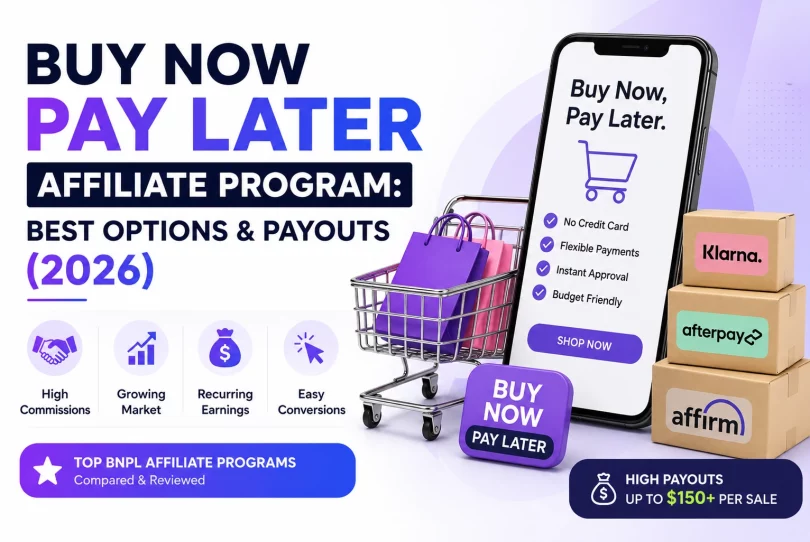
Top providers to consider
Klarna is one of the most widely recognized names in the space, offering multiple consumer products — Pay in 4, Pay in 30, and longer-term monthly financing — which gives affiliates flexibility to match different Klarna offers to different content angles, from shopping roundups to financial literacy guides. Klarna is one of the highest-revenue BNPL providers globally, which has made its affiliate program a frequent starting point for publishers exploring a buy now pay later affiliate program for the first time.
Affirm focuses more heavily on higher-ticket purchases and longer financing terms, and it’s known for fast affiliate onboarding — brands and publishers are often approved within 48 hours. Its transparent, no-hidden-fee positioning also makes it a comparatively easy product to explain in content aimed at cautious or first-time BNPL users.
Afterpay sticks closest to the original BNPL model: split a purchase into four interest-free installments. Its simplicity makes it a strong fit for publishers writing about smaller, everyday retail purchases rather than big-ticket financing.
PayPal Pay in 4 is worth including for publishers whose audience already trusts and uses PayPal, since it integrates directly into an ecosystem many shoppers are already familiar with.
Commission structures and approval requirements shift often in this space, so confirm current terms directly on each provider’s affiliate or partner page before applying.
Who should promote a buy now pay later affiliate program
BNPL affiliate content performs best on sites already covering:
- Personal finance and budgeting
- Deals, coupons, and shopping guides
- E-commerce and retail comparisons
- Credit-building and credit score education
A buy now pay later affiliate program pairs naturally with comparison content — for example, “Klarna vs. Afterpay vs. Affirm” style posts capture readers who are already at the decision stage, which tends to convert better than generic “what is BNPL” explainer content.
Content angles that convert
- Provider comparisons. Head-to-head breakdowns of fees, financing terms, and merchant acceptance tend to outperform single-provider reviews.
- Use-case guides. Content framed around a specific outcome (for example, using BNPL to spread out a large purchase interest-free) performs better than generic reviews.
- Credit impact explainers. Since major BNPL providers now report to credit bureaus, content explaining how missed payments affect credit scores is both genuinely useful and a strong lead-in to affiliate links. The Consumer Financial Protection Bureau publishes consumer guidance on BNPL terms and risks that’s worth citing for accuracy and trust.
- Retailer-specific guides. Posts covering which major retailers accept which BNPL providers help capture bottom-of-funnel, high-intent searches.
Compliance considerations
BNPL sits at the intersection of e-commerce and consumer lending, so affiliate content in this space should be held to the same accuracy standard as other financial content. Avoid overstating BNPL as “risk-free,” since missed payments can now affect credit scores across all three major bureaus. Clearly disclose affiliate relationships near any BNPL link or recommendation, and cite fee and term information directly from the provider rather than estimating figures — terms change frequently enough that stale numbers can quickly become inaccurate.
Is a buy now pay later affiliate program worth it?
For publishers already covering personal finance, shopping, or e-commerce topics, a Buy Now Pay Later Affiliate Programis a reasonable addition to a diversified affiliate strategy — but it shouldn’t be treated as a standalone income source. CPA payouts are typically one-time rather than recurring, so BNPL programs work best layered alongside recurring-revenue verticals (like SaaS or subscription affiliate programs) rather than replacing them.