

For more than a decade, getting Google’s AdX demand onto your pages meant running Google’s ad server too. The Google ad tech remedies now taking shape in a Virginia federal court are designed to end that bundle. Nothing changes in your account on Monday morning, and nothing in the ruling promises you a higher CPM. What does change, over the next 12 to 18 months, is how AdX can compete inside your auction, what data you can take out of Google Ad Manager, and how much freedom you have to choose your stack.
This guide explains what the court ordered, what Google and the Justice Department are still fighting about, which publishers are actually covered, and a practical checklist you can work through while the final judgment is pending.
What the Court Ordered in the Google Ad Tech Case
On September 2, 2026, Judge Leonie Brinkema of the Eastern District of Virginia rejected the structural fixes the government wanted. Google will not have to sell AdX, open source the final auction logic inside its publisher ad server (still widely known as DFP), or face a contingent sale of the rest of DFP. Instead, the court accepted most of the proposed behavioral remedies, with modifications, and ordered both sides to turn them into one final judgment. The 106 page opinion was unsealed on September 16.
According to the Justice Department’s summary of the decision, the core obligations are:
- Prebid integrations. Google must build and support integrations between AdX and Prebid, and between DFP and Prebid.
- Bids to rival ad servers. AdX must submit real time bids to publisher ad servers that Google does not own.
- Data access. Publishers must be able to access and export their own data from DFP and AdX.
- No self preferencing. Google’s advertiser tool cannot bid preferentially into AdX or other Google tools because Google owns them, and it cannot bid directly into DFP.
- Oversight. A monitor and a technical committee will oversee compliance for six years, the length of the judgment.
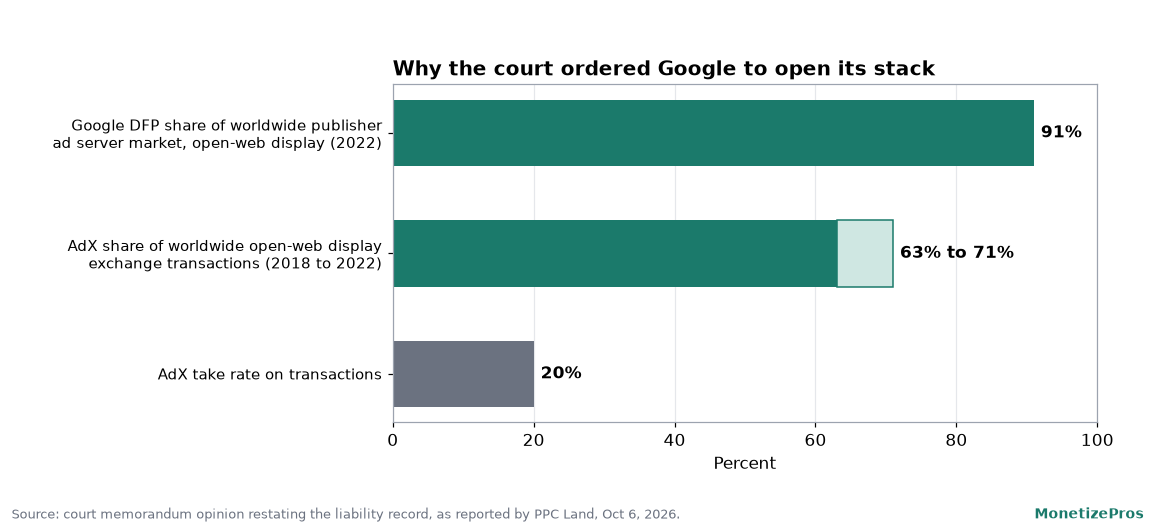
The reason the court went this far sits in the liability record. As restated in the opinion and reported by PPC Land, Google held 91 percent of the worldwide publisher ad server market for open web display in 2022, AdX handled 63 to 71 percent of worldwide open web display transactions among exchanges that produced data between 2018 and 2022, and AdX charged a take rate of about 20 percent.
Where Google and the DOJ Still Disagree
The court gave the parties 30 days to file one proposed judgment and to bracket anything they could not agree on. They filed a 41 page document on October 2, 2026. AdExchanger’s reading is that there are no major disagreements on the core remedies. The fights are about speed, reach, and enforcement.
- Timing. The DOJ and the 17 state plaintiffs want the AdX adapter for Prebid, AdX bids into rival ad servers, and publisher control over request routing within 6 months of the Effective Date. Google proposes 12 months for each.
- Geography. Google’s version applies its timelines to the United States and allows up to 24 months elsewhere, extendable for local law. The plaintiffs want worldwide application from the start.
- Your data. The plaintiffs want a publisher to be able to export DFP data while it is “considering or evaluating” a rival ad server. Google would limit that to publishers that have already chosen one.
- The monitor. Both accept a six year term, but they disagree on who nominates the monitor and how much access it gets.
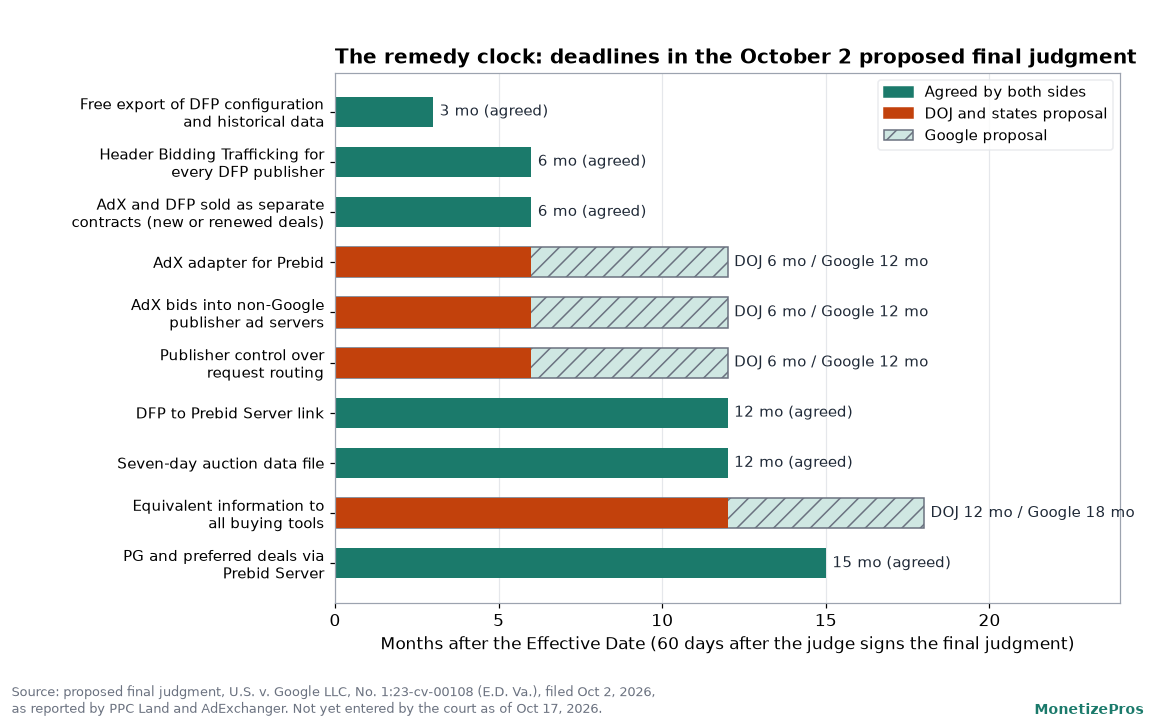
Two timing facts matter more than any bracket. First, the clock has not started. The Effective Date is 60 days after the judge signs the final judgment, and as of the latest reporting no date has been set for that ruling. Second, the Effective Date is paused during any stay granted on appeal, and AdExchanger expects Google to appeal. Plan with the later dates in mind.
Which Publishers Do the Google Ad Tech Remedies Cover?
This is the question most small and mid sized publishers should ask first, and the answer is narrower than the headlines suggest. According to PPC Land’s reading of the proposed judgment, it applies to indirect demand, meaning inventory sold through open or private auctions, and only to open web display. It does not apply to AdSense, AdMob, or DV360, and the open web display definition excludes native ads, in-stream video, search ads, social placements, mobile apps, and connected TV.
In practice:
- If you only run AdSense, nothing in this judgment changes your account directly.
- If you run Google Ad Manager with AdX and Prebid, you are the main audience for these remedies.
- If a managed monetization partner runs Ad Manager for you, the changes reach you through that partner, so the questions in the checklist below are questions for them.
What Changes Inside Your Auction
AdX becomes a bidder you can call through Prebid
Today, Prebid usually runs a pre auction and passes its winning bid into Google Ad Manager, where AdX competes. The remedies require Google to build an adapter so a qualified Prebid setup can send requests to AdX and receive bids back. Prebid’s own working group wants to go further. At the Prebid Summit in New York on October 13, it previewed a proposal for ad servers to bid into Prebid, rather than Prebid bidding into ad servers. AdX would then sit in the same auction as every other SSP. One of the proposal’s co-authors, Teal CTO Olly Burns, told AdExchanger that the current flow lets Google see the winning Prebid price before AdX bids. The proposal is in public comment and only applies if Google builds to Prebid Server rather than Prebid.js alone.
Unified pricing rules go away for indirect demand
Both sides agree to deprecate unified pricing rules for indirect demand and to ban any return of first look or last look. Unified pricing rules are the settings that stopped you from setting different floors for different buyers. Once they go, buyer level floor strategy becomes possible again inside Google’s stack, which also means new ways to get floors wrong. If you need a refresher on testing floors safely, start with the MonetizePros guide on setting price floors without killing fill rate.
Your data becomes portable
The agreed text gives publishers free export of DFP configuration and historical data within 3 months of the Effective Date, a seven day auction data file within 12 months showing the prices and adjustments used in DFP’s final logic, and Header Bidding Trafficking for every DFP publisher within 6 months, regardless of size or Ad Manager 360 status. From 6 months, new or renewed AdX and DFP agreements must be offered as separate contracts.
Is Anyone Searching for This Yet?
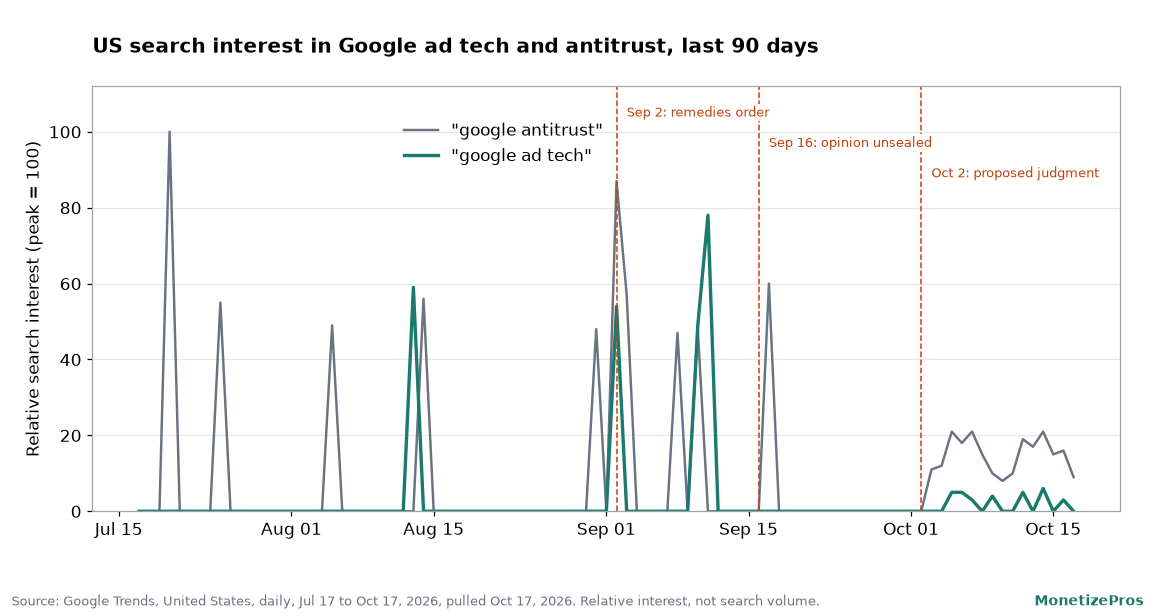
Mostly when the court acts. In a Google Trends check of United States daily interest over the last 90 days, pulled on October 17, 2026, the phrase “google ad tech” was close to zero most days and spiked around the decision, with its highest day on September 11 and another spike on September 2, the day of the order. “Google antitrust” also jumped on September 2. Interest has stayed low since the October 2 filing. These are relative signals, not search volumes, but they fit the pattern you would expect: attention follows court dates, while the operational work happens quietly between them.
A Publisher Checklist While the Final Judgment Is Pending
- Map your stack and your contracts. Write down what you actually use: AdSense, AdX through Ad Manager, a managed partner, Prebid.js, Prebid Server, or a mix. Add renewal dates for every agreement. Before you sign a long renewal, ask how its terms would change once AdX and DFP are offered as separate contracts.
- Start a baseline now. Record AdX share of programmatic revenue, Prebid bidder win rates, eCPM by demand source, timeout rates, and page latency, every week. When the integrations go live, you will need a clean before and after.
- Audit your Prebid setup. Check your Prebid version, which bidders run client side versus server side, and how many bidders actually earn. If you are deciding between setups, compare the trade offs in header bidding versus waterfall before you add complexity.
- Prepare your data request. List the fields you would want in an export: bid level prices, rejection reasons, deal types, and timestamps. Whether the DOJ or Google wording wins, knowing what you need will save weeks.
- Plan floor tests, do not run them yet. Draft the buyer level floor experiments you would try once unified pricing rules are deprecated, with clear stop rules for fill and viewability.
- Ask your partners four questions. Will you support AdX through Prebid when it is available? Will you pass bid level data to us? How will your fees change if AdX no longer requires DFP? What is your timeline if the judgment is stayed on appeal?
- Do not rip and replace. The deadlines run in months, an appeal is likely, and PPC Land cites a PubMatic engineering estimate of roughly a year to 15 months for the interoperability work. Q4 is not the time to change ad servers.
What This Means for Your 2027 Revenue Plan
The honest answer is that the remedies create options, not guaranteed revenue. If AdX demand can compete inside Prebid on materially identical terms, and Google no longer gets an informational advantage from the auction sequence, the price discovery on your inventory should be fairer. Whether that means higher yield for your site depends on your traffic, your demand partners, and how well you test. Use the next two quarters to get your measurement ready, review which SSPs actually earn for you with the help of the MonetizePros ranking of the best SSPs for publishers, and be ready to move when the integrations ship.
Quick Answers
Is Google being forced to sell AdX?
No. The court rejected divestiture on September 2, 2026 and ordered behavioral remedies instead.
When do the Google ad tech remedies take effect?
Sixty days after Judge Brinkema signs the final judgment. As of October 17, 2026, no signed final judgment had been reported, and any stay on appeal would pause the clock.
Does the ruling affect AdSense?
Not directly. The proposed judgment covers Google Ad Manager and Google Ads, not AdSense, AdMob, or DV360.
Will my CPMs go up?
No one can promise that. The remedies change auction access and data rights. Any revenue effect will show up in your own before and after data, which is why the baseline step matters.
Sources
External links are kept short on purpose. The claims above are drawn from these named sources, checked on October 17, 2026.
- U.S. Department of Justice, Department of Justice Again Wins Substantial Relief Against Google, September 16, 2026. Read the DOJ release
- U.S. District Court, E.D. Va., Order, Document 1857, September 2, 2026. Read the court order
- AdExchanger, Google And The DOJ Filed Their Proposed Final Judgments In The Ad Tech Case, October 5, 2026. Read the AdExchanger analysis
- PPC Land, DOJ seeks 6 months, Google 12, to open its ad exchange to rivals, October 6, 2026. Read the PPC Land breakdown
- AdExchanger, Prebid’s Proposed Auction Overhaul Would Do What The Court Wouldn’t, October 14, 2026. Read the Prebid proposal coverage