

Every publisher who clears 25,000 sessions a month eventually asks the same question: Mediavine or Raptive? Both promise premium RPMs, hands-on support, and an exit from AdSense’s bargain-bin rates. Only one is right for your site, though, and the answer depends on more than whatever number is sitting on someone else’s dashboard.
This comparison covers traffic requirements, RPM data from early 2026, payment terms, and niche performance, so you can decide with real numbers instead of a gut feeling.
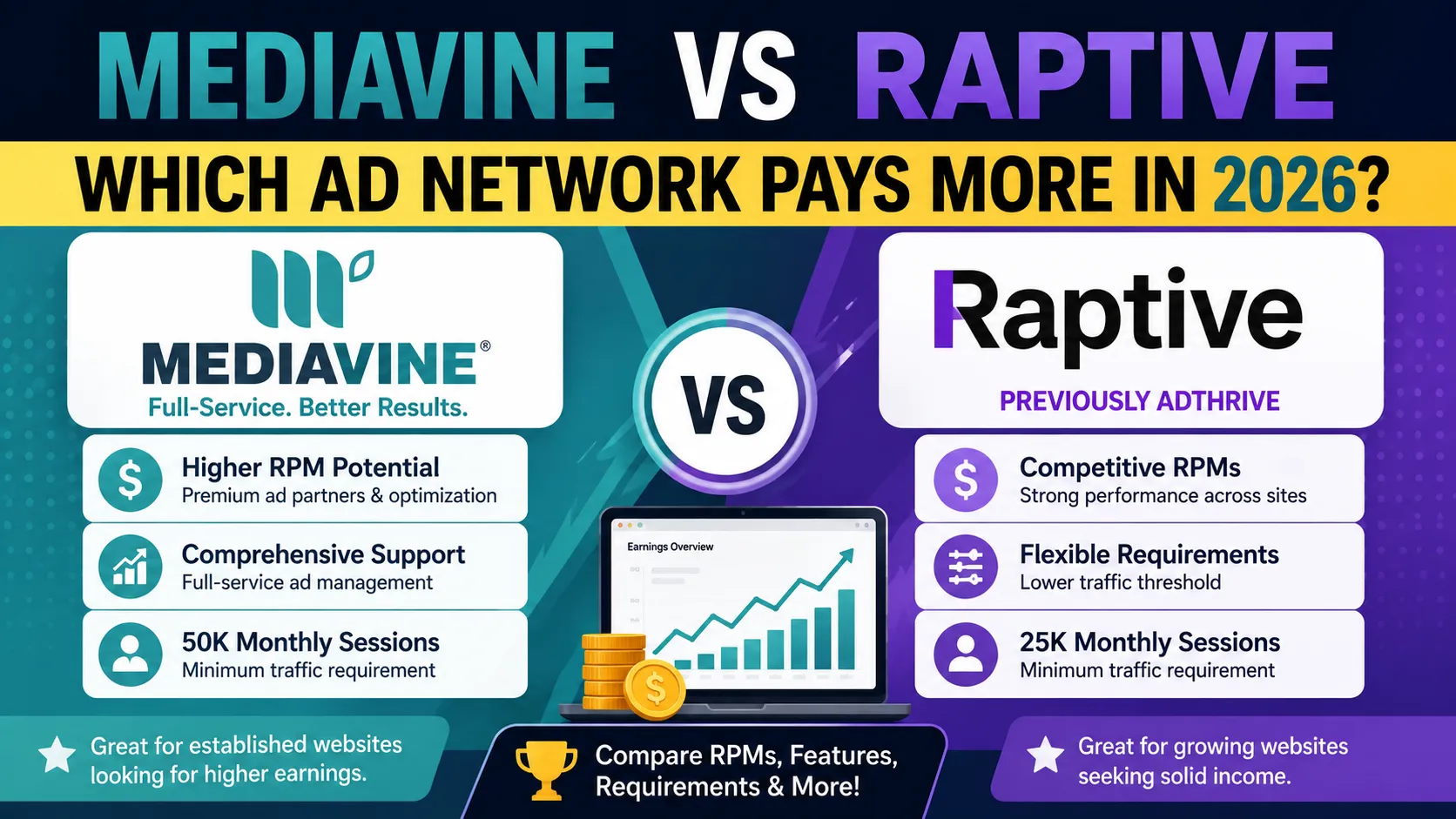
What Are Mediavine and Raptive, Exactly?
Mediavine has managed publisher ad inventory since 2004. Its reputation rests on a clean, transparent dashboard and a support team willing to walk you through settings changes yourself. For 2026, the network accepts sites with either $5,000 or more in annual ad revenue or at least 50,000 monthly sessions.
Raptive, formerly AdThrive, takes the opposite approach. Even a small change, like ad density, has to go through Raptive’s support team by email. That’s on purpose. Raptive wants to run the optimization for you rather than hand you the controls, and its account managers stay involved long after onboarding. The bigger 2026 shift: Raptive dropped its entry point from 100,000 pageviews down to 25,000, opening premium monetization to a lot of sites that couldn’t qualify a year ago.
Which Network Requires Less Traffic to Join?
Raptive wins this one outright now. Here’s the current side-by-side:
| Requirement | Mediavine | Raptive |
| Minimum traffic | 50,000 sessions/month (or $5,000/year in ad revenue) | 25,000 pageviews/month |
| Starter tier available | Yes — Mediavine Journey, from 1,000 sessions | No |
| AdSense standing required | Yes | Yes |
| Content preference | No strict length rule | Favors long-form posts, often 1,000+ words |
| Traffic geography | No hard rule, though US traffic lifts RPMs | At least half of monthly traffic from tier-1 countries |
Sitting at 30,000 pageviews and getting rejected everywhere? Raptive’s lower bar, plus Mediavine’s Journey tier, means you probably qualify for something premium right now. Sites below either threshold should look at a broader ad network comparison for low-traffic sites before applying anywhere.
Does Mediavine or Raptive Pay More in 2026?
Here’s the part everyone actually wants answered, and the honest version is: it depends on your niche, your traffic mix, and which quarter you’re measuring.
Publisher-reported numbers from early 2026 put both networks in a similar band. Mediavine sites commonly report RPMs of $15 to $40, with some crossing $50 during Q4. Raptive publishers land in a comparable range, and several sites that switched from Mediavine reported averages climbing from around $35 to $47 or higher, with $50-plus becoming routine by the holiday quarter. One detailed publisher log tracked a January 2026 average just over $34, a February average near $44 — then a roughly 5% year-over-year dip by April, a reminder that momentum doesn’t run in one direction forever.
Take switch-story numbers with some skepticism. Q4 inflates everyone’s RPM because of holiday ad spend, so a comparison built on Q4 data flatters whichever network the publisher happened to move to. A fairer test is your own site’s trailing twelve months on each platform, which is exactly the data you don’t have until you’ve already made the jump.
Niche still moves the number more than brand loyalty does. Mediavine tends to edge ahead for lifestyle and recipe content. Raptive shows more strength in parenting, food, and home sites.
How Do Revenue Share and Payment Terms Compare?
Both platforms start publishers at a 75% revenue share. Mediavine has more room to grow that number over time through tenure-based increases, though the network’s loyalty bonus program is reportedly winding down for anyone who joined after January 2026. Raptive holds firm at its 75% base with no path upward.
Payment speed favors Raptive outright. Raptive pays on Net 45 terms, about twenty days faster than Mediavine’s Net 65 schedule. For a publisher watching cash flow closely, that gap is real money parked in someone else’s account for an extra three weeks, every month, indefinitely.
What Do Publishers Say After Switching?
Switch stories tend to run in one direction: publishers who move from Mediavine to Raptive usually report being glad they did, citing faster payouts and more attentive support as the reasons. One publisher who moved several sites over described fewer total ads running post-switch, alongside higher RPMs than they’d ever hit on Mediavine.
That doesn’t mean Mediavine is losing its base broadly. Plenty of publishers stay for years without testing the alternative, and switching carries real costs: a fresh onboarding period, new ad testing, sometimes a temporary revenue dip while the algorithm relearns your site. People who write switch-story blog posts are, by definition, the ones unhappy enough to leave. Nobody publishes “I Stayed With Mediavine and Nothing Changed,” even though that’s probably the more common outcome.
Is There a Downside to Both Networks?
Yes, and it’s the same one for both. Neither has a real answer for AI search traffic. Raptive’s entire model depends on a browser rendering the page for a human visitor — when an AI agent pulls your content to answer someone’s query instead, no ad loads, and no revenue gets generated. Mediavine’s display model hits the identical wall.
If your traffic mix is already shifting toward AI-driven answers or zero-click search results, RPM comparisons alone won’t tell you much about where your site’s monetization is actually headed. That’s a separate problem from picking a network, but it’s worth watching alongside whatever numbers you’re weighing here.
Which Ad Network Should You Choose?
- Mediavine fits publishers who want the lower Journey entry tier, prefer a highly customizable dashboard, or run lifestyle and recipe content where Mediavine’s demand tends to run deeper.
- Raptive fits publishers under 50,000 sessions but over 25,000 pageviews, anyone prioritizing faster Net 45 payments, or sites in parenting, food, and home niches where Raptive’s advertiser relationships typically run stronger.
- Staying put makes sense if you already have a Mediavine loyalty bonus grandfathered in. Giving that up for an unproven bump on a new network is a real trade, not a free upgrade.
Publishers weighing where to focus content energy next, rather than which network to sign with, might get more mileage out of a look at high-paying ad niches for 2026 — the network matters less than what’s actually sitting on the page.
Frequently Asked Questions
Can I run Mediavine and Raptive on the same site?
No. Both are exclusive display partners. You sign one revenue-share agreement per site and run that network’s script exclusively for programmatic display inventory.
Do I need to reapply if I was rejected before?
Usually, yes. Traffic minimums shift often enough that a rejection from six months ago doesn’t reflect current requirements — Raptive’s drop to 25,000 pageviews alone has made previously-rejected sites newly eligible.
Will switching networks hurt my SEO?
Not directly. Page speed can dip briefly during script migration, so check Core Web Vitals before and after the switch instead of assuming the new script is automatically lighter than the old one.
Is Raptive’s 20% RPM guarantee real?
Raptive says it will cover the gap if a switching publisher doesn’t see a 20% RPM bump in month one. Several publishers report never bothering to file the claim, since their numbers trended upward anyway.
What traffic counts toward the minimum?
Both networks generally count sessions or pageviews sitewide, not just organic search traffic. For Raptive, where that traffic originates matters just as much as the total, given the tier-1 country requirement.