What Should Publishers Look for When Comparing SSPs?
A few things separate an SSP that helps you make more money from one that quietly holds you back.
Demand Quality
The big question is simple: are real advertisers competing for your ad space, or is the SSP just passing along leftover bids that nobody else wanted? More competition usually means higher earnings.
Header Bidding Support
Almost every serious SSP supports header bidding now, but not all of them do it well. A good one runs smoothly. A bad one can slow your site down, and nobody likes waiting for a page to load.
Minimum Traffic Requirements
Some premium SSPs only work with bigger publishers. If your site is still growing, don’t waste time chasing platforms that won’t approve you yet.
Payment Terms
Getting paid matters. Some SSPs pay in 30 days, while others make you wait 60 or even 90. If your website is paying the bills, those extra weeks can feel like forever.
CTV and Video Support
Planning to add video later? Make sure your SSP is ready for it. Some platforms treat video like a VIP, while others barely pay attention to it.
Transparency
You should always know what’s happening behind the scenes. The best SSPs clearly show bids, fees, and reporting, so you know exactly where your money is coming from instead of guessing.
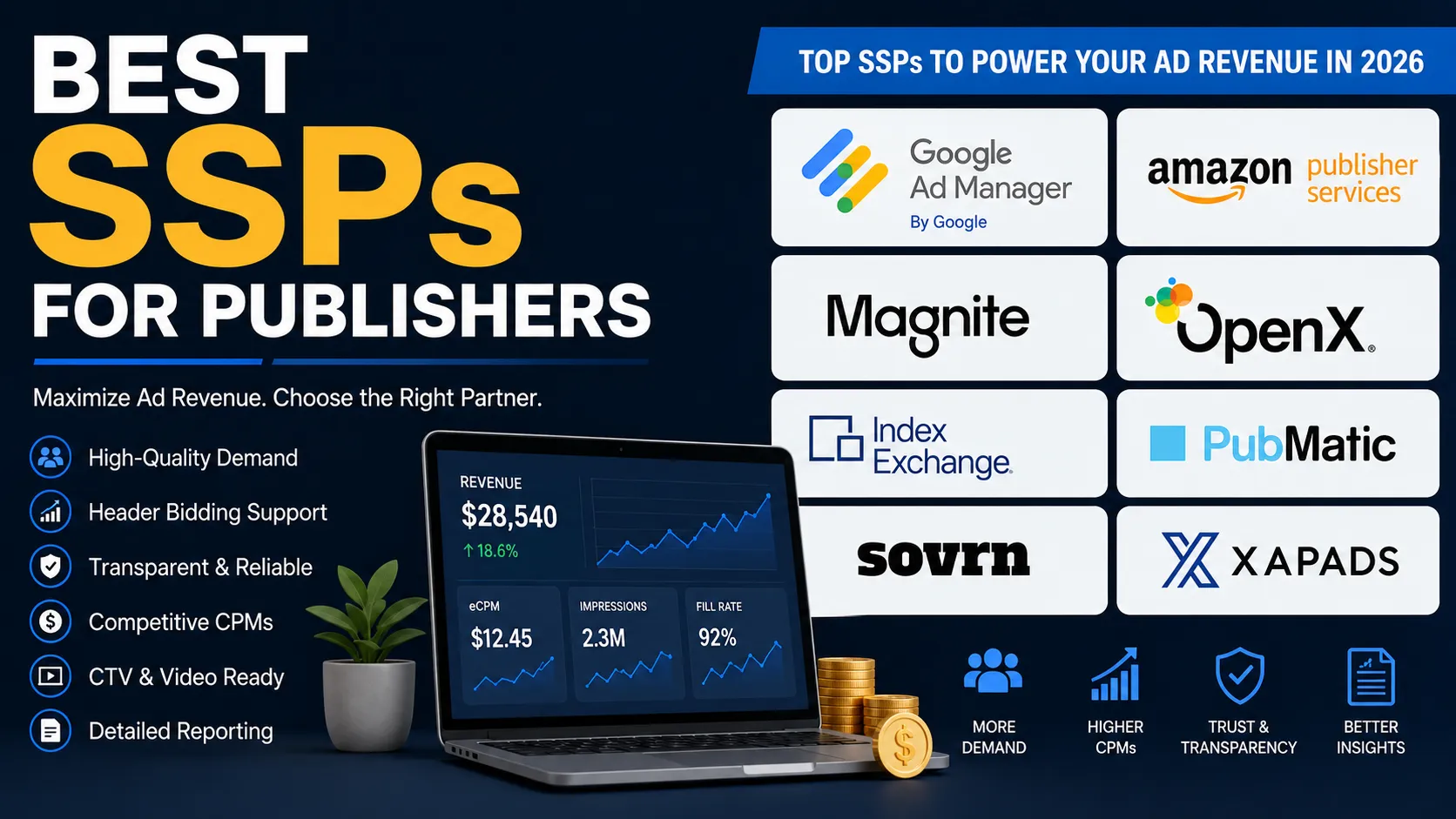
Which Are the Best SSPs for Publishers in 2026?
| SSP | Best For | Notes |
| Google Ad Manager | Publishers already anchored in the Google ecosystem | Functions as both SSP and exchange; deepest reach, but reporting favors Google’s own demand |
| Magnite | CTV, video, and live sports inventory | Largest independent sell-side platform; strong omnichannel coverage |
| PubMatic | Mid-to-large publishers wanting balanced demand across formats | Solid header bidding integration, competitive CTV push |
| OpenX | Publishers with high impression volume (100M+/month) | Strong win rates, but a steep minimum traffic bar and demanding onboarding |
| Amazon Publisher Services | Sites with high purchase intent — reviews, comparison content, shopping | Access to Amazon’s advertiser base; low payout minimums |
| Index Exchange | Publishers prioritizing transparency and clean auction data | Well-regarded reporting, slightly less flashy demand pool |
| Criteo | Commerce-adjacent and performance-driven inventory | Strong for retail and e-commerce content specifically |
No single SSP on this list is the right fit for every publisher. A niche content site running on Prebid or GAM’s server-side auction setup will get more out of two or three well-matched partners than out of bolting on every name in this table.
How Many SSPs Should a Publisher Run at Once?
More isn’t automatically better. Each additional SSP adds a small amount of latency, a new reporting dashboard to reconcile, and one more relationship to manage. Most mid-sized publishers land somewhere between four and eight SSPs in their header bidding wrapper — enough to create real competitive pressure in the auction without turning ad ops into a full-time reconciliation job.
Publishers still leaning on a single network instead of a competitive SSP stack are usually leaving revenue on the table. Worth comparing that setup against the broader AdSense alternatives publishers use once they outgrow a single-demand-source model.
How Does Cookieless Targeting Affect SSP Performance?
Third-party cookie deprecation hasn’t played out the way the industry expected a few years ago, but its effects are already baked into how SSPs perform. Safari and Firefox have blocked third-party cookies by default for years, so a meaningful share of most publishers’ traffic was already untargetable through cookies before Chrome’s plans changed direction. SSPs with strong contextual targeting and first-party data integrations are holding CPMs steadier on that untargetable traffic than platforms still leaning hard on behavioral signals. For a fuller breakdown of what’s changed and what publishers should actually do about it, see this guide to cookieless advertising.
What’s the Biggest Mistake Publishers Make When Choosing an SSP?
Chasing the biggest name on the list instead of the best fit. OpenX has strong win rates, but a site under 100 million monthly impressions can’t even get through the door. Magnite is excellent for CTV and live sports; it does little for a text-heavy niche blog with no video inventory. The mismatch isn’t a failure of the SSP — it’s a publisher optimizing for reputation instead of actual demand overlap with their traffic.
The second mistake is setting up an SSP once and never touching it again. Price floors that made sense a year ago can quietly cap revenue as demand shifts. Bid scaling left untouched for months stops reflecting real auction dynamics. A stack that isn’t reviewed on a regular cadence tends to decay slowly enough that nobody notices until a competitor audit or a revenue dip forces the question.
Frequently Asked Questions
Do I need a developer to set up an SSP?
Sometimes. Platforms like Google Ad Manager and Prebid usually need technical setup, while others are much easier to get running.
Can small publishers use premium SSPs like OpenX or Magnite?
Usually not directly. Many premium SSPs want huge traffic numbers, so smaller sites often reach that demand through header bidding or managed services.
Is Google Ad Manager an SSP or an ad exchange?
Both. It helps publishers manage ad inventory and also runs auctions through AdX.
Do more SSPs always mean more revenue?
No. Think of it like adding players to a basketball team—you only need enough good ones. Too many SSPs can create extra work without making you more money.
How often should I review my SSP stack?
About twice a year. The ad market changes fast, and an SSP that was amazing last year might not be your best option today.
Getting the Most Out of an SSP Stack
The right SSP mix depends on traffic volume, content vertical, and how much time an ad ops team has to manage multiple partners. Google Ad Manager, Magnite, and PubMatic cover most publishers well as a baseline; Amazon Publisher Services and Criteo are worth adding for commerce-heavy content specifically. Whatever the combination, the real work isn’t picking names off a list — it’s testing them against actual traffic, tracking win rates and CPMs by partner, and cutting the ones that don’t earn their place in the auction.