The Taboola Dianomi deal is done. On November 16, 2026, Taboola said it had completed its acquisition of Dianomi, the finance focused native ad network that places sponsored recommendations on business and money sites. If you run a finance, business or lifestyle site, the Taboola Dianomi combination changes who sells your inventory, which demand reaches it and what kind of contract you may be asked to sign next.

This guide covers what Dianomi brings, what Taboola says publishers gain, the contract detail tied to the earnout and the practical steps worth taking now.
Table of Contents
What Happened With the Taboola Dianomi Deal
Taboola first announced its offer on September 18, 2026. Dianomi was listed on London’s AIM market, and the purchase was structured as a UK scheme of arrangement, with Taboola Europe Limited, a wholly owned Taboola subsidiary, as the buyer. According to Dianomi’s completion notice, the scheme became effective on November 16, 2026, and the acquisition completed that day.
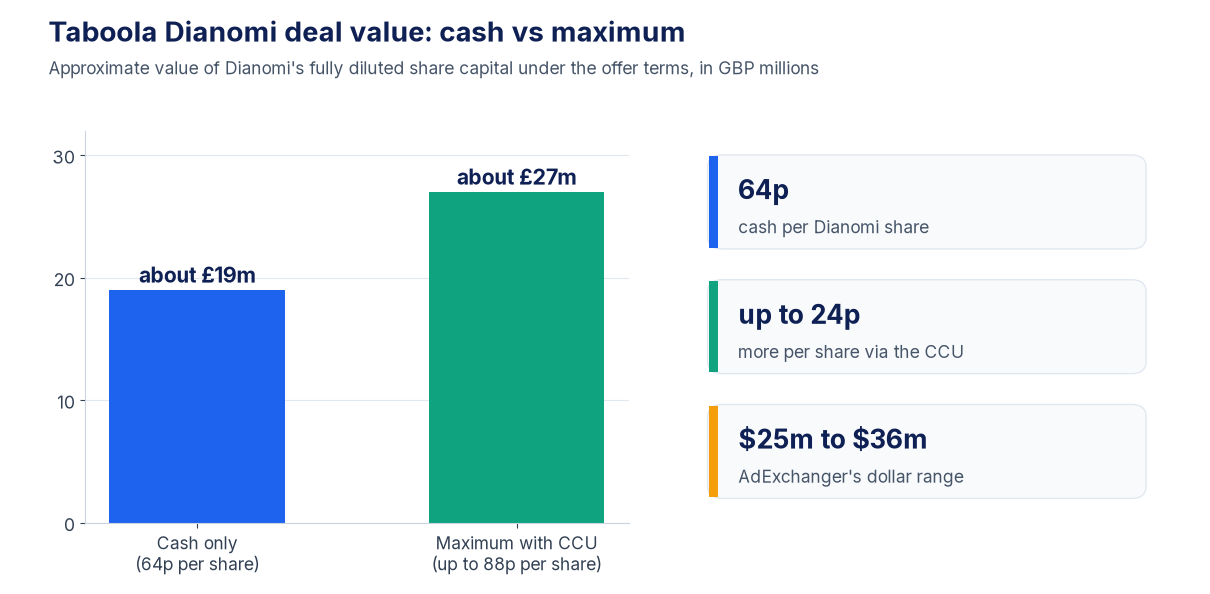
For each Dianomi share, holders get 64 pence in cash and one Contingent Consideration Unit that may pay up to 24 pence more. Trading in Dianomi shares on AIM was suspended on November 16, and cancellation of the listing was expected by 7.00 a.m. London time on November 17, 2026.
The Taboola Dianomi price is modest by ad tech standards. The original offer said the cash alone values Dianomi at approximately £19 million, rising to up to approximately £27 million if the contingent units pay in full. AdExchanger put that at roughly $25 million to $36 million.
For publishers, the Taboola Dianomi headline matters less than the plumbing. Taboola says performance advertisers will be able to reach Dianomi’s finance network through Realize, its performance advertising platform. The company describes Realize as combining its own supply, first party data and AI to drive results for advertisers on major publishers.
What Dianomi Brings to Taboola
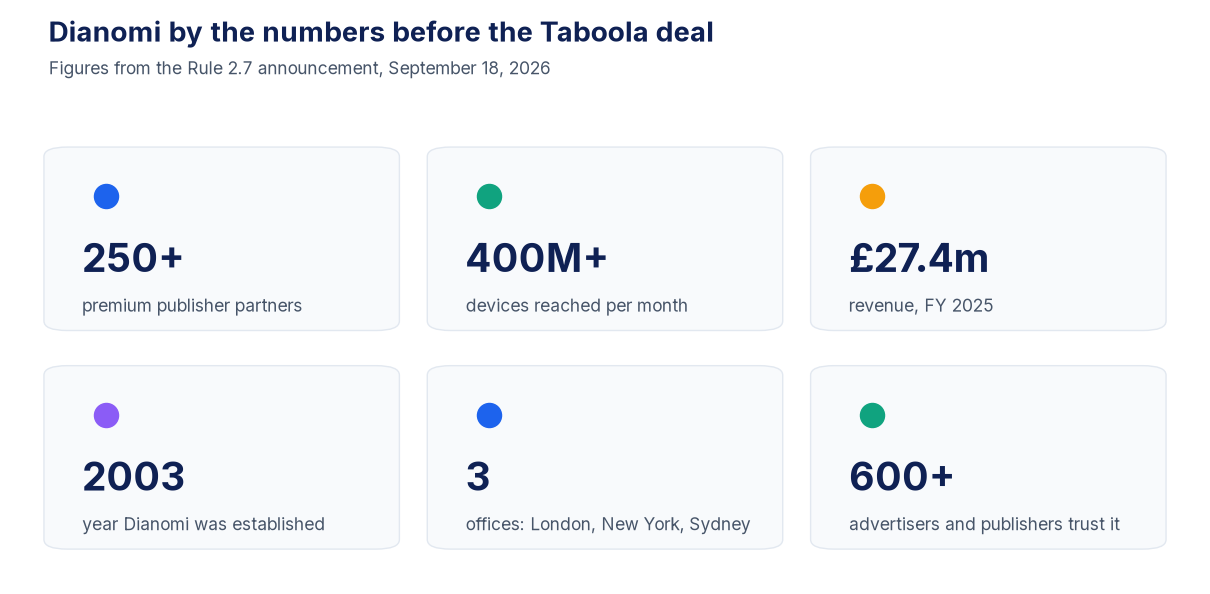
Dianomi is not a general audience network. The Rule 2.7 announcement says it was founded in 2003, serves premium advertisers in business, finance and lifestyle, and works from offices in London, New York and Sydney.
The same filing says Dianomi links blue chip advertisers, among them Charles Schwab, Invesco and Bank of America, to more than 400 million devices a month, using partnerships with over 250 premium publishers, among them Reuters, CNN Business, the Times and WSJ. Its ads are contextually relevant to the page and mirror the style of the page, the classic native format.
The business is small next to its new owner. For the financial year ended December 31, 2025, Dianomi reported revenue of £27.4 million and an operating loss of £0.3 million. Taboola reported revenue of $1.91 billion for the same year, and says Realize reaches over 600 million daily active users across publishers such as NBC News and Yahoo.
That gap explains the logic of the Taboola Dianomi pairing. Taboola gets a specialist finance supply network with blue chip advertiser relationships. Dianomi’s publishers get access to a much larger demand engine, at least in theory.
Taboola CEO Adam Singolda framed it as a two sided win. In the completion announcement, he said: “This is a win for advertisers seeking to connect with leaned in, finance-minded consumers on premium publishers, as well as for publishers that seek to connect with a deeper roster of blue-chip advertisers in the finance vertical.”
The Publisher Contract Detail Behind the Price
The most useful part of the Taboola Dianomi paperwork for publishers is the earnout. The extra 24 pence per share is not tied to Dianomi’s revenue in general. It depends on publisher contracts.
The official Rule 2.7 announcement says payment through the units is subject to “a subset of Dianomi’s publishers incorporating certain provisions of the Taboola Group’s standard terms in their publisher agreements (either through the entry into a new agreement or an amendment of the existing agreement) within the agreed time frame and subject to a minimum threshold, and the net revenue generated by these publishers.”
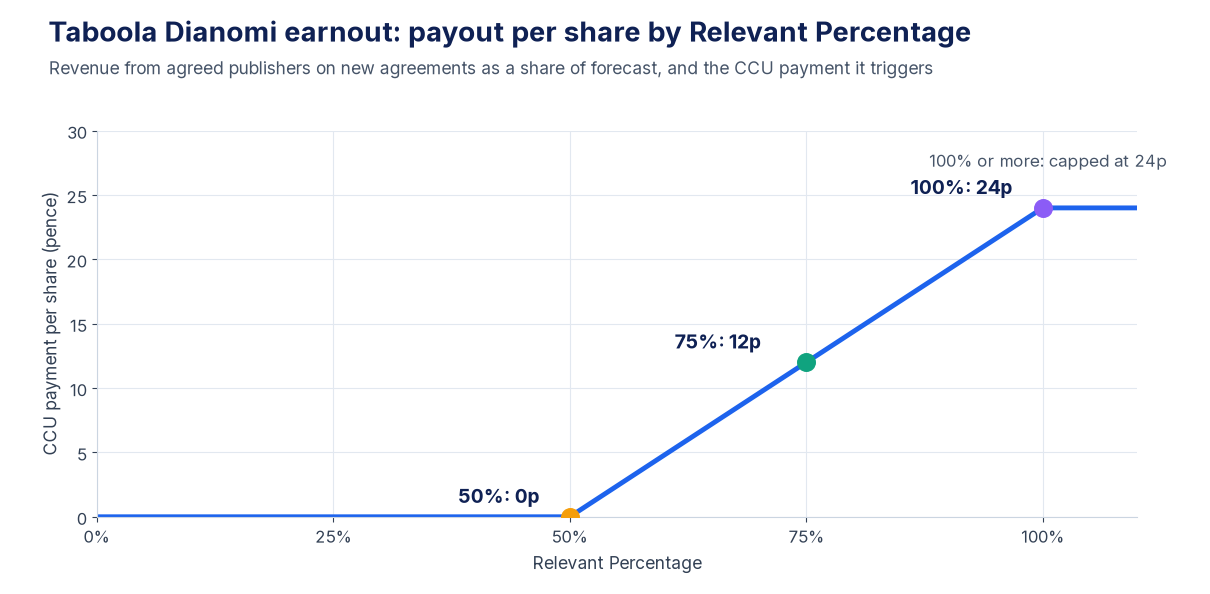
The payout formula is spelled out. Net revenue from the agreed publishers that move to new agreements is compared with a revenue forecast for all agreed publishers. At a Relevant Percentage of 50% or less, the units pay nothing. At 75%, they pay 12 pence. At 100% or more, they pay the full 24 pence, on a straight line in between.
The filing also says that from the effective date, Taboola’s acquiring entity has control over Dianomi’s day to day operations, “including in negotiations with publishers,” and has committed to “commercially reasonable efforts” to move the agreed publishers onto new publisher agreements before the reference period ends.
In plain terms, there is a financial incentive built into the Taboola Dianomi deal to move a group of Dianomi publishers onto contracts that include Taboola’s standard terms. The list of those publishers and the exact terms were not published in the announcement, so if you work with Dianomi, expect a contract conversation and read it closely.
Which Publishers Should Pay Attention
Three groups have a direct stake in the Taboola Dianomi outcome.
- Current Dianomi partners. If Dianomi units run on your pages today, your account now sits inside Taboola, and your agreement may be among those Taboola wants to update.
- Current Taboola partners in finance. Taboola says the combination offers advertisers a larger, trusted network of finance publishers, which could mean more finance demand flowing through Realize to your placements.
- Finance and business sites shopping for native demand. One of the specialist options in finance native is now part of a much larger company, which changes how you compare offers.
Lifestyle publishers with money content, such as personal finance sections or retirement guides, sit in the middle. Dianomi’s own description includes the lifestyle sector, so those pages may also be in scope.
5 Smart Moves for Publishers After Taboola Dianomi
None of these steps require guessing at Taboola’s plans. They are basic hygiene for any publisher whose demand partner just changed owners.
1. Pull your current agreement and note the key terms
Before any new paper arrives, write down what you have today: revenue share, payment terms, notice period, any exclusivity language and where units may appear. You cannot judge a new offer without a clean baseline.
2. Benchmark yield before anything changes
Before the Taboola Dianomi integration moves further, export at least a few months of Dianomi or Taboola revenue, RPM and fill by page type. Taboola lists higher yield for Dianomi’s publishers as one of the benefits it expects. A baseline lets you check whether that shows up on your own pages.
3. Read any new agreement for length, exclusivity and placement rules
The filing confirms that the earnout depends on publishers adopting certain provisions of Taboola’s standard terms but does not list them. When a draft arrives, look closely at contract length, exit rights, exclusivity across your site and any rules about where code must sit on the page.
4. Protect the experience that makes finance inventory valuable
Finance advertisers pay for trusted, brand safe context. If new terms push for more units per page, test the change on a slice of traffic and watch engagement, not just revenue. Our guide to native advertising covers the basics of balancing sponsored units with reader trust.
5. Keep competing demand in the conversation
A bigger buyer can bring more demand, but it can also bring more leverage at the negotiating table. Keep relationships with other native and display partners warm so you can compare offers on real numbers. Our breakdown of what publishers can earn from Taboola and Outbrain is a useful starting point for that comparison.
The Bigger Picture for Native Advertising
The Taboola Dianomi deal fits a pattern that AdExchanger described when the offer was announced: Taboola built its reputation on content recommendation widgets but has been shifting away from them and toward performance advertising through Realize.
In short, Taboola Dianomi adds premium, vertical supply that Realize can sell to performance advertisers. For publishers, that pushes native toward measurable results rather than raw clicks, the same shift we covered in our look at outcome-based advertising.
The practical takeaway is simple. Treat the Taboola Dianomi combination as a reason to review your native setup, not a reason to panic. Know your numbers, read new contracts carefully and keep options open while the integration plays out.
Taboola Dianomi FAQ
When did the Taboola Dianomi deal close?
Taboola announced its offer on September 18, 2026. The scheme of arrangement became effective and the acquisition completed on November 16, 2026.
How much did Taboola pay for Dianomi?
For each Dianomi share, holders get 64 pence in cash and one Contingent Consideration Unit that may pay up to 24 pence more. The cash values Dianomi at approximately £19 million, or up to approximately £27 million if the units pay in full. AdExchanger put that at roughly $25 million to $36 million.
What is Dianomi?
Dianomi, founded in 2003, is an ad network serving premium advertisers in business, finance and lifestyle. It works with over 250 premium publishers, including Reuters, CNN Business, the Times and WSJ, and reaches over 400 million devices per month.
Why does the Taboola Dianomi earnout matter to publishers?
The extra payment depends on a subset of Dianomi’s publishers adopting certain provisions of Taboola’s standard terms in their publisher agreements, plus the net revenue those publishers generate. Dianomi partners should expect a contract conversation.
How does Dianomi fit with Taboola Realize?
Taboola says performance advertisers will be able to reach Dianomi’s finance network through Realize, its performance advertising platform.
What should publishers do now?
Record your current terms, benchmark yield, read any new agreement for length, exclusivity and placement rules, test any change in ad load on a slice of traffic, and keep competing demand partners warm.
Related posts:

The Ultimate Guide to AdSense & Ad Networks

Three Ways To Find Out Just How Awesome (And Valuable) Your Audience Is

How to Make an Awesome, Free Media Kit in Under Two Hours

Should You Sell Ads On Your Website Directly?

CPM Rates for Programmatic Audio Ads & Trends : 2026 Guide