

Your ad revenue lives or dies by the deal type behind it. Pick wrong, and your best inventory gets sold cheap or sits there collecting dust while a weaker bidder sneaks in.
That is why programmatic direct vs open auction matters so much. Programmatic is huge now, and publishers have to choose between locked-in deals and the wild open market where bids fight it out.
This guide shows when each one wins, how they pay differently, and how to mix both without leaving money on the table.
What Is Programmatic Direct?
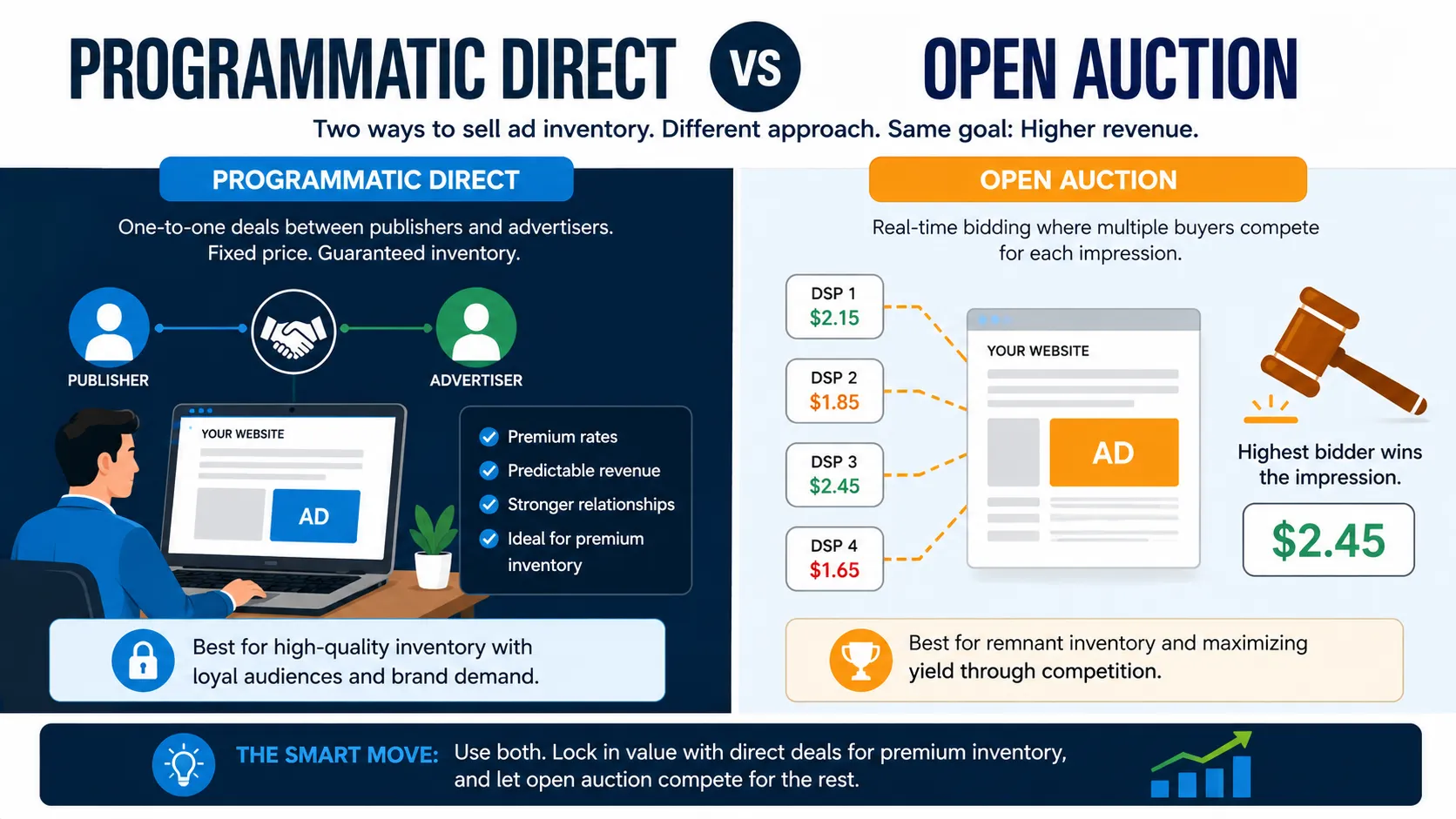
Programmatic direct is a negotiated sale.
A publisher and an advertiser agree on price and (often) volume ahead of time, then the transaction runs through automated software instead of a manual insertion order.
No bidding war, no real-time price discovery. Just a fixed arrangement executed at scale.
It splits into two main flavors:
- Programmatic guaranteed — fixed price, fixed impression volume, locked in for a flight period. The publisher commits the inventory whether or not a better offer shows up later.
- Preferred deals — the advertiser gets first look at a set eCPM before the impression heads to open auction, but nothing is guaranteed. If they pass, the inventory moves on.
Both formats trade flexibility for certainty. Advertisers get private marketplace deals with hand-picked publishers and predictable delivery; publishers lock in premium pricing on their best placements.
What Is Open Auction?
Open auction, also called the open exchange or open marketplace, is real-time bidding at its purest.
Inventory hits the exchange, every connected buyer can bid on it, and the highest bid wins the impression in milliseconds. No relationship, no negotiation, no minimum spend commitment.
That openness is the whole appeal.
A small publisher with 50,000 monthly pageviews has zero leverage to land a guaranteed deal with a Fortune 500 brand, but they can absolutely compete in open auction the moment their site is on an exchange.
It’s why open auction remains the default monetization layer for most mid-size and smaller sites, even ones running a full header bidding setup to boost competition among bidders.
Programmatic Direct vs Open Auction: Where They Actually Differ
| Factor | Programmatic Direct | Open Auction |
| Pricing | Fixed, pre-negotiated | Dynamic, set by real-time demand |
| Inventory guarantee | Yes (guaranteed deals) | None |
| Buyer pool | One advertiser per deal | Unlimited, any connected buyer |
| Setup effort | Requires outreach and negotiation | Plug into an exchange, largely automated |
| Best suited for | Premium placements, large audiences | Remnant and mid-tier inventory, smaller sites |
| Revenue predictability | High | Low, fluctuates with demand |
| Ad format flexibility | Custom formats often negotiable | Standard exchange formats |
| Fraud/brand safety risk | Lower — direct relationship | Higher — anonymous bidders |
Neither wins outright. A site running only direct deals leaves unsold inventory on the table the moment demand dips.
A site running only open auction caps its own ceiling, because auction dynamics push average CPMs down even on placements that could command a premium.
Why Does Pricing Work So Differently Between the Two?
In open auction, price is a live negotiation between every bidder connected to the exchange, resolved in the time it takes a page to load.
That’s efficient, but it also means CPMs swing with demand. A slow news week or a soft ad quarter and your RPM drops with it, no matter how good your content is.
Programmatic direct removes that variable. A publisher negotiating a guaranteed deal locks in, say, a $12 CPM for a month regardless of what happens in the broader market.
The trade-off is upside: if demand spikes and open auction CPMs jump to $18, that guaranteed inventory is still selling at $12.
Predictability and ceiling pull in opposite directions, and most yield strategies are really just decisions about how much of each to hold.
Which Inventory Should Go to Direct Deals vs Auction?
Not every impression deserves the same treatment. A rough allocation model most ad ops teams land on eventually:
- Top-of-page and above-the-fold placements on high-traffic pages → programmatic direct first. These get the most eyeballs and justify a negotiated premium.
- Seasonal or contextually relevant inventory (holiday shopping pages, event coverage) → short-term guaranteed deals timed to the spike.
- Remnant inventory, lower-traffic pages, non-premium placements → open auction. Let the market decide, since there’s rarely a buyer willing to negotiate a fixed rate for this tier.
- Anything unsold after a preferred deal window closes → falls through to open auction automatically, so nothing goes empty.
This is also where header bidding earns its keep.
It lets direct deals and multiple exchange partners compete for the same impression simultaneously, rather than stacking them in a rigid waterfall where the auction only sees what direct deals didn’t want.
Does Open Auction Still Make Sense for Smaller Publishers?
Yes, and for most smaller sites it’s still the primary revenue engine. Direct deals depend on leverage: traffic volume, a defined audience, a sales team capable of running outreach.
None of that is something a site under a few hundred thousand monthly visits usually has. Open auction asks for none of that. Connect to an exchange, and demand shows up without a single phone call.
The smarter move for growing publishers isn’t abandoning open auction, it’s layering preferred deals on top of it once traffic and niche authority justify the conversation.
A site that’s built a name in a specific vertical, whether that’s finance, health, or another niche with strong advertiser interest, can often land its first preferred deal well before it has the scale for a full guaranteed contract.
How Does This Play Into Broader Programmatic Strategy?
Programmatic direct and open auction aren’t competing strategies, they’re two rungs on the same ladder alongside private marketplace deals and preferred access.
Private marketplace spending actually surpassed open exchange spend industry-wide back in 2020, a sign of just how far publishers have shifted toward negotiated, controlled selling wherever they have the leverage to do it.
Staying current on programmatic advertising trends matters here, since where advertiser demand concentrates shifts year to year, and that shift changes which deal type performs best on which placements.
The publishers seeing the strongest yield aren’t the ones picking a side.
They’re the ones auditing their display ad CPM rates by placement, then routing each one to whichever channel — direct or auction — actually pays more for it.
FAQ
Is programmatic direct more profitable than open auction?
Usually for premium ad spots. A pre-negotiated deal often pays more, but only if advertisers actually want that inventory.
Can a site use both programmatic direct and open auction at the same time?
Absolutely. In fact, that’s how many successful publishers make the most money by letting different buyers compete.
What’s the difference between programmatic direct and programmatic guaranteed?
Programmatic direct is the big category. Programmatic guaranteed locks in the price and inventory, while preferred deals don’t guarantee either.
Do I need a sales team to run programmatic direct deals?
Not always. You can negotiate deals yourself or let an SSP or monetisation partner handle the hard part.
How much of my inventory should go to open auction vs direct?
It depends. Smaller sites usually rely on open auction, while bigger publishers often reserve their best ad space for direct deals.
The Bottom Line
Programmatic direct and open auction solve different problems. Direct deals buy certainty and premium pricing on inventory advertisers actually want to commit to.
Open auction fills in everything else, no relationship required.
The sites getting the most out of their ad stack aren’t choosing one; they’re routing each placement to whichever channel pays best for it, and using header bidding to let both compete instead of stacking them in sequence.
If you’re not sure where your own inventory splits, start by looking at which placements consistently sell out in auction at strong CPMs. Those are your first candidates for a direct deal conversation.