

Buyers are starting to send software, not people, to book your inventory. Agentic advertising, where AI agents on the buy side and the sell side discover, negotiate, and book media, often with a human approving each deal, moved from conference demos to booked orders this month. If your inventory cannot be read by a machine, those agents are likely to book someone else’s.
The good news: the publishers that win here are not the ones with the biggest engineering teams. They are the ones with clean data, clear packages, and a short list of rules. This guide explains what changed in October 2026, where publishers really stand, and seven practical steps to get agent-ready without betting the business on hype.
What Is Agentic Advertising?
Agentic advertising is the use of autonomous or semi-autonomous AI agents to plan, buy, and optimize media. A buyer agent receives a brief in plain language (budget, dates, markets, frequency cap), turns it into a structured request, and asks seller agents what they can deliver. The seller agent answers with products, prices, and availability pulled from the publisher’s own systems. A person on each side can approve or reject the order before it goes live.
Three pieces of plumbing make this work:
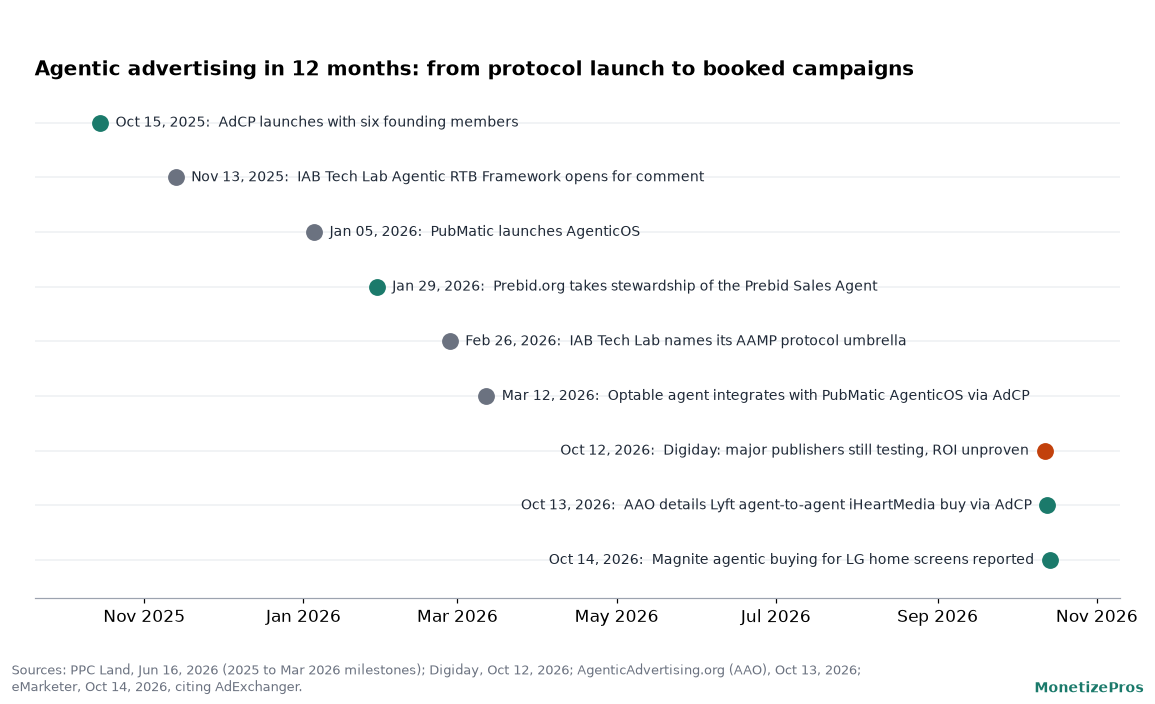
- AdCP, the Ad Context Protocol. An open standard that gives buyer and seller agents a shared vocabulary for discovery, proposals, booking, and delivery reports. It launched on October 15, 2025 with six founding members: Optable, Scope3, Yahoo, PubMatic, Swivel, and Triton Digital, according to PPC Land.
- IAB Tech Lab’s AAMP. IAB Tech Lab named its umbrella of Agentic Advertising Management Protocols in February 2026, covering an agent registry, taxonomy, and execution standards.
- adagents.json. A file you host on your own domain that tells buyer agents which properties you own and which sales agents may sell them. Think of it as a more detailed cousin of ads.txt.
Agentic advertising is not a replacement for programmatic. It sits on top of the systems you already run. In the Lyft buy described below, the order landed in the publisher’s existing ad server, and AgenticAdvertising.org says trackers still fire and ad servers still report as before.
Why Agentic Advertising Became Real in October 2026
For most of 2026, agentic buying meant pilots and small tests. Then three reports landed within three days.
A real campaign was booked agent to agent. AgenticAdvertising.org, the group behind AdCP, described on October 13 how Lyft booked a Citi Bike audio campaign with iHeartMedia through AdCP, live at Advertising Week. The brief went into a chat window: a $5,000 budget, the New York region, a short flight, and a cap of three exposures a day. Minutes later the order was approved and booked in iHeart’s ad server.
Premium video inventory opened to agents. eMarketer reported on October 14, citing AdExchanger, that Magnite is offering agentic media buying for home screen ads on LG smart TVs, with Toyota as the first brand to test it.
Publishers pushed back on the hype. Digiday reported on October 12 that three senior commercial executives it interviewed at Advertising Week New York all described some version of evaluating, testing, or learning, not buying at scale. The Economist’s global head of advertising, Jamie Jouning, said it would be “very hard” to seek investment for something whose value is still unknown. The New York Times’ Joy Robins said it is “not really something we’re doing,” adding that the paper is always evaluating.
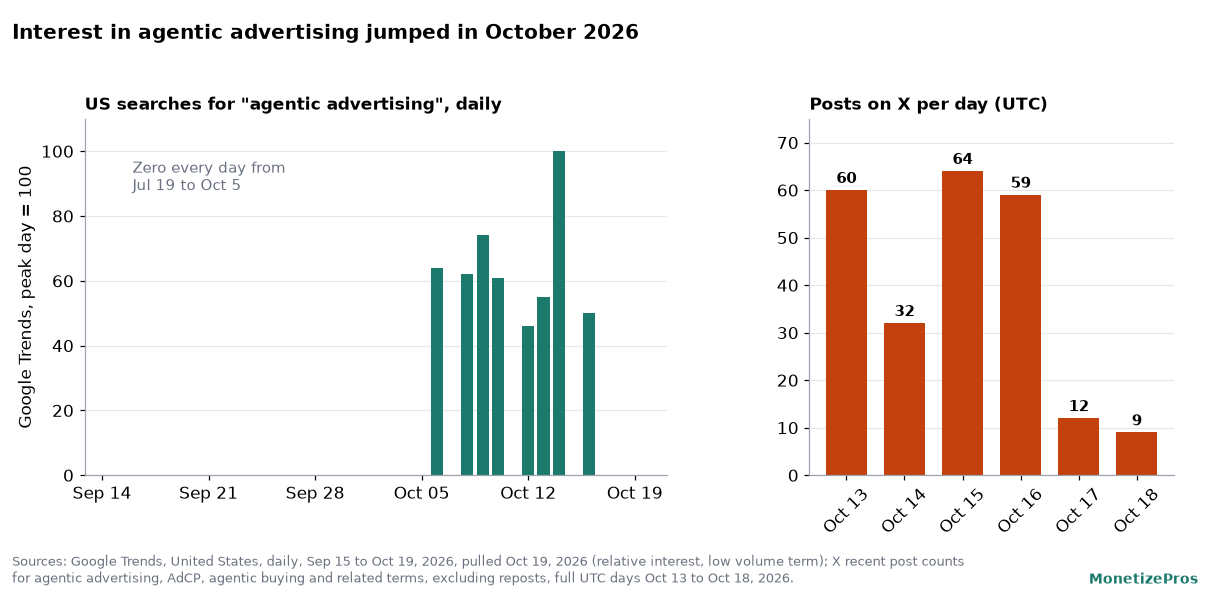
Search and social data show the same jump. In Google Trends, US searches for “agentic advertising” were at zero every day from July 19 to October 5, 2026, then registered on eight of the eleven days from October 6 to 16, peaking on October 14. On X, posts about agentic advertising, AdCP, and agentic buying totaled 257 in the seven days to October 19, with 59 to 64 posts a day on October 13, 15, and 16. Both are low volume signals, but the timing lines up with the news.
Where Publishers Stand on Agentic Advertising
The clearest numbers come from a Digiday survey of 180 agencies, publishers, brands, and retailers, published in May 2026 and sponsored by Optable (an AdCP founding member, so read it with that in mind).
- 42% of publishers were not prioritizing agentic advertising or had no long term plans for it.
- 29% were in early planning or piloting.
- 29% were actively deploying it.
- By contrast, 89% of advertisers said they were using or building agentic AI, and 66% planned to increase spend in agent-enabled buying environments over the next 12 to 18 months.
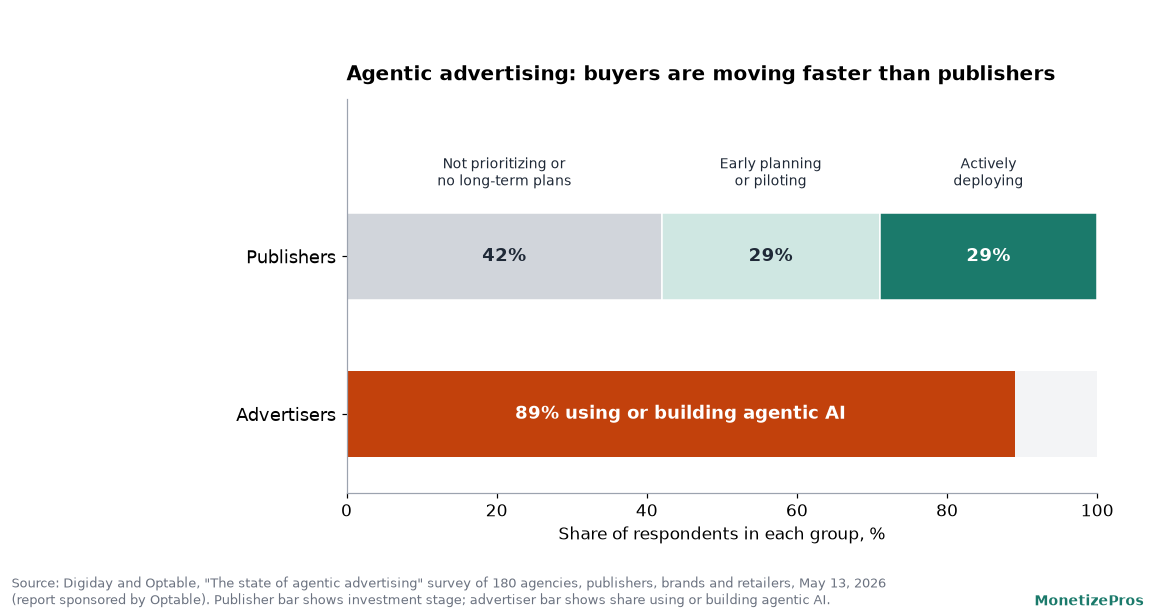
That gap is the opportunity and the risk. Buyers are building the tools. If they cannot find or read your inventory, their agents will route budget to sellers they can read.
What publishers want, and what stops them
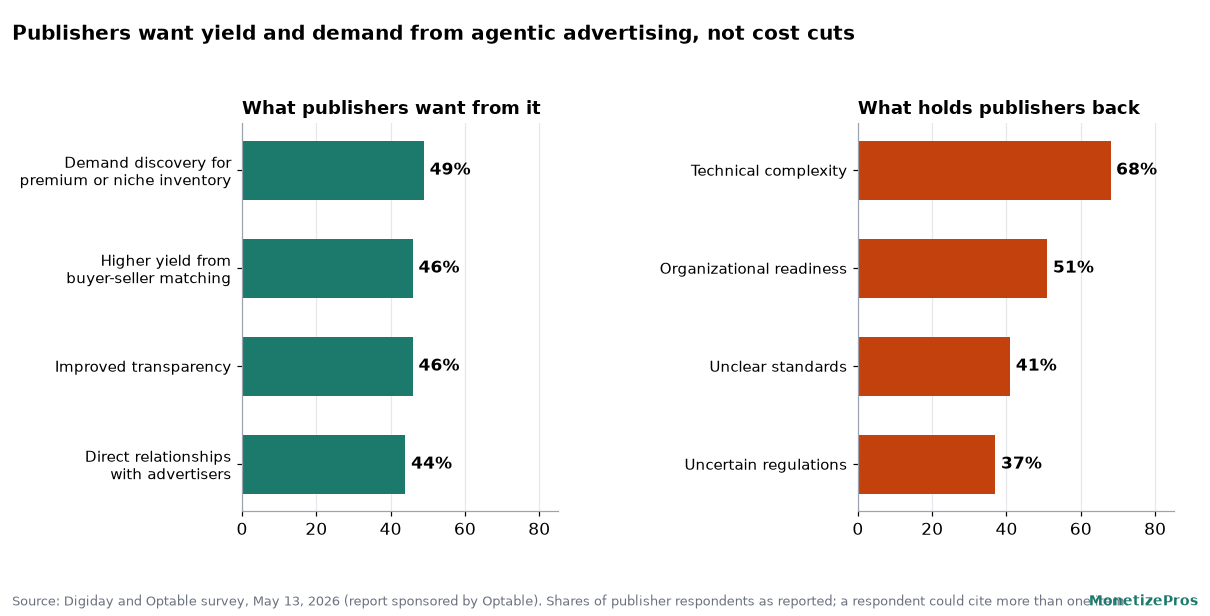
Publishers in the same survey were not chasing cost cuts. The top goals were demand discovery for premium or niche inventory (49%), higher yield from better buyer-seller matching (46%), improved transparency (46%), and direct relationships with advertisers (44%). The barriers were mostly practical: technical complexity (68%), organizational readiness (51%), unclear standards (41%), and uncertain regulations (37%).
One number stands out for smaller sites. Only 5% of respondents said they would focus on building or enhancing their own AI agents in the coming year, while 49% said they were improving first-party data and signals so external agents can discover them. In other words, most of the work is making your inventory legible, not writing software.
Will Agents Push Your CPMs Down?
This is the right worry. An agent told to hit a cost target will look for the cheapest impression that meets the brief. If your inventory looks like everyone else’s, the agent has no reason to pay more for it.
The defense is the same one that works in programmatic today: differentiation a machine can see. Optable’s readiness framework, summarized by PPC Land, says agent-ready publishers offer differentiated pricing and deal types rather than one blanket floor, with floors defined by segment and deal type. Buyer agents also lean on page metadata to classify content, so thin or inaccurate metadata can lead to over-blocking or under-valuation. If you have not reviewed your floors recently, our guide on how to set price floors for programmatic ads is a good starting point.
You also keep control of approvals. According to AgenticAdvertising.org, each side decides how much of a transaction to automate. Its example is a seller that pre-approves any order within 10% of a buyer’s usual weekly spend and reviews everything else by hand.
Seven Steps to Get Agent-Ready
None of these steps requires you to build an AI agent. Most take days, not months, and every one of them also helps your programmatic and direct sales today.
1. Audit your first-party data and logged-in rate
Agents can only surface what your data can describe. Optable’s framework treats an authentication rate below 10%, combined with siloed data and no consent for activation, as “not ready.” Measure your logged-in share, list the audience segments you can actually prove, and check that your consent records allow you to use them. Our guide to monetizing first-party data walks through the basics.
2. Fix your content metadata
Ask the diagnostic question from the Optable framework: could a system reading only your metadata describe what each page is about? Map sections to the current IAB Content Taxonomy, clean up titles and categories, and make sure brand suitability signals are accurate.
3. Package inventory into clear products
A buyer agent needs three fast answers: what is available, who it reaches, and what it costs. Turn your inventory into a handful of named packages (for example, homepage takeover, finance section display, newsletter sponsorship) with audience descriptions and prices by package, not one site-wide floor.
4. Publish an adagents.json file
The AdCP specification says publishers host the file at /.well-known/adagents.json on their domain, as valid JSON that returns HTTP 200. It lists your properties and your authorized sales agents, and it can scope each agent by placement, country, time window, and relationship type (direct, delegated, or ad network), details that ads.txt cannot express. If you work with a managed ad network, ask whether it already covers you: the specification cites Mediavine as one of the managed networks using a central file that names each publisher’s domain.
5. Ask your SSP and ad network what they support
You do not need to connect to agents yourself. Ask your partners three questions: Do you support AdCP or IAB Tech Lab’s agentic frameworks? Can buyer agents discover my packages through you? How will agentic revenue show up in my reports? PubMatic launched its AgenticOS in January 2026, and Prebid.org took stewardship of the open source Prebid Sales Agent the same month, so these are fair questions to ask.
6. Write your approval rules before the first order arrives
Decide in advance which orders can be auto-approved (budget ceiling, approved advertiser categories, placements) and which always need a person. Regulated categories deserve manual review by default. Write the rules down and share them with whoever manages your ad operations.
7. Pilot small and track agentic revenue separately
Pick one property, one audience, or one deal type, keep a clean control group, and tag agent-sourced revenue as its own line in reporting. Optable’s 90 day plan follows the same pattern: assess and organize in days 1 to 30, run a limited pilot in days 31 to 60, and build a repeatable agentic sales strategy in days 61 to 90, with agent-sourced revenue tracked separately.
Agentic Advertising FAQ
Is agentic advertising the same as programmatic advertising?
No. Programmatic automates the auction for individual impressions. Agentic advertising automates the conversation around a deal: discovery, proposals, negotiation, and booking. Orders still run through existing ad servers. For a refresher on how automated buying works today, see programmatic buying explained.
Do small publishers need to do anything now?
Yes, but cheaply. Clean metadata, clear packages, and an up to date ads.txt help today. Adding adagents.json and asking your partners about agent support costs very little. There is no need to buy an agent platform until your partners show real agent-sourced demand.
How much money is flowing through agents today?
Not much that is public. The Lyft campaign was deliberately small at $5,000, and the three publisher executives Digiday interviewed in October described testing or evaluating rather than buying at scale. Treat agentic advertising as an option to prepare for, not a revenue line to forecast yet.
The Bottom Line
Agentic advertising will reward publishers whose inventory is easy to understand, price, and trust. You do not need to bet on any one protocol to get there. Clean your data, describe your content, package your inventory, publish your authorizations, and set your rules. If agents scale, you are ready. If they stall, you still end up with a sharper sales operation.
Sources
We keep outbound links to a minimum. The facts above come from these named sources, checked on October 19, 2026.
- Digiday, For some publishers, agentic advertising is still a question of ROI, October 12, 2026. Read the Digiday report
- Digiday and Optable, The state of agentic advertising, May 13, 2026 (sponsored by Optable). View the survey report
- AgenticAdvertising.org, What Marketers Want to Know About Agentic Buying, October 13, 2026. Read the Lyft case
- PPC Land, Most publishers aren’t ready for agentic advertising, Optable’s test reveals, June 16, 2026. Read the PPC Land analysis
- Ad Context Protocol, adagents.json Tech Spec (version 3.1.2). View the specification
- eMarketer, Magnite opens agentic media buying for CTV home screen ads, October 14, 2026 (citing AdExchanger).