

Odysee spent years selling itself as the platform where creators keep control, no demonetization, no algorithm roulette, no arbitrary strikes.
Then in mid-2026 it ripped out its own payment plumbing and rebuilt it from scratch. If you’re trying to figure out Odysee monetization right now, you’re evaluating a moving target, not a settled system.
This guide breaks down how creators earn on Odysee today, what just changed, and whether it’s worth your time next to YouTube or a straightforward ad network alternative.
What Is Odysee and How Does Its Monetization Work?
Odysee is a video platform built on the LBRY protocol, launched in 2020 by Julian Chandra as a friendlier front end for a blockchain-based content network.
The pitch: publish without a centralized gatekeeper, and let creators get paid through crypto rather than a single company’s ad-sales team.
That changed hands in June 2024. LBRY Inc. lost its SEC lawsuit, its parent company shut down, and Forward Research acquired Odysee to keep the platform running.
The interface still looks and feels like YouTube — upload flow, channel pages, subscribe button — but the money underneath works differently.
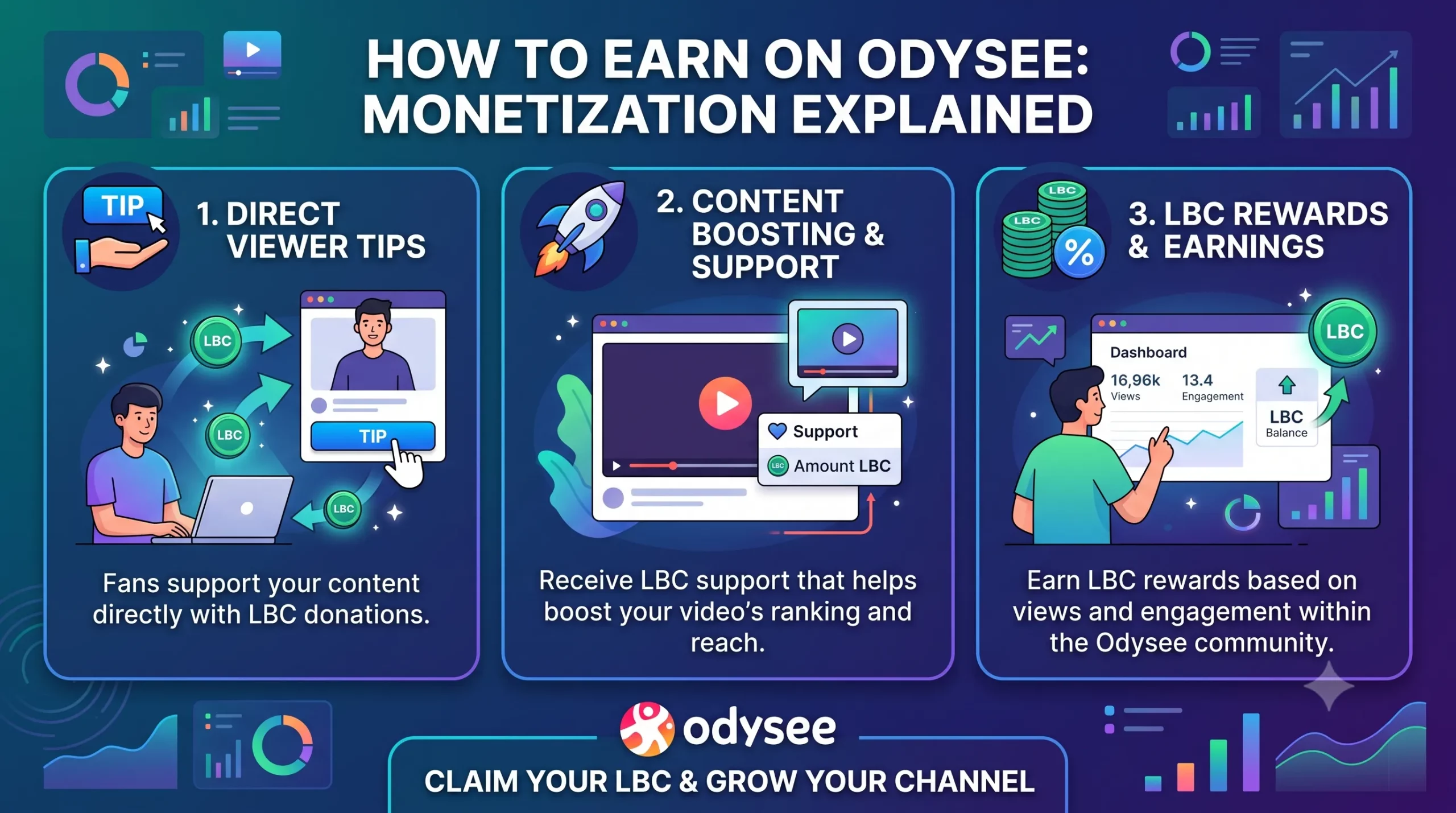
Historically, monetization ran through three channels:
- Rewards — LBC (LBRY Credits) paid out for validated views and watch time
- Tips — viewers sending LBC directly to a creator’s Tip Jar
- Paid content and memberships — gated videos or subscriber-only perks, plus a Stripe option for creators who wanted to get paid in regular currency
Two of those three just got rebuilt.
What Changed With Odysee’s 2026 Payment Overhaul?
In mid-2026, Odysee retired Stripe-based monetization entirely. No new Stripe creator accounts, and existing Stripe tipping, memberships, and paid-content purchases were shut down.
Premium memberships were canceled outright. LBC tipping is also being phased out, with a deprecation date set for July 10.
In their place, Odysee rolled out a new decentralized payment system built to replace both — the company’s stated goal is removing the need for a payment processor middleman altogether.
Badges creators already earned through past support stay on their profile, but the mechanics of turning viewer support into a payout have moved to this new rail.
Practically, this means anyone researching how to make money on Odysee right now needs to check the platform’s current payment documentation before building a strategy around a specific feature.
A YouTube monetization plan barely changes year to year. An Odysee one might not survive the quarter.
Why go through the trouble of ripping out working (if imperfect) payment rails? Odysee’s own framing is that both Stripe and LBC tipping still routed value through intermediaries — a card processor on one side, a single token on the other.
The new system is pitched as removing that dependency altogether, letting value move between viewer and creator without either checkpoint.
Whether that holds up under real transaction volume is a separate question from whether it sounds good in an announcement post.
For a creator, the near-term effect is simple: don’t build a monetization plan around a feature the platform is actively phasing out.
Check what’s currently live before you invest time setting anything up.
Is There a Real Cost or Risk to Relying on Odysee for Income?
Yes, and it’s worth naming plainly. LBC is a cryptocurrency, so its value moves with crypto markets, not with your view count.
A month of strong traffic can still net you less than expected if the token dips before you cash out. Liquidity is another factor — converting LBC requires an exchange that lists it, and not every exchange does.
There’s also a scale problem that no amount of platform loyalty fixes. Odysee’s audience is a fraction of YouTube’s, and ad demand follows audience size.
Publishers used to negotiating CPMs on a site with millions of monthly visitors will find far thinner demand here.
That’s not a reason to skip Odysee — it’s a reason to treat it as a supplemental channel rather than a primary one, at least until the payment rebuild settles down and earnings data catches up to the promise.
How Does Odysee Monetization Compare to YouTube?
YouTube still wins on raw scale and program maturity.
Its Partner Program pays creators a majority share of ad revenue after Google’s cut, and its infrastructure for monetizing YouTube videos has existed, largely unchanged in structure, for well over a decade.
Odysee’s case rests on different ground: no demonetization for edgy or niche content, no subscriber threshold to start earning, and a payout system that doesn’t route through a single corporate ad-sales pipeline.
For a creator who got a video pulled or a channel flagged elsewhere, that’s a real draw — even if the dollar amounts are smaller.
| Factor | YouTube | Odysee |
| Entry requirements | Subscriber/watch-time thresholds for the Partner Program | No threshold; earning can start immediately |
| Payout currency | Direct cash via AdSense | LBC (crypto), moving to a new decentralized system |
| Content moderation risk | Demonetization and strikes are common | Positioned as censorship-resistant |
| Revenue scale | Mature, high-volume ad marketplace | Smaller audience, thinner ad demand |
| Platform stability | Long-standing, predictable program rules | Payment infrastructure actively changing |
Most creators who use Odysee seriously treat it as a second channel, not a replacement — a hedge against getting demonetized elsewhere rather than a primary income source.
That mirrors the same logic covered in our broader look at YouTube alternatives: diversification beats betting everything on one platform’s rules.
What Do You Need to Start Earning on Odysee?
Getting set up takes a handful of concrete steps:
- Create an Odysee channel and upload original video content — synced YouTube re-uploads are allowed but tend to perform worse and carry platform risk.
- Set up a wallet to receive and manage LBC or whatever the current decentralized payment method requires.
- Enable the monetization options available on your channel (Rewards, Tips, Paid Content) based on what’s currently active.
- Grow real, validated views — Odysee’s reward system is built to exclude bot traffic, so inflated view counts won’t convert to earnings.
- To convert LBC to cash, send it to an exchange that supports the token, complete any required identity verification, and withdraw to a bank or payment account.
None of this replaces reading Odysee’s own help documentation before you commit, especially mid-transition. Policies here are unusually current-events-dependent for what looks like a simple video site.
Is Odysee Monetization Worth It for Content Creators?
For a creator already building an audience elsewhere, yes, as a supplement. The barrier to entry is low, the moderation risk is lower than on centralized platforms, and it costs nothing but upload time to test.
As a primary income plan, it’s a harder sell right now: the payment infrastructure is mid-rebuild, LBC’s value floats with crypto markets, and the audience is a fraction of YouTube’s.
If you’re weighing this against other paths to diversify video income, our video monetization resource guide walks through more stable options side by side.
FAQ
Does Odysee still pay creators in LBC?
Partially, and only for now. LBC tipping has a stated deprecation date, and the platform is shifting future payments to a new decentralized system.
Can I still use Stripe to get paid on Odysee?
No. Stripe-based monetization — new accounts and existing tipping, memberships, and purchases — has been fully retired.
Do I need a large following to earn on Odysee?
No. Unlike YouTube’s Partner Program, Odysee doesn’t gate monetization behind subscriber or watch-time minimums.
How do I convert Odysee earnings to real currency?
Move LBC to a crypto exchange that supports the token, complete identity verification if required, sell for a stablecoin or fiat currency, then withdraw to your bank.
Is Odysee a good YouTube replacement?
Not as a full replacement for most creators. It works better as a second, censorship-resistant channel alongside a primary platform.