

You finally hit page one on Google. Feels amazing. Then you ask ChatGPT the same question… and your site is nowhere. A lower-ranked competitor gets the mention instead.
That is not bad luck. Google, ChatGPT, and Perplexity all judge content differently. If you want AI tools to cite your site, you need more than good rankings.
This guide shows you how to get cited by ChatGPT and Perplexity, the mistakes that keep sites invisible, and the simple fixes that can make a real difference.
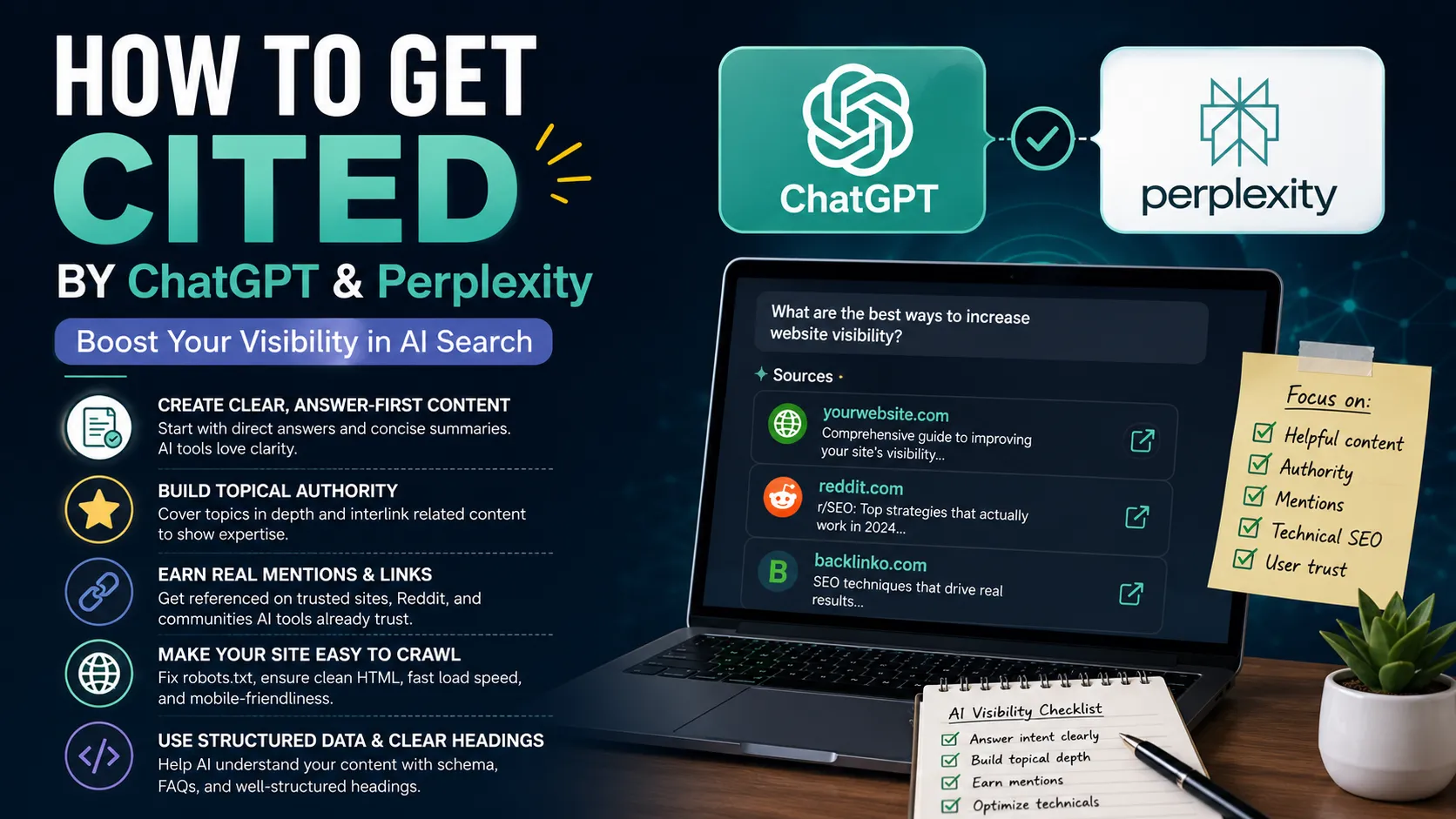
What Makes AI Search Different From Ranking in Google?
Google sends people to your page. ChatGPT and Perplexity try to answer the question themselves, then name (sometimes) where the answer came from. That shift changes what “winning” even means. You’re not competing for a click anymore. You’re competing to be the source an AI model trusts enough to repeat.
Traditional SEO still matters here, but it’s the floor, not the ceiling. A page has to be crawlable, indexed, and fast before an AI engine will even consider it. Past that baseline, the two channels diverge. Google still leans heavily on backlinks and on-page signals. AI engines lean on something closer to consensus: do independent sources, forums, review sites, and your own domain all say roughly the same thing about a topic? If so, the model gains confidence and starts repeating it.
Why Isn’t Your Content Showing Up in ChatGPT or Perplexity?
Before anything else, check whether you’ve accidentally locked the AI crawlers out. This is the single most common reason content that should be citable simply isn’t.
OpenAI and Perplexity each run more than one bot, and confusing them is an easy mistake:
- OAI-SearchBot — powers ChatGPT’s search results and citations. Block this and you’re invisible to ChatGPT search.
- ChatGPT-User — fetches a page when a user pastes a specific URL into ChatGPT. Also worth allowing.
- GPTBot — only affects AI training data. Blocking it doesn’t remove you from ChatGPT search results, so this one’s safe to restrict if you’re worried about training use.
- PerplexityBot — builds the index Perplexity cites from. Block it, and Perplexity has nothing to pull from.
A lot of sites added a blanket “disallow all AI bots” rule to robots.txt sometime in 2023 or 2024, reacting to headlines about scraping, and never revisited it. Pull up your robots.txt today and check it line by line. Five minutes of review can undo months of invisibility.
How Does ChatGPT Actually Pick What to Cite?
ChatGPT often answers from its training data without searching the web at all, especially for well-established topics. When it does search, it tends to favor sources it already trusts: Wikipedia, major publications, and established industry sites with a long track record. That bias toward authority is stronger here than on Perplexity.
Practically, that means a single great article rarely gets you cited on ChatGPT by itself. What helps is a body of work: consistent coverage of a topic, cited by others, referenced across the kind of sites ChatGPT already leans on.
How Does Perplexity Choose Its Sources?
Perplexity works differently. Every answer starts with a live web search, and it always shows its sources, which makes it a more immediate and measurable opportunity than ChatGPT. Since it’s retrieving in real time rather than answering from memory, freshness matters more here. Content cited by AI engines tends to run noticeably newer than what ranks in classic Google results, so a cornerstone page that hasn’t been touched in two years is working against you.
To be retrieved by Perplexity, a page needs to already rank well enough to enter its search pool in the first place. Structured data helps the model parse the page once it’s there, but it isn’t a substitute for the underlying authority that gets you into consideration.
Does Schema Markup Still Matter for AI Citations?
Somewhat, but keep expectations in check. Schema gives AI engines a machine-readable description of what a page is about, who wrote it, and how facts connect to known entities.
It reduces the guesswork a model has to do. That’s genuinely useful.
What it won’t do is manufacture citations out of thin air. One widely cited experiment found that adding schema to pages that were already visible in AI search produced no measurable lift in citations.
Treat structured data as a way to make good content easier to parse correctly, not as a lever you pull to force your way into an answer.
Should You Publish an llms.txt File?
llms.txt is a plain-text file at your site’s root that summarizes what your site covers and points to your most important pages, similar in spirit to robots.txt.
It’s cheap to build, usually a few hours of work, and the honest picture on it is mixed.
Monitoring across hundreds of millions of AI bot visits has found only a tiny fraction go directly to llms.txt, and none of the major search-focused crawlers (OAI-SearchBot, PerplexityBot) have confirmed they use it as a ranking input.
Where it does show real value is in the agentic layer: coding assistants and AI agents that need to quickly understand a site’s structure before acting on it.
If your business has any developer-facing surface, it’s worth the afternoon. If your only goal is more ChatGPT or Perplexity citations, don’t expect it to move that number on its own.
What Actually Moves the Needle: Consensus and Mentions
If there’s one underrated lever here, it’s this: brand mentions across the web now correlate with AI visibility more strongly than backlinks do.
Reddit shows up as the single most-cited domain across major AI engines, and LinkedIn has climbed fast into that same territory.
Neither platform passes traditional link equity the way a backlink would, yet both carry real weight with AI models.
The earned version of this works. The manufactured version doesn’t. Search engines’ spam systems are explicitly built to discount inauthentic mentions, so a batch of fake Reddit threads praising your product will do more harm than good if it’s ever caught.
Genuine participation, real reviews on sites like G2, and press coverage all build the kind of cross-source agreement that gets a brand repeated with confidence.
| Signal | Matters more for ChatGPT | Matters more for Perplexity |
| Established brand authority | Yes | Somewhat |
| Fresh, recently updated content | Somewhat | Yes |
| Live crawlability (robots.txt correctly set) | Yes | Yes |
| Structured data / schema | Minor | Minor |
| Third-party mentions (Reddit, reviews, press) | Yes | Yes |
| Direct question-and-answer page format | Yes | Yes |
How Do You Track Whether You’re Being Cited?
Set a baseline, then check it monthly. Ask each platform your real customer questions, ChatGPT, Perplexity, and Google’s AI Mode, and log whether your brand shows up, how it’s described, and who’s cited instead of you.
Cross-reference those competitor citations against your own keyword-cluster content strategy to see where the actual content gaps are, not just the visibility gaps.
Watch your server logs for crawl activity from OAI-SearchBot and PerplexityBot after you make changes; a jump in bot visits is often the first sign something’s working before any citation shows up.
Frequently Asked Questions
Does ranking #1 on Google guarantee a ChatGPT or Perplexity citation?
No. AI tools play by different rules. A page lower in Google can still get the citation if it gives the clearest answer.
Should I block AI training bots like GPTBot?
That depends on your goals. Blocking GPTBot stops training access, but it does not stop ChatGPT Search from citing your content.
How long does it take to see results after fixing crawler access?
Usually a few days to a few weeks. Think of it like waiting for Google to re-index your site.
Is Reddit worth it for a small publisher?
Yes. Reddit is one of the biggest sources AI tools trust, so being genuinely helpful there can pay off.
Do I need different strategies for ChatGPT and Perplexity?
Mostly, yes. They often cite different websites, but strong content, easy crawling, and real mentions help you on both.
The Bottom Line
Getting cited by ChatGPT and Perplexity starts with the boring stuff: making sure your own robots.txt isn’t locking the door.
From there, the two platforms genuinely want different things, ChatGPT leans on established authority, Perplexity rewards fresh, retrievable content, and both increasingly trust what the rest of the web is already saying about you.
Start by auditing your crawler access this week, then build toward the consensus signals that actually compound over time.
If you’re already running a keyword cluster strategy for your site, this is a natural next layer on top of it, since the same topical-authority work that builds Google rankings also feeds the consensus signals AI engines look for.
And if you’re weighing how much of your roadmap to shift toward this versus classic SEO, our breakdown of GEO versus SEO walks through where each one actually pays off.