

Video ads usually pay more than banners. That is not hype. It is the money talking. Video CPMs often land around $10 to $30, which can be way higher than regular display ads.
But there is a catch: you have to choose between outstream and instream. That choice affects your earnings, your site’s vibe, and whether you can even run video ads at all.
This guide breaks down the difference, where each one works best, and how to figure out which one fits your site. And honestly, if you do not have your own video content, that may already tell you the answer.
What Are In-Stream Video Ads?
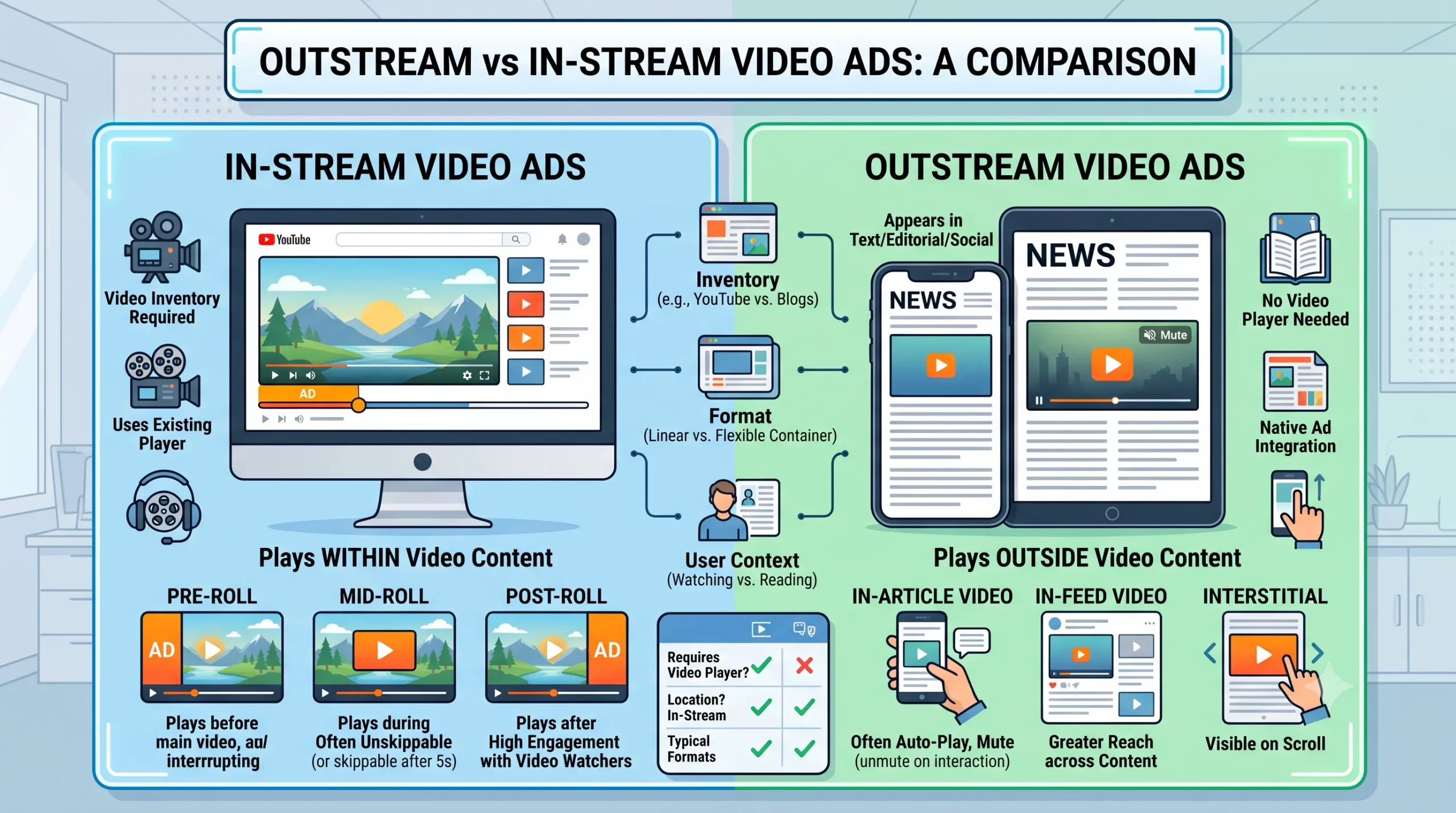
In-stream ads play inside an existing video player, before, during, or after the content someone chose to watch. Pre-roll runs before the video starts. Mid-roll interrupts partway through. P
ost-roll plays once the content ends. All three require the same thing: a video player and actual video content to attach to.
That requirement is also the format’s biggest limitation. No video library, no in-stream inventory. Full stop.
What you get in exchange is attention. A viewer who pressed play is already committed. Sound is on by default, skip options are often delayed or absent, and the user’s eyes are already on the screen.
That’s why in-stream CPMs sit at the high end of the video ad market, and why OTT and CTV inventory in particular commands premium pricing.
Publishers running their own video content, or working with a network like Newor Media, lean on in-stream because the engagement math simply works in their favor.
What Are Outstream Video Ads?
Outstream ads live outside any video player. They drop into article text, sidebars, social feeds, or app inventory, places that never had video before. A short JavaScript snippet is usually all it takes to embed one, no player build required.
Because there’s no player to interrupt, outstream units behave differently.
They autoplay muted as a reader scrolls past, and sound only kicks in if the viewer taps to enable it. Most formats let the reader scroll away or skip entirely.
That’s a lower bar for attention than in-stream, but it’s also why outstream opened up video monetization to publishers who never had a video library to begin with.
Reviews of ad networks like Video Intelligence highlight exactly this: publishers with zero video content of their own can still run in-article outstream units and collect a video-tier CPM.
Outstream vs In-Stream Video Ads: Side-by-Side Comparison
| Factor | In-Stream | Outstream |
| Requires video content | Yes | No |
| Player needed | Yes, custom video player | No, JavaScript snippet |
| Sound | On by default | Muted by default |
| Skippable | Often limited or delayed | Usually skippable/scrollable |
| Typical placement | Pre-roll, mid-roll, post-roll | In-article, in-feed, sidebar |
| CPM range | Higher end, especially CTV | $10-$18 typical, narrower band |
| Completion rate | 60-95%, depending on format | Optimized for viewability, not full watch-through |
| Setup complexity | Higher | Lower |
| Best fit for | Publishers with existing video libraries | Publishers with mostly written content |
Which Format Performs Better?
Neither wins outright, they’re built for different jobs. In-stream ads deliver stronger completion rates because the viewer already opted into video.
CTV in-stream routinely clears 85-95% completion, and even standard online video in-stream lands in the 60-80% range.
That reliability, plus compatibility with premium CTV inventory, is why in-stream tends to command the higher CPM.
Outstream trades some of that intentional attention for reach.
It measures success against viewability standards instead, generally 50% of the ad’s pixels in view for at least two seconds, rather than a full watch-through.
That’s a fundamentally different success metric, and it’s a fair one, since outstream never claimed to hold a captive audience the way a pre-roll does.
If your site is thin on video content but heavy on written articles, outstream is the only realistic entry point into video advertising.
If you’re already producing video and have the traffic to support a proper player setup, in-stream is where the bigger checks live.
How Do CPMs Compare Between the Two Formats?
Numbers here move constantly, and geography does most of the driving. US traffic can post CPMs north of $20, while European traffic frequently lands 15-25% below that.
As a rough industry band, outstream and social video ads tend to settle around $10-$18 CPM, while premium in-stream placements, particularly on YouTube or CTV, push toward the top of the broader $10-$30 video CPM range.
Two other levers matter more than the format label itself.
Running your video inventory through a header bidding auction, the same approach covered in MonetizeMore’s programmatic advertising trends breakdown, forces multiple demand sources to compete for the same impression instead of accepting the first bid.
Separately, passing user identity signals and hitting viewability benchmarks can add a real percentage bump to either format’s CPM, while stale metadata or missing identity does the opposite.
Format matters, but a poorly optimized in-stream setup can easily underperform a well-optimized outstream one.
Can You Run Both Formats on the Same Site?
Yes, and most publishers with any real video ambitions eventually do.
A common setup: outstream units embedded in article body content for sites without a dedicated video section, paired with in-stream pre-roll on any video pages or a video hub the site does have.
Ad servers built for publishers, the kind discussed in MonetizePros’ guide to implementing DoubleClick for Publishers, can run both formats side by side without conflict, and a header bidding wrapper will happily auction both.
The practical constraint isn’t technical, it’s content. You need actual video assets or a partnership to supply them before in-stream makes sense.
Outstream has no such requirement, which is why it’s usually the first video format a text-heavy publisher adds.
Frequently Asked Questions
Is outstream video a display ad or a video ad?
It is still a video ad. Even if it shows inside an article instead of a video player, advertisers buy and measure it like video, not display.
Do outstream ads slow down a website?
They can if they are set up badly. A well-optimized ad that loads only when someone scrolls near it keeps your site much faster.
How much traffic do you need for in-stream ads?
There is no magic number. Every ad network has its own rules, but the biggest requirement is having real video content to show.
Are outstream ads less annoying?
Usually, yes. They start muted and readers can scroll past them, so they feel much less disruptive than a loud pre-roll ad.
Which format should new publishers choose?
Outstream is the easiest place to start. You do not need your own videos, and it works great on content-heavy websites. Save in-stream for when you have a real video strategy.
The Bottom Line
The outstream vs instream video ads question isn’t really about which format is “better.” It’s about what your site already has.
If you’re producing video content and can support a real player, in-stream will typically out-earn outstream on a per-impression basis.
If you’re a text-first publisher looking to add a new revenue line without building a video studio, outstream gets you into the video CPM tier with a script tag and an afternoon of setup.
Most publishers with real scale end up running both. Start with whichever one matches the content you already have, then layer the other in as your video inventory grows.