

Black Friday affiliate marketing is won in October, not in Thanksgiving week. By the time shoppers start searching in earnest, the pages that rank and get cited are the ones that were published, indexed, and linked weeks earlier. For 2026, Black Friday falls on November 27, which leaves you about five weeks from today.
The prize is large, but the rules have shifted. Adobe expects record US online holiday spending and a bigger share of revenue for affiliates, yet last year’s affiliate data showed many more clicks and noticeably fewer conversions. This playbook pulls together the forecast, the search calendar, and the commission math so you can decide what to publish, when, and for which categories.
Black Friday Affiliate Marketing in 2026: The Numbers That Matter
Adobe Analytics published its holiday forecast on September 28, 2026, based on more than 1 trillion visits to US retail sites. The headline figures:
- $275.1 billion in US online spending from November 1 to December 31, up 6.7% year over year.
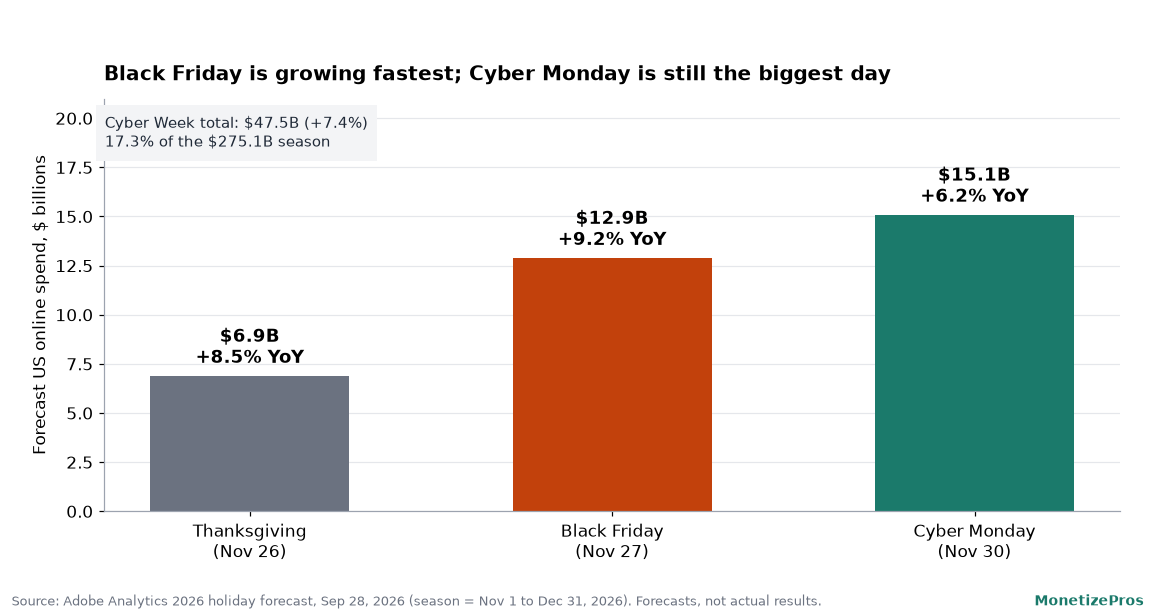
- $47.5 billion during Cyber Week, the five days from Thanksgiving to Cyber Monday, up 7.4% and equal to 17.3% of the season.
- Cyber Monday (November 30): $15.1 billion, up 6.2%, still the biggest single day.
- Black Friday (November 27): $12.9 billion, up 9.2%, growing faster than Cyber Monday.
- Thanksgiving (November 26): $6.9 billion, up 8.5%, with a record 63% of that day’s spending expected on mobile devices.
Mobile is expected to account for 57.4% of spending across the full season. If your deal pages are slow or clumsy on a phone, you are designing for the minority of buyers.
The season also starts earlier than the calendar suggests. Adobe projected $95.8 billion in US online spending for October alone, up 8%, including $9.9 billion during the October 6 to 7 Prime Day event.
Affiliates Are Gaining Share, but Clicks Convert Less
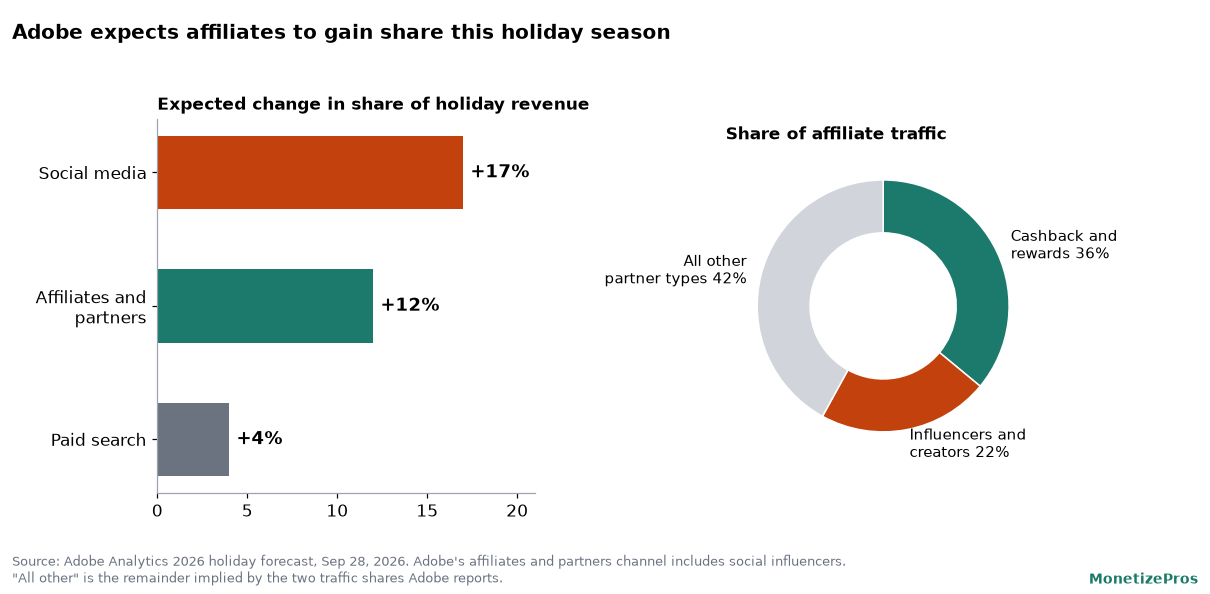
Adobe measures how much each marketing channel contributes to retail revenue. For this season it expects affiliates and partners, a group that includes social influencers, to grow their share of revenue by 12%, and social media by 17%. Paid search is expected to rise by only 4%.
Look closely at who inside the affiliate channel gets the traffic. Adobe says cashback and rewards partners lead with a 36% share of affiliate traffic, followed by influencers and creators at 22%. That leaves the remaining 42% for every other partner type, including content publishers, review sites, and deal blogs.
Last year’s results add an important warning. Partnerize reported, for its affiliate benchmark group, that from November 1 to December 2, 2025, global retail affiliate revenue (excluding food and drink) rose 3% year over year. That growth came from 18% more clicks and a 5% higher average order value, while the conversion rate fell 17%. During the Cyber 5 period from November 27 to December 1, 2025, clicks jumped 31% but the conversion rate fell 26%, leaving revenue flat. Partnerize also found that coupon and value proposition partners lost the most share, while influencers gained the most.
The lesson for publishers: more Black Friday clicks do not guarantee more commission. Shoppers browse more and buy less per click, so the pages that win are the ones that send ready-to-buy readers, not just curious ones.
When to Publish Your Black Friday Affiliate Content
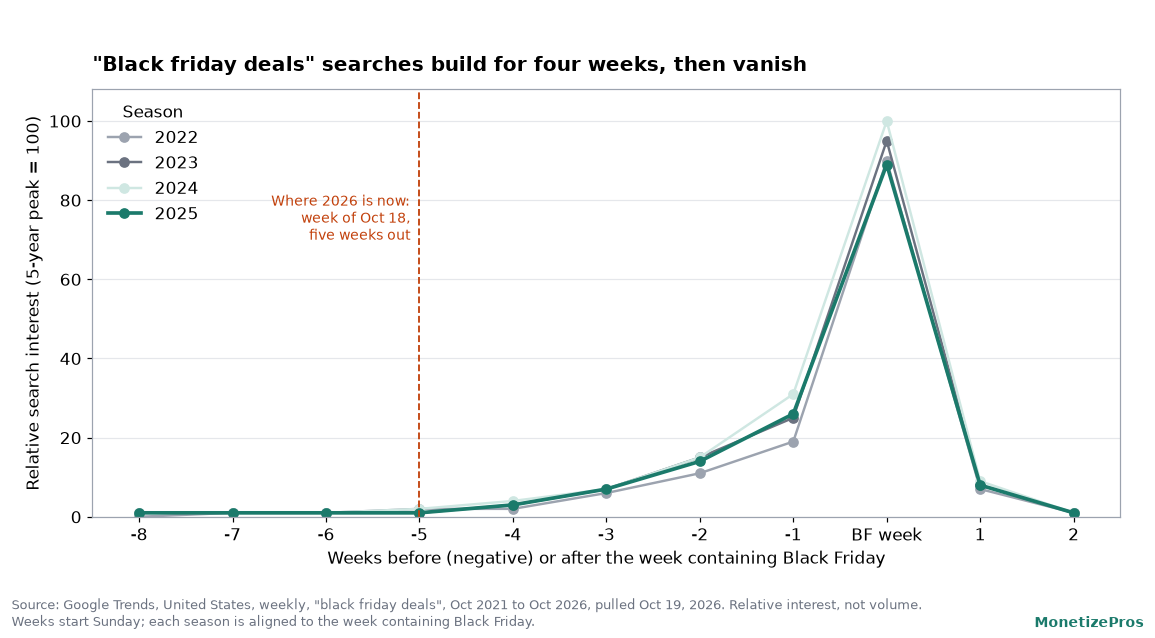
Google Trends shows a remarkably stable pattern for US searches of “black friday deals” in each season from 2022 to 2025. On a five year scale where the busiest week equals 100:
- Interest sits at 0 to 2 through mid October.
- It reaches 2 to 4 four weeks before Black Friday week, and 6 to 7 three weeks before.
- It climbs to 11 to 15 two weeks before and 19 to 31 the week before.
- It peaks at 89 to 100 in Black Friday week, then drops to 7 to 9 the following week.
In 2026, Black Friday week starts on Sunday, November 22, so the week of October 18 is five weeks out. Your pages should be live and internally linked before the climb starts in the week of October 25, and fully updated by the week of November 8. The rising related searches in the past 90 days are practical questions, such as “when do black friday deals start” and “does apple have black friday deals.” Answer those questions directly near the top of your pages.
Discounts follow a similar curve. Adobe expects deals of up to 14% off listed prices in early November, up to 21% just before Thanksgiving, and up to 30% during Cyber Week. That gives you a natural update schedule: publish now, refresh when early deals appear, and refresh again on Thanksgiving week.
Which day is best for which category
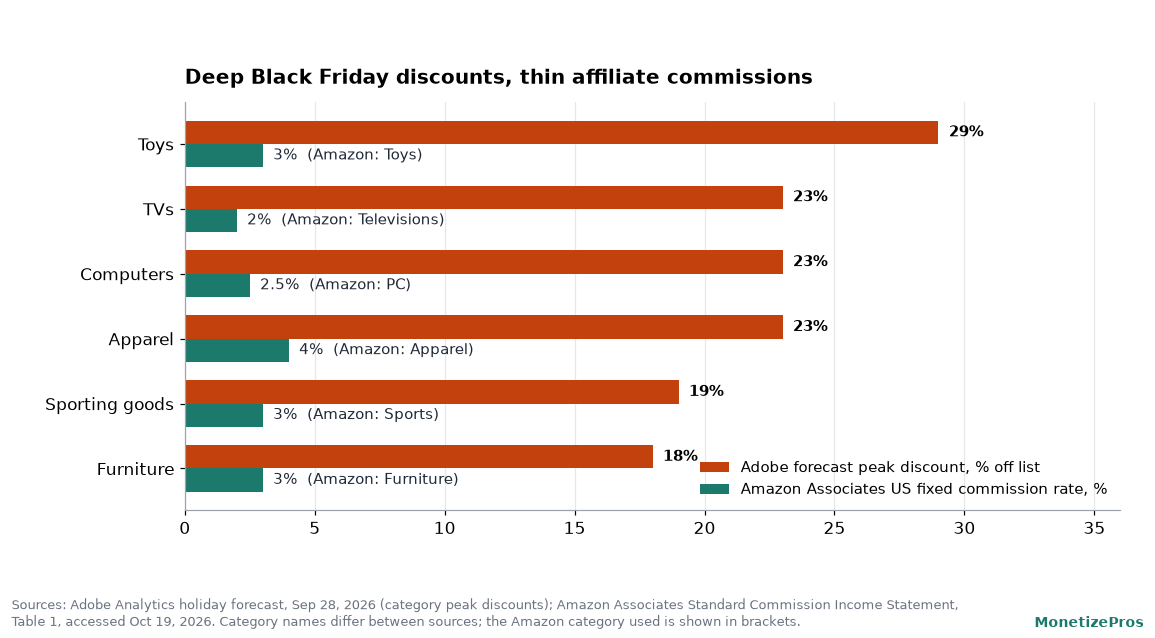
Adobe also forecast the peak discount and the best day for each major category. Pair that with Amazon’s published commission rates and you get a simple planning table.
| Category | Adobe peak discount | Best day (Adobe) | Amazon Associates US rate |
|---|---|---|---|
| Electronics | 30% | Cyber Monday | Varies (Televisions 2%, Headphones 3%) |
| Toys | 29% | Black Friday | 3% |
| TVs | 23% | Black Friday | 2% |
| Computers | 23% | Cyber Monday | 2.5% (PC) |
| Apparel | 23% | Black Friday | 4% |
| Sporting goods | 19% | Thanksgiving | 3% (Sports) |
| Appliances | 18% | Black Friday | Not listed separately |
| Furniture | 18% | Black Friday | 3% |
Sources: Adobe Analytics holiday forecast (September 28, 2026); Amazon Associates Standard Commission Income Statement, Table 1, accessed October 19, 2026. Category names differ between the two sources.
The Commission Math Behind Black Friday Affiliate Marketing
The deepest discounts are often in the categories that pay the least. Amazon’s US fixed rate is 2% for televisions, 2.5% for PCs, and 1% for physical video games and consoles. Apparel pays 4%, kitchen 4.5%, and luxury beauty 10%.
Here is an illustrative calculation, not a forecast: at those rates, a $400 TV order earns $8 in commission, while $400 of furniture at 3% earns $12 and $400 of apparel at 4% earns $16. A popular TV deal page can still win on volume, but a balanced portfolio of categories protects you if one big-ticket deal sells out.
Adobe’s forecast also points to categories that are growing faster than the season overall: grocery ($26.1 billion, up 10.3%), toys ($9.6 billion, up 9.6%), cosmetics ($9.2 billion, up 9.5%), and furniture ($33.4 billion, up 7.3%). The two biggest categories, electronics ($63.3 billion) and apparel ($51.3 billion), are growing more slowly at 5.9% and 4.7%. Adobe also expects shoppers to stock up on essentials during Cyber Week, with online sales of clothing basics up 210%, personal hygiene products up 150%, baby products up 113%, and pet products up 93% compared with average September levels. If your audience fits those niches, an “essentials worth stocking up on” roundup is a fresh angle that fewer deal sites cover.
A Seven-Step Black Friday Affiliate Checklist
1. Reuse and refresh your existing URLs
If you published Black Friday pages last year, update the same URLs instead of creating new ones, and change the year in the title and headings. Pages that already have links and history usually have a head start over brand new ones.
2. Build category hubs around the best day
Use the table above. A “Black Friday toy deals” hub and a “Cyber Monday laptop deals” hub match how Adobe expects discounts to land, and they give you two distinct ranking opportunities instead of one generic page.
3. Design for phones first
With mobile expected at 57.4% of season spending and 63% on Thanksgiving, put the deal, the price, and the button above the fold on a small screen. Compress images and keep ad density reasonable on deal pages.
4. Check every program’s holiday terms
Commission rates, cookie windows, and excluded products differ by retailer and network, and some programs change terms for the season. Confirm the current terms in each dashboard before you write, and note which categories pay zero (Amazon’s table lists gift cards at 0%, for example).
5. Judge pages by earnings per click, not clicks
Partnerize’s 2025 data shows why: clicks rose sharply while conversion fell. Track revenue per click and revenue per session for each page, and move links and internal promotion toward the pages that convert.
6. Be the answer AI shopping assistants can cite
Adobe expects AI-driven traffic to US retail sites to rise 130% this holiday season, with the biggest jumps on Thanksgiving (up 159%), Black Friday (up 95%), and Cyber Monday (up 88%). Clear headings, plain-language verdicts, prices with dates, and short answers to common questions make your page easier to summarize and cite. Our guide to the new affiliate funnel from search boxes to chatbots covers this shift in more depth.
7. Plan affiliate and display revenue together
Ad rates also tend to climb in the fourth quarter, so deal pages earn from two directions. Balance ad placements against affiliate clicks rather than letting one crowd out the other. Our Q4 ad revenue plan and the breakdown of seasonal RPM trends show how to time both.
Finally, disclose your affiliate relationships clearly and close to the links. Readers trust deal pages that are upfront about how they earn.
Black Friday Affiliate Marketing FAQ
When should I publish Black Friday affiliate content?
Now. In Google Trends data for 2022 to 2025, US search interest for “black friday deals” started rising about four weeks before Black Friday week, so in 2026 your pages should be live before the week of October 25 and refreshed as deals appear.
Is Black Friday or Cyber Monday bigger for online sales?
Cyber Monday is still bigger: Adobe forecasts $15.1 billion versus $12.9 billion for Black Friday. Black Friday is growing faster, at 9.2% versus 6.2%.
Which Black Friday categories pay the highest affiliate commissions?
On Amazon’s US fixed rate table, luxury beauty (10%), kitchen (4.5%), and apparel (4%) pay more than TVs (2%), PCs (2.5%), or consoles (1%). Other retailers and networks set their own rates, so compare program by program.
Why did affiliate clicks rise while sales stayed flat last year?
Partnerize’s 2025 data shows Cyber 5 clicks up 31% and the conversion rate down 26%. Shoppers compared more options before buying, so each click was worth less.
Sources
We keep outbound links to a minimum. The facts above come from these named sources, checked on October 19, 2026.
- Adobe, U.S. Holiday Shopping Season to Hit Record $275.1 Billion Online, Rising 6.7% YoY, September 28, 2026. Read the Adobe forecast
- Partnerize, Peak 2025: Cyber 5 Performance Summary, December 9, 2025. Read the Partnerize summary
- Amazon Associates, Associates Program Standard Commission Income Statement, Table 1. View the commission table
- Google Trends, “black friday deals”, United States, weekly, October 2021 to October 2026, pulled October 19, 2026.