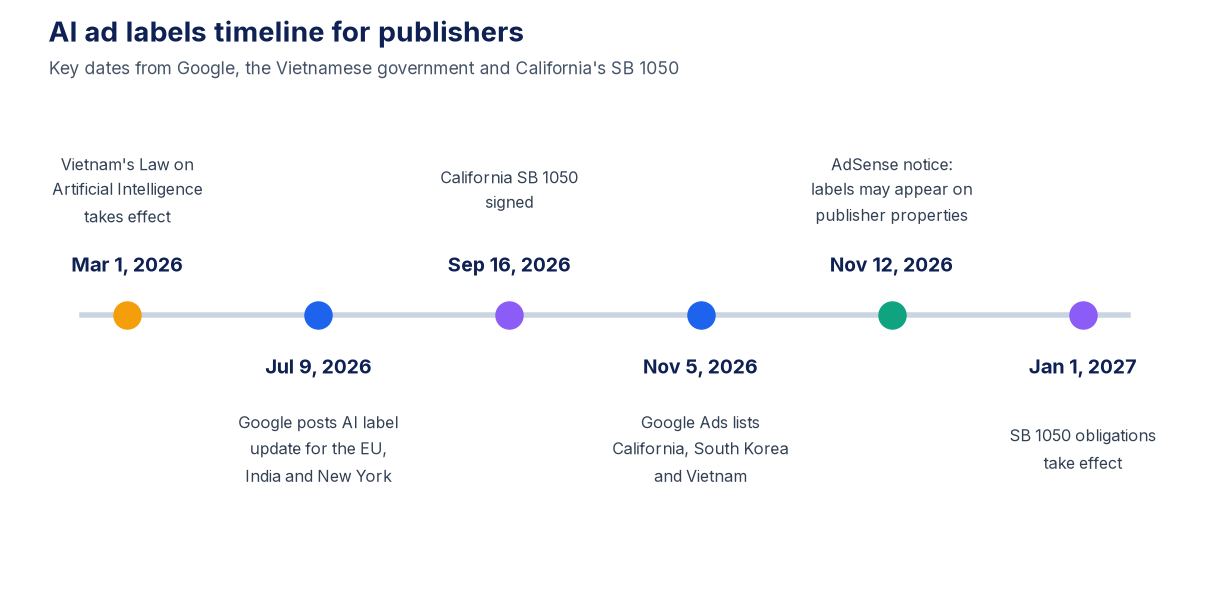
AI ad labels are about to show up on more of the ads that run on your pages. On November 12, 2026, Google posted an AdSense notice saying its visible AI labels will reach three more regions, California, South Korea and Vietnam, beginning in November 2026, and that publishers may see them on creatives bought through Google Ads or Display & Video 360, as PPC Land reported the same day.
For most AdSense sites, the change is something readers will see rather than a setting you manage. The harder part sits with ads Google does not label for you: third-party programmatic demand and the creatives you traffic yourself. This guide explains where AI ad labels now appear, who is responsible for which ads, where the technical work lands, and 6 essential checks to run before the busiest weeks of the year.
Table of Contents
What Google Announced About AI Ad Labels
The AdSense notice is short. “In response to upcoming regulatory requirements in California, South Korea, and Vietnam, Google is extending its AI Labeling functionality in these regions starting November 2026,” Google’s November 12 notice says. It adds: “For publishers, these AI labels may appear on creatives served to their properties when coming from Google demand (Google Ads, Display & Video 360).” The wording appears in Google’s November 12 AdSense announcement, which PPC Land also reported the same day.
The notice gives a month rather than a start day, does not name the specific laws behind the change, and links to a longer Google help page, Navigate AI labeling regulations. The help page covers AI ad labels and disclosures for publishers using Ad Manager, AdMob and AdSense.
That page explains the backdrop in one line: “These laws generally require certain AI-generated or edited content to be labeled, among other things.” Its main advice to publishers is to work with their buying partners, and with their legal teams where needed, to confirm the right disclosures in creative content.
Where AI Ad Labels Now Appear
The buying side moved first. In July 2026, Google told advertisers that rules in the European Union, India and New York call for disclosures or labels on ads that use certain AI-generated or edited assets. It began rolling out an AI label setting gradually through July in Google Ads, Display & Video 360, Campaign Manager 360, Merchant Center and Ads Editor, according to a Google Advertising Policies Help update posted on July 9, 2026.
By November 5, 2026, Google had added California, South Korea and Vietnam to its Google Ads help page, Search Engine Roundtable reported. The Google Ads help page now lists 6 locations where campaigns with assets marked as AI created or edited also get visible overlays on the ads: the European Union, India, New York, California, South Korea and Vietnam.
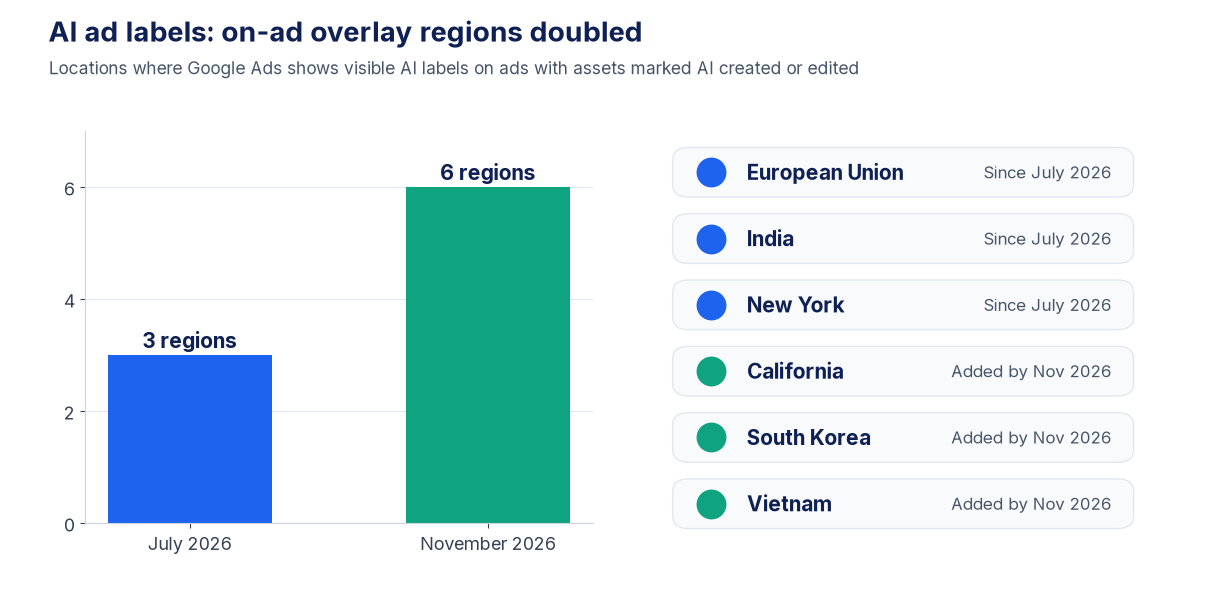
Outside those regions, AI ad labels do not sit on the ad itself, but the disclosure still exists. Google says ads with assets marked as AI-generated or edited still get a disclosure under “How this ad was made” in the My Ad Center panel, which is available globally.
Advertisers do not always get the final say. Google says it may apply labels itself, for example where the law requires Google to do so or when other platforms send it signals. Assets made with Google’s fully automated features may be labeled on the advertiser’s behalf, and in any of these cases the labels cannot be overwritten.
Who Labels Which Ads
The core of Google’s publisher guidance on AI ad labels is a table that splits demand into three groups. Each group gets a different answer on who handles the disclosure, and that split decides how much work lands on your team.
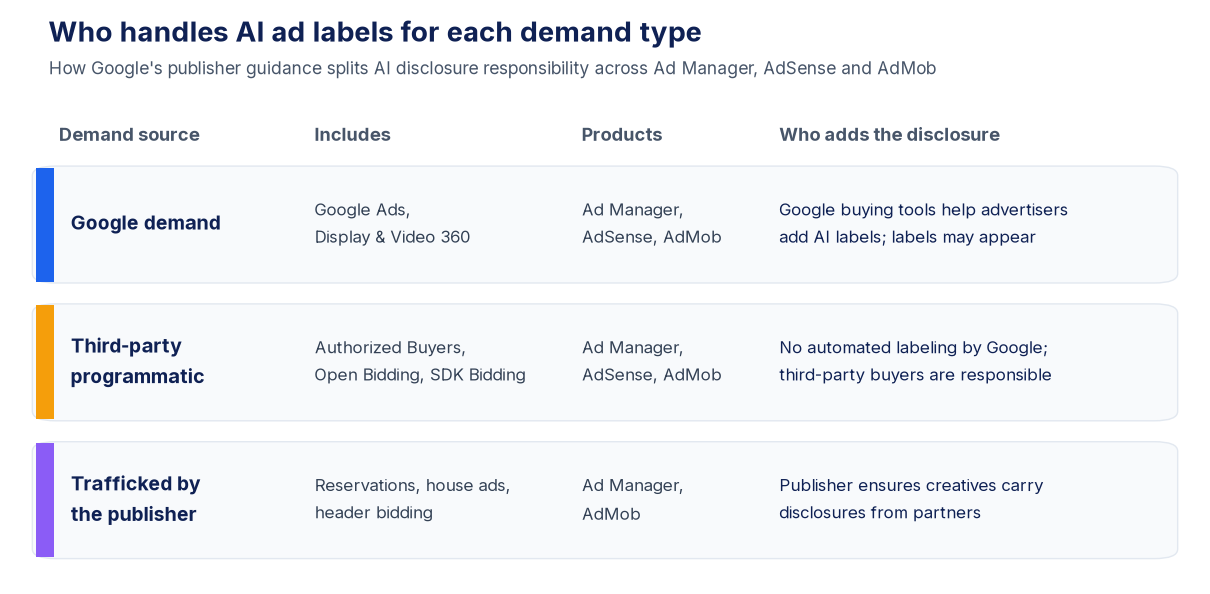
Google demand. When Google Ads or Display & Video 360 buys the ad and it serves through Ad Manager, AdSense or AdMob, Google says its buying platforms “will offer assistive tools to help advertisers add appropriate AI labels to creatives.” This is the group where the new labels may show up.
Third-party programmatic demand. For Authorized Buyers, Open Bidding and SDK Bidding, Google tells publishers to ask their third-party buying partners how they plan to comply with AI disclosure rules. Google is blunt about the limit: “Google publisher products do not provide automated labeling for third-party creatives.” Third-party buyers are responsible for their own obligations and disclosures.
Ads you traffic yourself. For reservations, house ads, header bidding and similar direct demand, the burden is yours: Google says publishers should make sure creatives they traffic carry suitable AI disclosures supplied by their buying and creative partners. Google lists this row for Ad Manager and AdMob only.
As PPC Land puts it, the result is a split screen. On one page, an AI-assisted Google Ads creative might show up already labeled, while a comparable ad from a third-party buyer shows no label unless that buyer added one.
Display, Video and Native: Where the Work Lands
Display. Google says creative vendors and buyers can update creative JavaScript to show AI disclosures when the creative renders. Display creative providers can also edit the creative file itself so the disclosure is part of the image. Google’s July policy update says AI ad labels added this way will not break its rules against text overlays and watermarks.
Video. This is where your player matters for AI ad labels. Buyers and creative vendors can place the disclosure, with its click-through, in a VAST icons element inside the ad’s XML. If you use Google’s IMA SDK, Google says it handles the rendering and click-through automatically. Publishers on Publisher Authenticated Inventory (PAI) or the Programmatic Access Library (PAL) instead “will need to manually implement support” for showing those icons and handling clicks on them.
If you run video, that is real engineering work on your player, and it is worth reviewing alongside the rest of your video and CTV ad setup.
Native. Because publishers render native ads in their own layouts, Google points to the “privacy” field in its OpenRTB setup, which carries a “link to an ad preferences or opt-out page.” Third-party buyers decide where it leads, and that page may include further AI disclosures. Select publishers allow-listed for custom ad badging get a field in the ad response that flags that a native ad may include AI-generated content, and Google demand will not add disclosures for them automatically.
The Laws Behind the List
Google’s notice calls the requirements behind AI ad labels “upcoming” without saying which rules prompted the expansion. Public texts for two of the new regions show the kind of rules involved. Vietnam’s Law on Artificial Intelligence has been in force since March 1, 2026, according to the English translation on the Vietnamese government’s news portal. Article 11 makes deployers attach a clearly recognizable label to AI-made audio, images and video that mimic how real people look or sound, or that recreate real events.
In California, Governor Gavin Newsom signed SB 1050 on September 16, 2026, and its duties apply from January 1, 2027, according to an analysis by the law firm Mayer Brown. Ads that prominently include a synthetic performer, meaning a digital figure, voice or representation made wholly or partly with generative AI, need a “clear and conspicuous” disclosure. Mayer Brown adds that the law counts publishers and digital ad networks as advertising mediums, which must take down a violating ad once they are served with a court order that finds it unlawful and identifies it.
Google’s own help page ends with a reminder that it is for informational purposes only and is not legal advice. If you sell ads directly into these regions, your compliance team or counsel should make the final call.
6 Essential Checks for Publishers
You do not need to rebuild your stack for AI ad labels, but a few smart checks now can prevent awkward surprises during holiday campaigns.
- Map your demand into Google’s three groups. List which revenue comes from Google demand, third-party programmatic buyers and ads you traffic yourself, because each group follows a different rule for AI ad labels and disclosures.
- Ask third-party buyers for their plans. Google says it does not label third-party creatives, so ask your Authorized Buyers, Open Bidding and SDK Bidding partners how they will handle AI disclosures.
- Add a disclosure question to direct deals. For reservations, house ads and header bidding creatives, ask buyers and creative partners whether an ad uses AI-generated or edited assets and confirm the disclosure is built in.
- Test your video player. If you use PAI or PAL rather than the IMA SDK, confirm your player can render VAST icons and their click-through before a labeled ad needs it.
- Review native and custom badging. If you render native ads or use custom badging, check how your templates show the privacy link or the AI content flag Google passes in the ad response.
- Keep creative review in your routine. Fold AI ad labels and disclosure checks into the same creative quality controls you use against malvertising and your Q4 Google Ad Manager checklist.
What Google Has Not Said Yet
Several gaps remain. The official notice says “starting November 2026” without a day. PPC Land also reported that on November 12, Google’s AI label help page for Display & Video 360 still showed on-ad labels only for the European Union, India and New York. When we checked on November 15, that page listed all 6 locations, so Google’s buyer documentation now matches the AdSense notice.
The guidance also does not show how Google’s overlay will look in display, video or in-app placements, and it does not say whether publishers can block creatives that carry AI ad labels. Until Google fills those gaps, watch your own pages in the new regions and note how labeled ads render on your key templates.
The bigger picture is simple. AI ad labels on Google demand are handled upstream, while third-party and direct-sold ads still depend on the partners you choose and the checks you run. Publishers who sort their demand now will spend less time chasing disclosure questions later.
AI Ad Labels FAQ
What are AI ad labels?
AI ad labels are visible disclosures on ads that use assets created or edited with AI. Google shows them as overlays on ads in some regions, and it also notes AI use under How this ad was made in the My Ad Center panel, which is available globally.
Where do Google’s AI ad labels appear on the ad itself?
The Google Ads help page lists 6 locations: the European Union, India, New York, California, South Korea and Vietnam. California, South Korea and Vietnam were added by November 5, 2026, and the AdSense notice says labels expand there starting November 2026.
Does Google add AI ad labels to third-party programmatic ads?
No. Google says its publisher products add no automatic labels to third-party creatives. For Authorized Buyers, Open Bidding and SDK Bidding, publishers should ask their buying partners how they plan to handle AI disclosures.
Who is responsible for AI disclosures on direct-sold ads?
The publisher is. For reservations, house ads and header bidding, Google says publishers should make sure creatives they traffic carry suitable AI disclosures supplied by their buying and creative partners. Google lists this for Ad Manager and AdMob.
Do video publishers need to change anything?
It depends on the player. With Google’s IMA SDK, VAST icons for AI disclosures are rendered automatically. Publishers using Publisher Authenticated Inventory or the Programmatic Access Library have to build icon rendering and click handling into their own players.
What should publishers check first?
Map revenue into Google’s three demand groups, ask third-party buyers for their disclosure plans, add a disclosure question to direct deals, test your video player, review native templates and custom badging, and keep AI disclosure checks in your regular creative review.
Related posts:

Setupad Review 2026: Is It the Right Header Bidding Partner?

3 Ideas to Improve Leaderboard Ad Performance

Monetization Strategies: Maximizing Ad Revenue Through Ad Placement and Formats

7 Reasons Why Media.net Is A Great Alternative To Google Adsense

Best SSPs for Publishers in 2026: Compared and Ranked