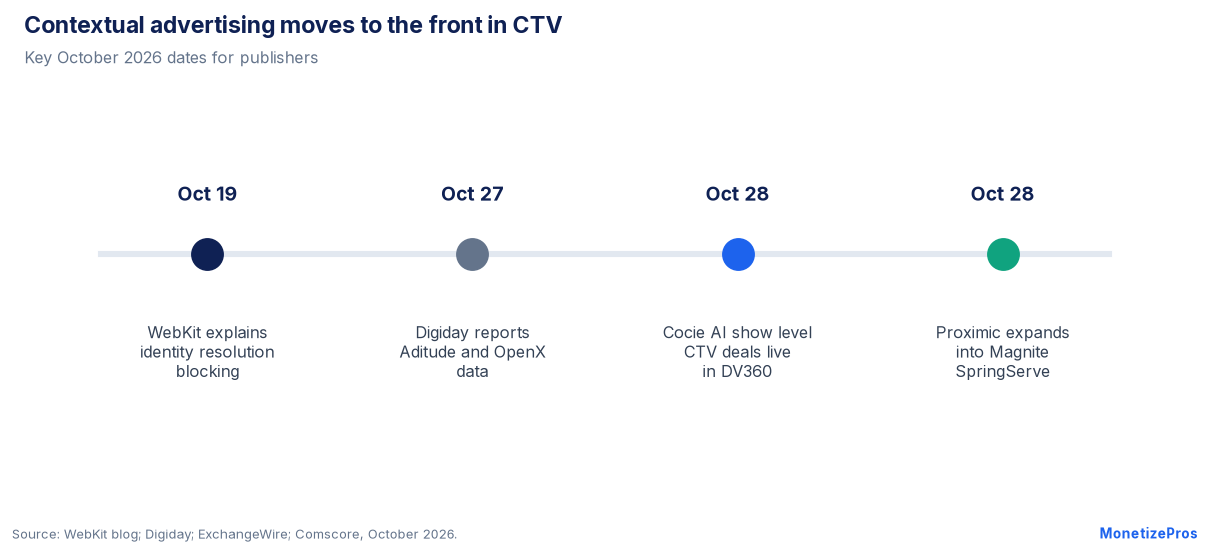
Contextual advertising just got two new routes into connected TV budgets. On October 28, 2026, Cocie AI said its curated, show level CTV deal packages are now available directly in Google’s Display & Video 360, and the same day Comscore said Proximic’s contextual and ID free targeting tools are expanding into Magnite’s SpringServe platform. Both lean on what viewers are watching rather than who they are. This guide explains what launched, why it matters for publishers and seven smart moves to make your inventory easier to buy on context.
We focus on the publisher side of the story. Neither announcement published performance figures, so we do not claim any lift. Where we cite numbers, they come from the companies, from IAB Tech Lab or from Digiday’s reporting, and we say which.
Table of Contents
What Is Contextual Advertising in CTV?
Contextual advertising matches an ad to the content around it instead of to a profile of the person seeing it. On a web page, that usually means the topic of the article. In connected TV, it can be far more specific: the show, the genre, whether the broadcast is live, the content rating and even the moment within a live event.
That precision is why CTV has become the proving ground for context. A buyer who knows an ad will run during a live sports stream or a premium drama has a clear reason to bid without needing a cookie, an email based ID or any personal data. For publishers, the value of that impression depends on how well the content is described in the bid request.
What Cocie AI Launched in DV360
According to Cocie AI’s announcement on ExchangeWire, its curated CTV deal packages are now available directly in Google’s Display & Video 360 through its exclusive SSP partnerships. Cocie describes itself as the contextual intelligence layer for connected TV. The packages give programmatic buyers a route to premium, multi publisher CTV supply, with no onboarding and no prior relationship with Cocie required.
Each package is curated with show level context and brand suitability applied before the bid. Cocie says the packages are built entirely on contextual signals, with no cookies and no personal data. They launch first in the U.S., with EU markets to follow, and run always on across streaming, FAST and broadcaster apps.
The launch categories include Premium Streaming, Live Sports and VOD, News and Politics, FAST Channels and High Completion, which Cocie defines as a 95% or higher video completion rate. There are also seasonal packages for key retail moments. Buyers find them in the DV360 Marketplace by searching for Cocie in the Discover tab and attaching a package to a line item.
The pricing model is the detail publishers should notice. The packages carry no fixed rate or upfront commitment and clear in the open auction, where live demand sets the price and the winning bid secures the impression. Context is used to choose the supply, not to set a premium floor in advance.
Comscore and Magnite Add a Supply Side Route
The second announcement works from the other end of the chain. Per Comscore’s release, Proximic’s Predictive Audiences, contextual intelligence and ID free activation tools are coming into Magnite’s SpringServe video platform, which combines ad serving and programmatic capabilities. Comscore calls it the first real time contextual integration across Magnite SpringServe.
Future Today is among the first publishers using Proximic’s Predictive Audience segments through the integration. The release says it combines Future Today’s first party viewership data with contextual signals, and can package inventory around timely seasonal audiences, such as fall allergy sufferers for allergy medicine advertisers and Halloween candy buyers for CPG brands. The inventory covered includes high impact formats such as pause ads.
Future Today’s Tim Ware said the partnership gives it access to a broader range of demand partners through Magnite, and described the company’s findings as preliminary. No performance numbers were published, so treat any lift as unproven until you see your own results.
Why Context Is Winning Budget Now
The timing follows a hard month for identity. On October 19, Apple’s WebKit team said Safari blocks network access to identity resolution infrastructure in its 27 releases. Digiday then reported that publishers are starting to feel it, and argued that publishers and marketers will have to get comfortable running ads on context and aggregate signals.
The budget shift was already under way. Digiday reported OpenX data showing that in 2022, 78% of U.S. buyer targeting spend through its platform went on third party audience data. By 2025, that share had shrunk to around 40%. Targeting by the content around an ad picked up most of the slack, rising to as much as 35% on the back of CTV, where buyers can buy on show, genre and rating.
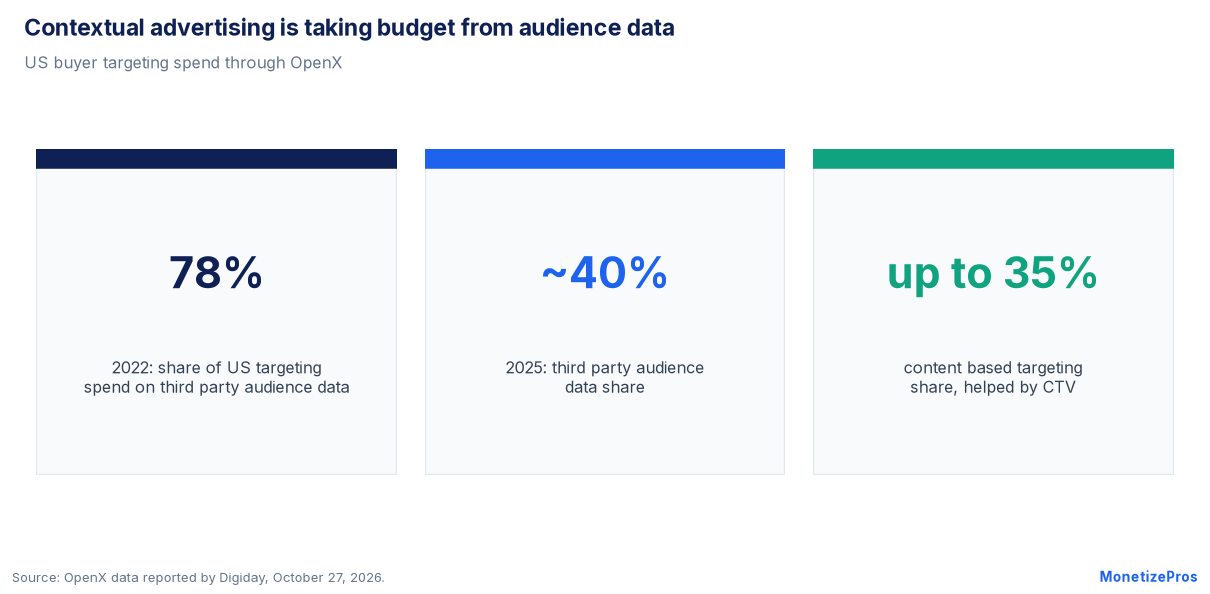
Digiday added that audience data remains the largest share, but each year it holds a little less of the budget, and what is replacing it does not depend on knowing who is watching. For a CTV publisher, that is a clear signal about where to invest metadata effort.
The Content Signals Buyers Read
Contextual advertising only works when the bid request carries the context. The OpenRTB 2.6 Content object gives publishers fields for the series, season, episode, title, genre, content rating, length, language, network and channel, plus a livestream flag that separates scheduled linear viewing from on demand content. Each one gives a curator like Cocie or Proximic something concrete to read.
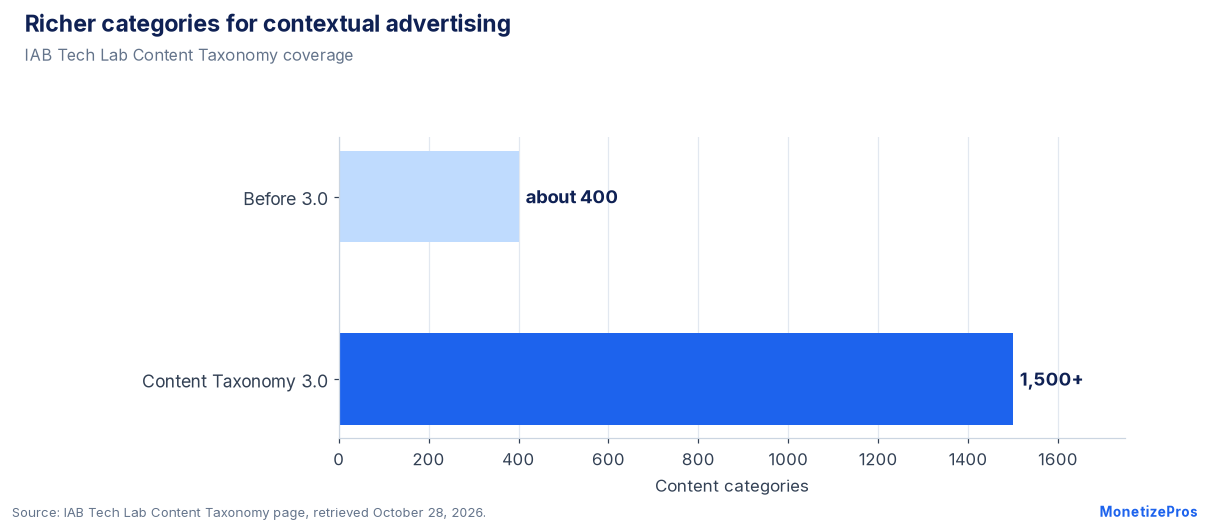
Categories matter too. The IAB Tech Lab Content Taxonomy is the common language for describing content, and IAB Tech Lab lists contextual targeting and brand safety as its typical uses. Version 3.0, released in June 2022 with updates to better support Video and CTV content, expanded coverage from about 400 categories to more than 1,500, and IAB Tech Lab says 2.x is being deprecated. A CTV Genre Mapping followed in December 2024.
| OpenRTB content field | What it tells a contextual buyer |
|---|---|
| series, season, episode, title | The exact show, which is the basis of show level targeting |
| genre and genres | The type of program, such as drama, news or sports |
| cat with cattax | IAB Tech Lab content categories and which taxonomy version you use |
| contentrating | The rating, which feeds brand suitability decisions |
| livestream and len | Whether the content is scheduled or on demand, and how long it runs |
| network and channel | Where the content is distributed |
7 Smart Moves for Publishers
These steps make your CTV and video inventory easier to buy through contextual advertising, whichever curator or platform the buyer uses.
1. Fill the Content object completely
Audit your bid requests and check that series, season, episode, genre, content rating, livestream and language are populated for every stream. Empty fields leave curators guessing, and supply that cannot be described is hard to package.
2. Move to Content Taxonomy 3.x
With 2.x being deprecated and 3.0 covering more than 1,500 categories, upgrading your category mapping gives buyers finer signals. IAB Tech Lab offers a free, open source mapper for converting 2.x codes.
3. Make brand suitability easy to judge
Cocie applies brand suitability before the bid. Accurate ratings and genres help your impressions pass those checks instead of being filtered out.
4. Package seasonal audiences around content
Future Today’s examples, from allergy season to Halloween candy, show how timely packages can pair content with buying moments. Build your own seasonal deals around the shows that fit them.
5. Combine context with your own data
Future Today blends first party viewership data with contextual signals. If you have logged in viewers, consented data can add a layer on top of context without relying on third party IDs.
6. Watch open auction pricing closely
Cocie’s packages have no fixed rate and clear in the open auction. Monitor clearing prices on curated deal IDs separately so you can see whether context driven demand is lifting your yield. Our guide to programmatic deals covers how to set them up.
7. Lead with your strongest formats
Pause ads and live content are named in these launches for a reason. Make sure those formats are clearly labeled in your supply so curators can find them. For the bigger picture, see our guide to CTV advertising for publishers.
Caveats Before You Commit
Both launches are new, and both come from vendors describing their own products. Cocie’s U.S. first rollout means EU publishers will wait, and Comscore’s Future Today findings are described as preliminary. Curators also sit between you and the buyer, so ask how they select supply, what fees apply and what reporting you will see.
Still, the direction is hard to miss. Contextual advertising is no longer a fallback for when IDs fail. It is becoming a primary way buyers choose CTV supply, and publishers that describe their content clearly will be easier to find and easier to pay.
Contextual Advertising FAQ
What is contextual advertising in CTV?
Contextual advertising matches an ad to the content around it instead of to a profile of the viewer. In connected TV, that can mean the show, the genre, whether the broadcast is live and the content rating.
What did Cocie AI launch?
On October 28, 2026, Cocie AI said its curated, show level CTV deal packages are available directly in Google’s Display & Video 360. They are built entirely on contextual signals, with no cookies and no personal data, and launch first in the U.S.
How are Cocie’s CTV packages priced?
The packages carry no fixed rate or upfront commitment and clear in the open auction, where live demand sets the price and the winning bid secures the impression.
What did Comscore and Magnite announce?
Comscore said Proximic’s Predictive Audiences, contextual intelligence and ID free activation tools are coming into Magnite’s SpringServe video platform, with Future Today among the first publishers using the segments.
How fast is contextual targeting growing?
Digiday reported OpenX data showing third party audience data fell from 78% of U.S. buyer targeting spend through its platform in 2022 to around 40% in 2025, while targeting by content rose to as much as 35%.
Which signals help publishers sell on context?
The OpenRTB 2.6 Content object carries fields such as series, season, episode, genre, content rating and livestream, and IAB Tech Lab’s Content Taxonomy 3.0 expanded coverage from about 400 categories to more than 1,500.
Related posts:

Top 10+ VOD Platform Companies to Build your Video on Demand Website

The Beginner’s Guide to Video Monetization: 10 Essential Resources

What is Pre-Roll Video Advertising?

Why You Probably Won’t Get Rich & Famous on YouTube

How to Monetize YouTube Videos