State privacy laws are about to change how ad-supported sites handle readers in four more US states. Google told publishers on November 16, 2026 that privacy law provisions in Oklahoma, Louisiana, Alabama and Vermont take effect on or after January 1, 2027, and that it has already updated its consent and data processing tools to cover them. If you run AdSense or Google Ad Manager and have US readers, now is the time to check your settings, not in January.
This guide explains what Google changed, which dates matter, what the new state privacy laws require in plain terms, and five smart steps to take before the holiday traffic winds down.
Table of Contents
What Google Changed for Publishers
Google posted three related notices for AdSense and Ad Manager publishers on November 16, 2026. The first, titled “Upcoming US states with comprehensive privacy laws,” says Google will treat the four new states much like the states whose comprehensive laws are already in force. In that AdSense announcement on new state laws, Google says that turning on Restricted Data Processing (RDP) mode “turns off ad personalization,” which can help publishers respect targeted advertising opt-outs and steer clear of anything that might count as a “sale” or “sharing” of user data.
The second notice covers opt-out signals. Google says rules on universal opt-out mechanisms and opt-out preference signals reach Louisiana and Vermont on or after January 1, 2027. Ahead of that, starting on or after November 17, 2026, Google reads Global Privacy Control (GPC) signals itself for readers in those two states and puts their ad requests into RDP mode.
The third notice updates the US state regulations messages in the Privacy & messaging tool to support Oklahoma, Louisiana, Alabama and Vermont. If you ticked “Select all” in the Geography selector earlier, Google says your messages pick up new states on their own once each state’s rules take effect and Google CMP supports them. If you did not, you need to edit the targeting yourself.
Google also adds a caution worth repeating: publishers should check with their legal teams on whether RDP is the right compliance answer for them. Google’s tools help, but they do not decide whether any of the state privacy laws apply to your business.
The Dates That Matter
The new state privacy laws do not all switch on at once. Google’s list of applicable US state data protection laws, last updated November 17, 2026, names 24 state laws and marks four of them with future effective dates: Oklahoma and Louisiana on January 1, 2027, Alabama on May 1, 2027, and Vermont on January 1, 2028. The law firm Wiley gives the same January 1 date for Oklahoma and Louisiana and May 1 for Alabama.
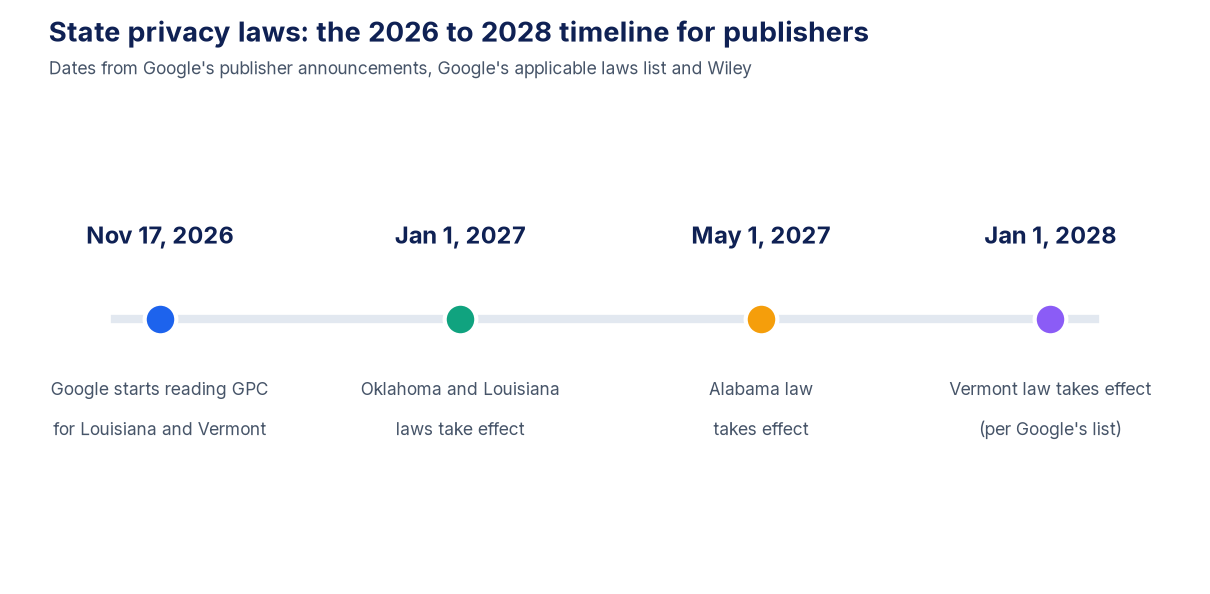
Two details are easy to miss. First, the GPC change for Louisiana and Vermont readers began on or after November 17, 2026, well before either law takes effect, so some of your ad requests may already be running in RDP mode. Second, Google’s announcements list Vermont among the states with provisions coming on or after January 1, 2027, while its own list of laws shows Vermont’s law taking effect on January 1, 2028. Until Google clears that up, confirm Vermont’s date with counsel and assume Google’s tools may treat Vermont like the January 2027 states.
Wiley also notes that changes to Delaware’s Personal Data Privacy Act kick in on January 1, 2027. With these changes, Wiley says, “by 2027, nearly half of U.S. states will have comprehensive consumer privacy laws.”
What the New State Privacy Laws Require
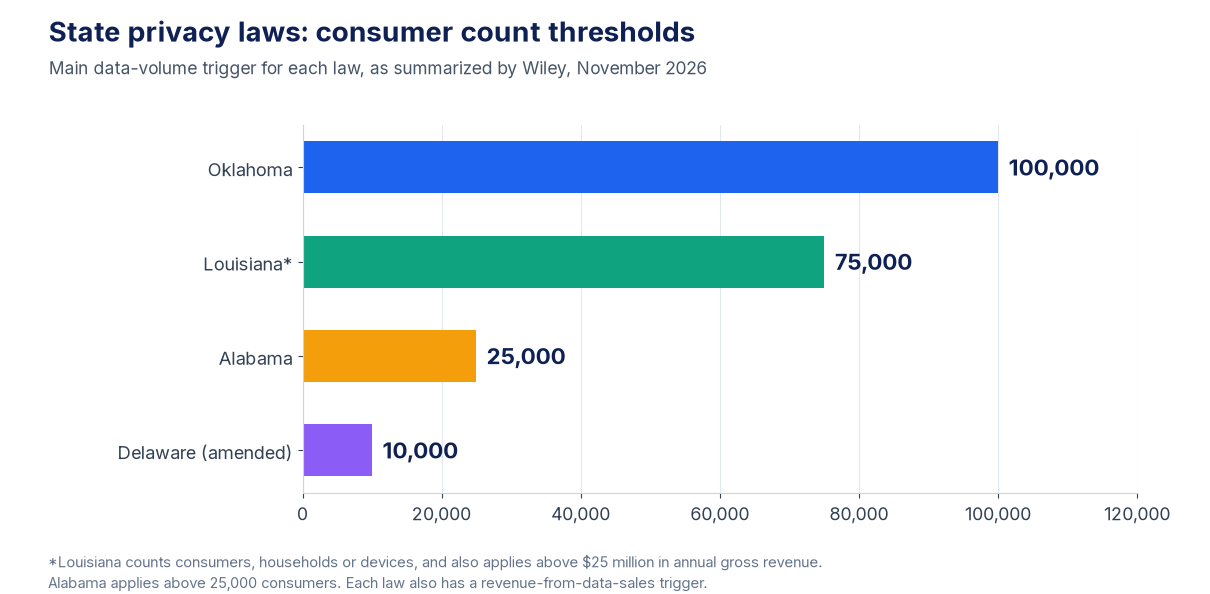
Each of the new state privacy laws decides who is covered with its own thresholds. Wiley’s November 2026 client alert summarizes them this way:
- Oklahoma. Covers controllers and processors that do business in Oklahoma or target its residents and either handle personal data on 100,000 or more consumers, or handle data on 25,000 or more consumers while earning over 50% of gross revenue from selling personal data.
- Louisiana. Covers a business operating in the state that meets any one of three tests: more than $25 million in annual gross revenue; buying, receiving, selling or sharing personal information on 75,000 or more consumers, households or devices each year for commercial purposes; or earning half or more of its annual revenue from personal information sales.
- Alabama. Covers entities that do business in Alabama or target its residents and either handle personal data on over 25,000 consumers or earn over 25% of gross revenue from selling personal data.
- Delaware (amended). The consumer threshold drops to 10,000 from 35,000, and the second test drops to 5,000 consumers from 10,000 for companies that derive more than 20% of gross revenue from selling personal data.
The consumer rights in these state privacy laws look familiar. In all three new laws, Wiley lists rights to access, correct, delete and port personal data, plus opt-outs from targeted advertising, sales and certain profiling. That targeted advertising opt-out is the part that touches ad revenue most directly.
The definition of “sale” differs. Wiley notes that Oklahoma limits a sale to exchanges for monetary consideration, which is narrower than several other states. Louisiana’s definition reaches monetary or other valuable consideration, and Alabama’s includes some exchanges for other valuable consideration. For publishers that pass data to ad partners, that difference matters.
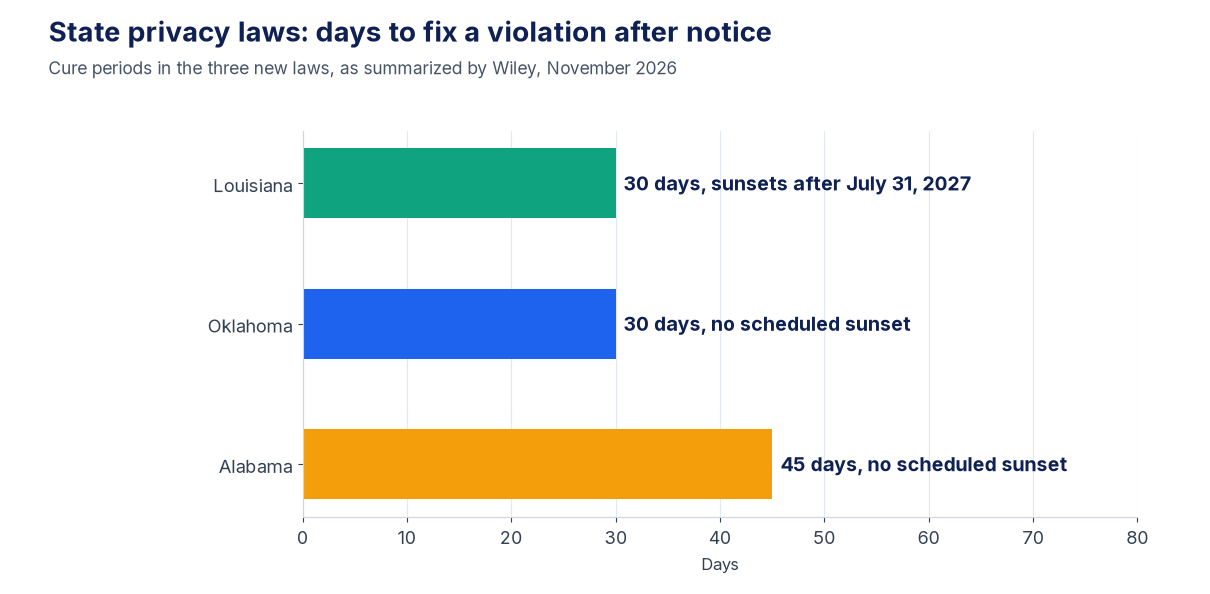
In all three new laws, the state Attorney General alone enforces, and each law offers a cure period: a window to fix a problem after notice. Louisiana offers 30 days, but that option sunsets after July 31, 2027. Oklahoma offers a mandatory 30 days with no scheduled sunset, and Alabama offers a mandatory 45 days with no scheduled sunset.
How RDP and GPC Affect Your Ad Requests
Restricted Data Processing is Google’s main tool for state privacy laws. Google’s Ad Manager guidance on US states privacy laws says that once an RDP signal arrives, Ad Manager “will not serve ads that are based on a user’s prior behavior and will send a non-personalized ad request to bidders.”
Google describes several ways to turn RDP on. Many publishers rely on a consent management platform (CMP), whether Google’s own, a third-party tool or one built in house, to pass Global Privacy Platform (GPP) signals to ad partners. Google adds that RDP can also go out through GPP National v2, which already covers the new states. A second route is publisher ad tags: you can activate RDP for only some users request by request, using GPT or asynchronous AdSense and Ad Exchange tags, which can be useful if you show a “Do Not Sell My Personal Information” link.
If your stack still relies on the IAB US Privacy String, note Google’s comment that the IAB deprecated it in January 2024 and pointed the industry to GPP instead. Ad Manager still reads it for backward support, but Google recommends migrating to the GPP string and says the US Privacy String may be deprecated in future releases.
GPC is different because the reader sets it, not you. For Louisiana and Vermont users, Google now reads that browser signal directly and switches those ad requests to RDP. Google’s notice lists no setup step for this, but you should expect it to show up in your reporting.
5 Smart Steps for State Privacy Laws in 2027
- Check your message targeting. Open Privacy & messaging, find your US state regulations message and confirm that Oklahoma, Louisiana, Alabama and Vermont are included. Google says new messages select all available states by default.
- Decide how you send RDP. Pick one clear route, either your CMP through GPP or per-request ad tags, and document it. If you still send the US Privacy String, plan the move to GPP.
- Run the threshold test with counsel. Compare your audience and revenue with the state privacy laws’ thresholds above for Oklahoma, Louisiana, Alabama and amended Delaware. Louisiana’s $25 million revenue test applies even if your reader counts are small.
- Review ad partners. Google’s “Review your ad partners” control lets you pick which third-party buyers may show ads to eligible readers in the covered states. Trim partners you cannot vouch for.
- Update your privacy notice and opt-out link. Make sure your notice names the rights these laws give readers and that your opt-out path actually triggers RDP or the matching GPP signal.
Keep Revenue Steady While You Comply
State privacy laws do not have to mean a revenue shock. Because RDP turns off ad personalization, any traffic that moves into RDP mode is bought differently. The right response is measurement, not guesswork. Segment your reports by state where your tools allow it, note November 17, 2026 as the earliest date GPC could start switching Louisiana and Vermont requests, and watch those segments through January and May 2027.
Non-personalized inventory still sells on context. Our guide to identity resolution for publishers covers first-party signals you can keep, and our breakdown of Safari ad changes in iOS 27 shows how other privacy shifts are already reshaping addressability. Google also used November to expand AI labels on ads, which we covered in our look at AI ad labels for publishers. The pattern is the same: state privacy laws and other rules are changing what Google’s tools do by default, so the publishers who check settings early avoid surprises in their reports.
State Privacy Laws FAQ
Which new state privacy laws did Google add for publishers?
Google told AdSense and Ad Manager publishers on November 16, 2026 that privacy law provisions in Oklahoma, Louisiana, Alabama and Vermont take effect on or after January 1, 2027, and updated its Privacy & messaging tool to support all four states.
When do the new state privacy laws take effect?
Google’s list of applicable laws shows Oklahoma and Louisiana on January 1, 2027, Alabama on May 1, 2027 and Vermont on January 1, 2028. Wiley gives the same dates for Oklahoma, Louisiana and Alabama.
What does Restricted Data Processing do?
Google says RDP turns off ad personalization. With an RDP signal present, Ad Manager stops serving ads based on a reader’s past behavior and sends bidders a non-personalized ad request.
What changed with Global Privacy Control?
Starting on or after November 17, 2026, Google receives GPC signals directly for users in Louisiana and Vermont and triggers RDP mode for those ad requests.
Do I need to update my US state regulations message?
If you ticked “Select all” in the Geography selector earlier, Google says your message picks up new states automatically. Otherwise, edit the message targeting to include Oklahoma, Louisiana, Alabama and Vermont.
Do these state privacy laws apply to small publishers?
It depends on the thresholds. Per Wiley, Oklahoma starts at 100,000 consumers, Alabama at more than 25,000, and Louisiana also applies above $25 million in annual gross revenue. Google advises publishers to work with their legal teams.
Related posts:

The Ultimate Guide to Ad Serving & Optimization

Mantis Ad Network: A Guide to Smarter, Safer Digital Advertising
Ad Network vs Ad Exchange: Understanding the Key Differences
Google Ad Manager Updates: Your Q4 2026 Checklist

3 Ideas to Improve Leaderboard Ad Performance