

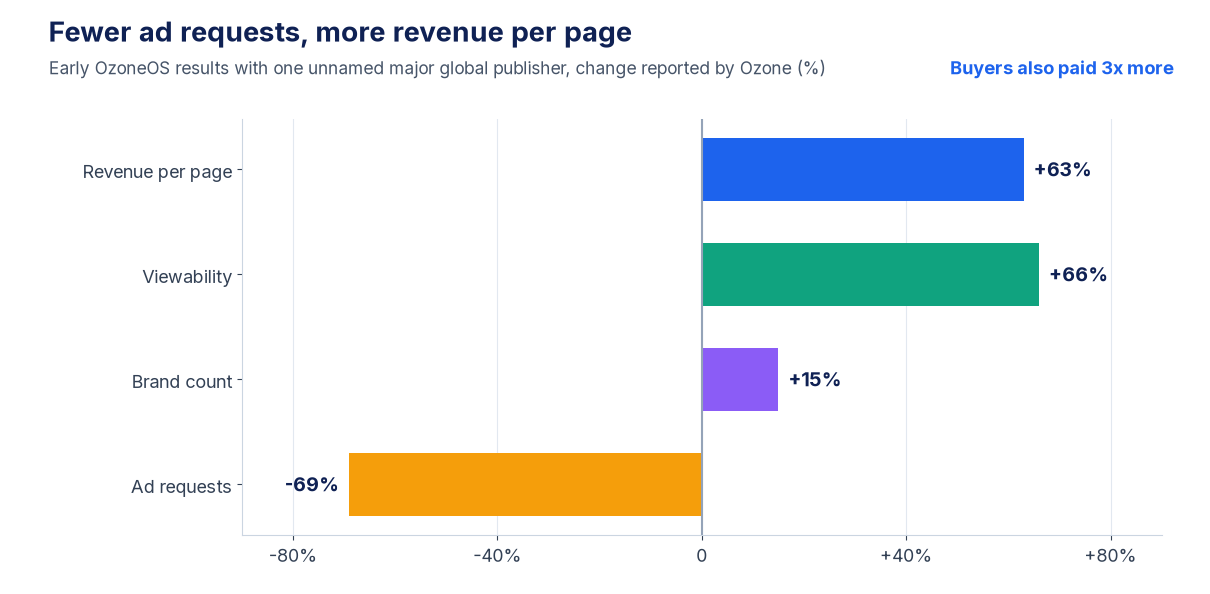
Many ad stacks are built to fire as many ad requests as a page can hold, on the theory that more chances to sell will always mean more money. Ozone’s new OzoneOS results push back on that idea. In early testing with one major global publisher, revenue per page climbed 63% while ad requests fell 69%, according to the company’s OzoneOS launch announcement on November 10, 2026.

That is a single, unnamed case, so it is not a promise for your site. It is a good reason to audit how many calls your pages make, how many of them ever turn into an ad a reader actually sees, and which ones only add cost and slow the page down. This guide explains what the numbers mean, what to treat with caution, and 6 smart fixes to trim the waste without giving up revenue.
Table of Contents
What Are Ad Requests?
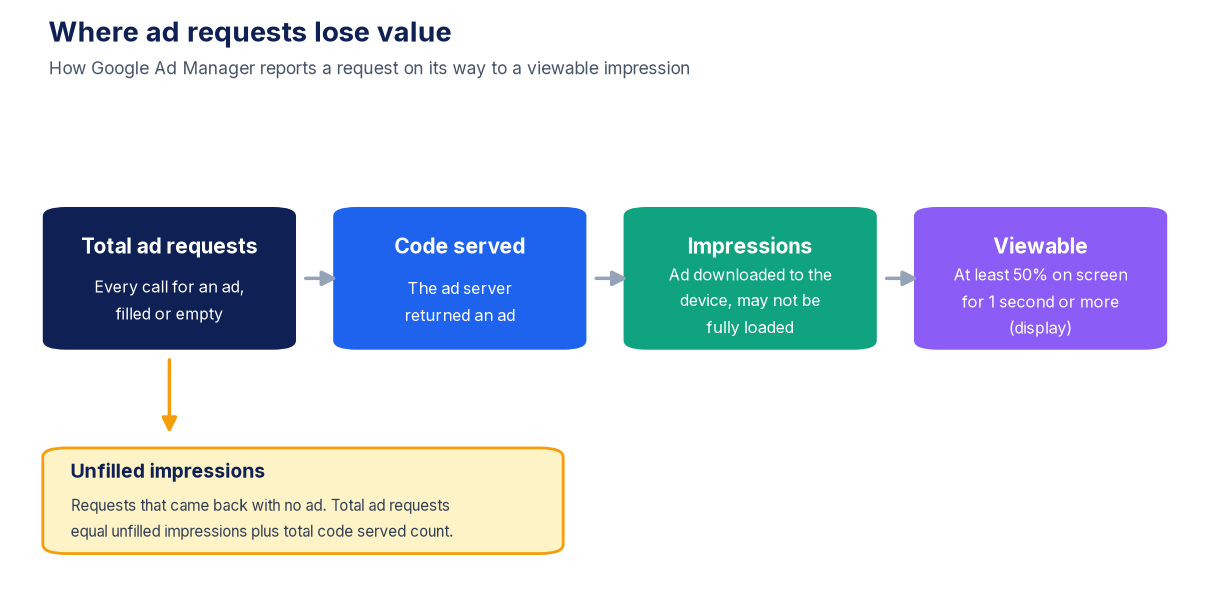
An ad request is the call a page or app sends to an ad server asking for an ad to fill a slot. In Google Ad Manager reporting, total ad requests are made up of two buckets: calls that came back with an ad, counted as the total code served count, and calls that came back empty, which Google labels unfilled impressions.
A served ad is still not the same as a seen ad. Google counts an ad server impression once the ad has downloaded to the reader’s device, even if the creative has not fully loaded. It treats a display ad as viewable only when at least half of it stays visible for one second or more, which is the IAB minimum.
So every page runs a chain: ad requests, then ads returned, then impressions, then viewable impressions. Value can leak at each step. A page that sends lots of calls but fills or shows few of them looks busy in reports while earning very little.
What OzoneOS Found When Ad Requests Fell
Ozone describes OzoneOS as a technology suite that brings a publisher’s first-party audience data into programmatic decisions. It has two parts. Audience models estimate the value of different reader groups and point to the buyers who will pay most for them. Orchestration tools help publishers control how ads are laid out, how pages behave and which demand partners get called.
Publisher partners got a first look at the suite on October 22 at Ozone’s CTRL event in London, and the first features are now being introduced in the UK and the US. The headline numbers come from what Ozone calls a major global publisher. For that publisher, revenue per page climbed 63% and viewability improved 66%, even as requests dropped 69%.
The same publisher saw a 3x increase in what buyers paid and the number of brands buying rose 15%, Ozone said. The company’s explanation is simple: a lighter ad load gives readers a cleaner page, and the ads that are left get more attention. Danny Spears, Ozone’s chief operating officer, told The Media Leader why buyers should care:
“A more efficient, better-organised publisher stack means fewer wasted requests and lower costs across the supply chain, which benefits advertisers without requiring any action on their part.”
How to Read the Ozone Numbers
These are encouraging results, but they deserve a careful read. Ozone does not name the publisher, and the announcement does not say how long the test ran or what it was measured against. Tomorrow’s Publisher raised similar cautions in its own review of the launch, noting that one anonymous case cannot tell another publisher what to expect.
It also helps to be precise about what fell. Ad requests are calls between software systems, not ads on a reader’s screen. A 69% cut in requests does not mean readers saw 69% fewer ads, so check what readers actually see as a separate metric.
Revenue per page is a rate as well. It shows how much each page view earns, not how much the site earns in total. A site can raise it and still bring in less money overall if traffic falls at the same time, so track both numbers side by side.
Why Fewer, Better Ads Matter Now
Ozone frames the launch around a traffic problem. Its announcement points to a fall in search-driven traffic across the past 18 months, which it says has made loyal readers who come to publishers directly more important. When page views are harder to win, getting more from each one matters more.
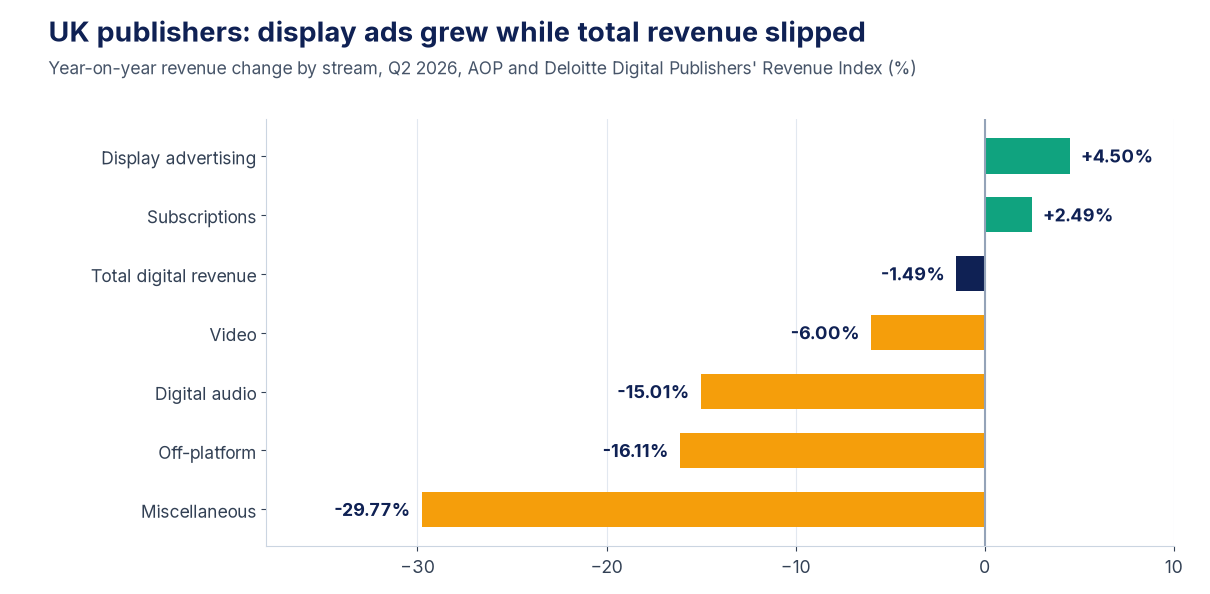
Fresh UK figures show the same pressure. On November 4, 2026, the Association of Online Publishers and Deloitte released their Digital Publishers’ Revenue Index for Q2. Total digital revenue for the participating publishers slipped 1.49% year on year in Q2 2026 to £155.04 million. Display advertising was a bright spot, up 4.50% to £54.08 million, and subscriptions rose 2.49% to £57.98 million.
Other lines shrank. Video was down 6.00%, digital audio 15.01%, off-platform revenue 16.11% and miscellaneous revenue 29.77%. Only half of the participating publishers grew revenue year on year in the quarter, compared with 62% in Q1. Andy Cowen, lead partner for telecoms, media and entertainment at Deloitte, said:
“The resilience of recurring subscription revenues, alongside growth in display advertising, suggests that publishers with strong audience relationships and established advertising propositions are better placed to navigate a more challenging market.”
The Hidden Costs of Wasted Ad Requests
Wasted ad requests cost more than they seem to. Three costs are worth checking on your own site.
Fees. Google Ad Manager 360 includes a report metric called invoiced unfilled impressions, which counts calls that came back without an ad from inventory that is not a mobile app or a video player. Unfilled requests from mobile app and video inventory are among those that are not billed. If you run on Ad Manager 360, check this metric, because some empty calls can carry a direct price.
Speed and experience. Every extra call adds work for the browser. The Google Publisher Tag documentation says lazy loading “enables pages to load faster, reduces resource consumption and contention, and improves viewability rate” by holding back requesting and rendering until a slot gets close to the reader’s screen.
Perceived value. In Ozone’s test, higher bids and new advertisers followed the cleanup, which Spears said “demonstrates the increase in perceived value of this supply,” according to The Media Leader. If you have not checked how many units each page carries, our guide to ad density guidelines covers the limits that keep pages usable.
6 Smart Fixes to Cut Wasted Ad Requests
You do not need a new platform to start. These steps use reports and settings most publishers already have.
- Measure requests per page view. Divide total requests by page views for each template, such as home, article and category pages. Then check what share came back unfilled. A template with many calls and a high unfilled share is the first place to look.
- Lazy load lower slots. Turn on lazy loading in Google Publisher Tag so slots further down the page only call for an ad as a reader scrolls near them. Readers who leave early never trigger those calls. One catch: Google notes that with single request architecture (SRA), lazy loading requests every slot at once when the first slot nears the screen, so check that your setup really delays the lower calls.
- Cut slots that rarely fill or get seen. Use unfilled impressions and Active View viewability by ad unit to find weak slots. Removing a slot that seldom delivers follows the idea Ozone describes: a lighter ad load with fewer, better placements.
- Review demand partners. Check how often each header bidding or exchange partner actually wins on your pages. Partners that seldom win still add calls and page work. Keep the ones that bring real revenue and test switching off the rest one at a time.
- Refresh only what is in view. Ad refresh creates new requests for slots already on the page. Limit refresh to slots that are on screen and keep the timing conservative, so calls do not grow faster than revenue.
- Judge every change on revenue per page. Run changes as controlled tests and compare revenue per page view, viewability and total revenue, not request volume. Our guide on how to A/B test ad placements walks through a clean setup.
What This Means for Smaller Publishers
Ozone pitches OzoneOS at premium, audience-first publishers, and it pairs control of the ad stack with data from across Ozone’s own network. If you are not an Ozone partner, the core lesson still applies: every ad request should have a fair chance of becoming a seen, paid impression.
You can track that with tools you already use. Google AdSense works out page RPM by dividing estimated earnings by page views and then multiplying by 1,000. If page RPM rises after you remove weak slots while total earnings hold steady or grow, the cut worked. For more ways to lift that figure, see our tactics to increase your website RPM.
The bottom line: more calls are not the same as more revenue. Count your calls, cut the ones that never pay, and let revenue per page, not request volume, tell you whether it worked.
Ad Requests FAQ
What are ad requests?
An ad request is the call a page or app sends to an ad server asking for an ad to fill a slot. In Google Ad Manager, total ad requests are calls that came back with an ad (the total code served count) plus calls that came back empty (unfilled impressions).
Can fewer ad requests increase revenue?
They can. In early OzoneOS results with one unnamed major global publisher, revenue per page climbed 63% and viewability improved 66% while ad requests dropped 69%. It is a single case, so test any change on your own site first.
What is OzoneOS?
OzoneOS is a technology suite Ozone launched on November 10, 2026. It combines audience models, which estimate the value of different reader groups, with orchestration tools that control ad layouts, page behavior and which demand partners get called.
Are unfilled ad requests billed?
Some can be. Google Ad Manager 360 reports invoiced unfilled impressions for calls that came back without an ad from inventory that is not a mobile app or a video player. Unfilled requests from mobile app and video inventory are among those that are not billed.
Does lazy loading reduce ad requests?
Lazy loading holds back requesting and rendering until a slot gets close to the reader’s screen, so readers who leave early may never trigger the calls for lower slots. With single request architecture (SRA), though, all slots are requested once the first one nears the screen. Google says lazy loading also helps pages load faster and improves viewability rate.
How can publishers cut wasted ad requests?
Measure requests per page view by template, lazy load lower slots, cut slots that rarely fill or get seen, review demand partners that seldom win, refresh only slots that are in view, and judge every change on revenue per page rather than request volume.
Related posts:

What is Ad Network Integration? A Complete Guide for Digital Marketers

What Does “Automatic Payment Pending” Mean in AdSense? (And When You’ll Get Paid)

Ad Management Partners: What the Stagwell Freestar Deal Means

Dynamic Ad Insertion: beehiiv and Substack Bring Podcast Ads

Top 5 Sell-Side AdTech Thought Leaders
