

- United States of America
- November 27, 2026
Company Information
Coloring pages: Choose drawings with a clear sense of scale
A balloon fills half the drawing. It might be close to you or big enough to tower over a pavilion. You can often tell which scene you’re looking at by seeing where each object is placed. That difference matters when you want a familiar park, a tiny imagined world, or a playful exaggeration. When you browse free coloring pages pdf format resources, look at size relationships inside the picture to find the kind of world you want to color.
1. Find a familiar object to compare against
The space an object takes up gives you one clue. Nearby objects often tell you more about its intended size.
1.1 Compare two things that belong near each other
Imagine a mushroom growing beside a twig. The cap fills much of the drawing, but the twig near its stem makes the scene feel like a close look at the ground. In another drawing, the mushroom stands beside a stair rail and reaches well above the first steps. The stairway gives you something familiar to compare with the unfamiliar mushroom.
A quick comparison can help:
- Find one object whose usual size you already understand.
- Check whether it sits beside, in front of, or behind the object you are judging.
- Look for ground lines, steps, or paths that show whether both objects belong at a similar distance.
1.2 Use a second familiar clue when the first is ambiguous
A big boot shape with a rectangle on its side could be a decorated boot. Add a handle, steps, and a path joining the steps to a gate, and the picture starts to read as a boot-shaped house. The everyday features fit together in a way you recognize.
A second clue works best when it supports the same reading. One window could be decoration; a window above a doorway with steps makes the building clearer.
Imagine Lily and her father looking at a fantasy drawing. At first, she calls the object “a giant shoe.” Then she notices the small door, steps, and path. The picture changes in her mind from an oversized object to a house shaped like a boot. The added clue makes the scale easier to read.
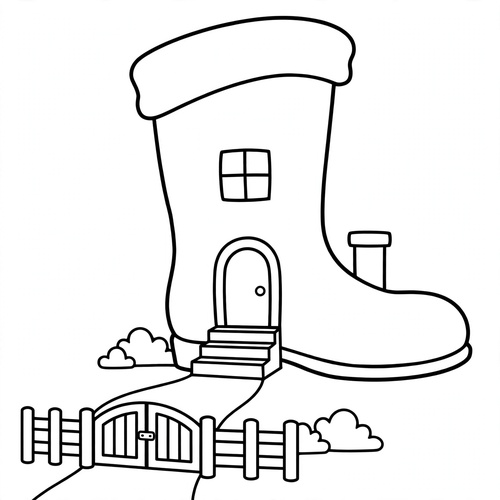
A boot-shaped house has a doorway, window, and steps
2. Check whether distance accounts for the difference
Objects closer to you can look larger. Use a path, string, or figure’s feet to see whether the big-looking object is simply nearer.
2.1 Read nearby and distant objects along the ground
In the park example, follow the string down from the balloon. If it ends at the hand of a person near the front, that gives you a place for the balloon. Farther along the path, a pavilion stands beyond other figures. The balloon holder gives you a reason to read the balloon as an ordinary object seen close up.
A balloon can cover part of a distant roof even when plenty of ground lies between them. The path and the hand holding the string tell you more than the overlap alone.
If you reached the topic through an external reference such as https://wildfiregames.com/forum/topic/27402-free-printable-coloring-pages-for-simple-everyday-fun/, use the same visual test once you open a drawing: judge scale from the objects and distance clues inside the image rather than from one outline alone.
2.2 Look at objects beside each other for actual proportion
Now imagine a balloon tied to a post beside the pavilion. Follow the string to its knot and compare both objects at roughly the same distance. If the balloon rises above the roof and spans much of its width, it reads as huge.
A smaller balloon tied to the same post might take up about as much space as one opening between the pavilion’s supports. That relationship changes the apparent scale. If you cannot see where the string is held or tied, leave the distance open.
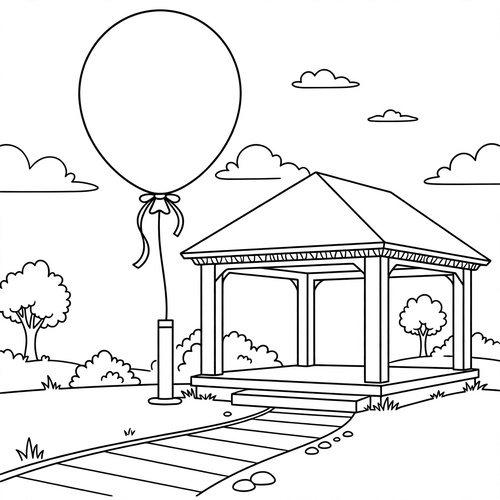
A big balloon rises higher than a park pavilion roof
3. Decide how clear or playful you want the scale to feel
Once you understand the size relationship, choose the effect you want. Familiar proportions feel recognizable; a size surprise creates something new to explore.
3.1 Enjoy a size reversal when the scene makes it clear
Picture a staircase beside an enormous mushroom. The visible ground connects the first step to the base of the stem. The rail runs beside the cap and gives you a familiar point of comparison. Those details make it easy to see that the mushroom belongs to the same scene as the steps and would tower over someone using them.
A miniature town can do the reverse: tiny doorways along a teacup create an unexpected relationship.
When you want a playful scale change, check for:
- A familiar object placed directly beside the enlarged or reduced subject.
- A visible point where both objects meet the same ground or structure.
- A size difference strong enough to read without guessing what is near or far.
3.2 Leave proportions open when they do not affect the choice
An isolated seashell may have no surroundings that tell you its size. If its ridges and curling edge are what you want to color, you already have enough to choose it.
To make the shell feel monumental, look for a doorway or path. To make it feel small, a nearby shoe or hand can provide the comparison.
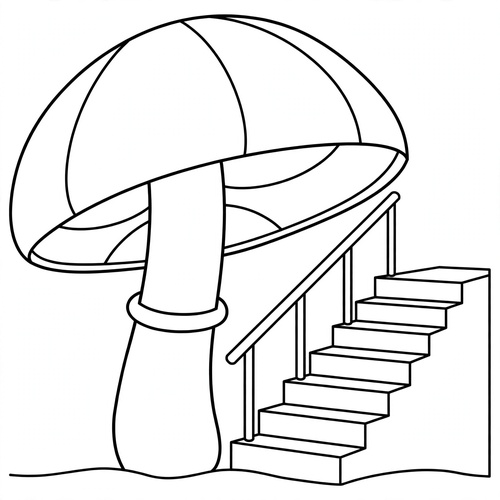
An oversized mushroom towers above a nearby staircase
4. Compare actual coloring pages across collections
Use theme navigation or search from the ColoringPagesCreative homepage to try the same size question in different scenes. Start with a recognizable pair, such as a balloon and pavilion or a boot and doorway. Open the drawing and check whether the context shows which objects are close together before judging their scale.
4.1 Carry the same size question across different subjects
Suppose you want something small to reveal the size of a larger place. Compare a person beside a tree with a tiny door at an imagined tower. The subject changes, but the size question stays the same.
Noah compares those two ideas. The park feels ordinary until he notices how small the person looks beside the tree. The tower feels stranger, but the tiny door gives him the same kind of scale clue. He chooses the tower because he wants a more playful world.
4.2 Use complete visual evidence when it matters
If a preview shows a balloon in front of a pavilion, you may need the whole string or ground before deciding what the scene depicts. A larger view matters only if it reveals that missing clue.
5. Choose one scale clue you can point to
Make the choice by saying what you wanted to see and which pictured detail helped you see it. One visible comparison can give you a solid reason. This is especially useful when you compare printable coloring pages pdf, because the strongest choice is still the drawing whose internal relationships make the intended world easy to read.
5.1 Pick the scene that makes your preferred size clear
If you want an imagined street with familiar objects turned into homes, the boot with a door and steps gives you a reason to select it. For an ordinary park scene, the person holding the balloon at the front helps you read the building behind them as a distant pavilion. Choose whichever scene gives you the proportions you want today.
5.2 Use a different criterion if the size can stay unknown
When the shell’s curl is all you need, choose it for that line and enjoy the open question. If you came looking for a tiny world, keep browsing for a scene with a readable point of comparison. Make the choice when the line drawing shows the relationship you came for.
Pick a pictured object and a clear point of comparison. Choose the scene whose visible size relationship makes the world feel the way you want.
See It Here:
Coloring pages to share: Plan a session with plenty of choice
Find fresh coloring pages to enjoy with ColoringPagesCreative