Every emerging brand hits the same wall. The first order was expensive to win: paid social, creator seeding, a launch promo, maybe a free-shipping threshold set lower than finance would like. The second order is where the unit economics either start to work or quietly fall apart.
The fastest lever is a discount code in the post-purchase email. It teaches customers to wait for the next code, gives away margin on orders that would have happened anyway, and tells people your product is worth buying only when it is cheaper.
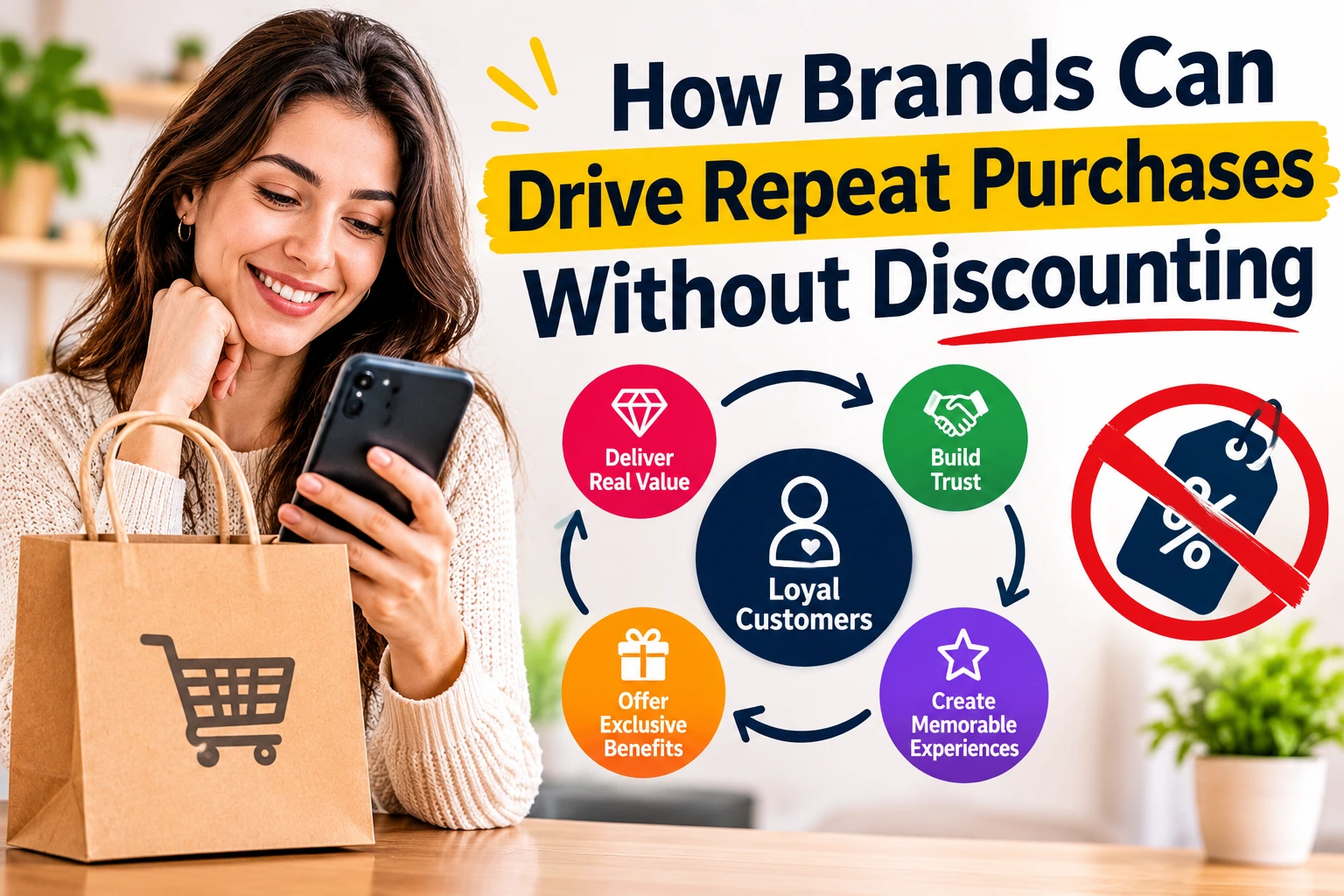
However, there are better strategies. None of them require cutting prices, and most of them compound over time instead of eroding. Here is how growing brands build repeat purchase without training customers to wait for a sale.
Why discounting is a weak retention tool
Discounts are not useless. However, here are four problems that show up as soon as they become the default retention tactic:
- They subsidize customers who would have bought anyway. A loyal customer who was going to reorder next week still gets the code. That is pure margin loss with no behaviour change.
- They reset price perception. Once someone pays $40 for a $50 product, $50 starts to feel like a markup rather than the real price.
- They attract deal-seekers. Customers acquired or retained mainly through codes are loyal to the code, instead of being loyal to the brand. When the code expires, they stop buying as well.
- The margin math is harsher than it looks. Take a $100 product with a 60% gross margin. A 20% discount cuts revenue to $80 and gross profit from $60 to $40. That is a one-third drop in profit per order. To earn the same gross profit, the brand now needs 50% more orders.
A discount campaign can lift orders by 30% and still leave the business worse off than if it had done nothing.
1. Build the second purchase into the first
The strongest predictor of a second order is a good experience with the first one. That sounds obvious, but many brands treat the period between order one and order two as dead air filled with generic promotional email.
Useful moves here:
- Time reminders to the product’s real consumption cycle. If a bottle lasts 30 days, a reminder on day 22 or 25 is a useful service. Most ecommerce platforms and email tools can trigger flows on days since last order.
- Design starter formats that lead to full formats. A trial size, sampler or starter kit sets up a natural next step without any price cut.
- Invest in onboarding. A how-to insert, a short video or a “getting the most out of it” email sequence reduces the number of customers who use the product wrong, get mediocre results and never come back.
2. Sell subscriptions on convenience, not on savings
Many brands lead their subscription offer with “save 15%.” That makes the subscription a permanent discount, with all the problems above.
Subscriptions work better when they are sold on control and convenience. Let customers skip, swap, pause or ship early in one click. Add perks that cost little but feel exclusive: early access to new flavors or colorways, a free sample of each new launch, priority on restocks. Customers stay because the subscription is easy and useful, not because canceling would cost them a discount.
3. Reward behavior instead of reducing price
This is the core distinction. A discount lowers the price of what you sell. A reward adds value on top of it. The customer pays full price and gets something extra for doing what you want them to do.
Classic loyalty programs follow this logic, but they have a weakness for smaller brands: the rewards are small and slow. If a customer earns 5% back in points and orders twice a year, the payoff is a few dollars many months away. It rarely changes behavior.
Large brands solve this with big, exciting rewards. Promotions like McDonald’s Monopoly have run for decades because a chance at a meaningful prize motivates repeat purchases far more than a small, certain saving. The catch is that a compliant prize promotion is expensive and difficult to run. The brand has to fund the prize, write official rules, and in some US states, including New York and Florida, register and bond larger promotions in advance. For a brand doing a few hundred orders a month, that is too burdensome.
That gap is why shared reward models have appeared. Instead of each brand funding its own prize, many brands contribute to one larger pool. Platforms built on this idea, such as the Bundle platform, give customers a free entry into a pooled prize draw with each qualifying order instead of a discount code. The brand pays a flat fee per action, and the platform funds the pool, runs the draw and handles compliance and payouts. The customer gets a shot at a reward far larger than anything a single small brand could offer, while the brand keeps its full price. In one published case study, Bundle reports that Revit, a supplement gummy brand from Singapore, saw 34% more orders and 35% more revenue after giving customers entries instead of discounts.
The principle applies to whatever tool you use. Retention rewards work best when they are tied to a specific action you want more of: a second order within 45 days, a referral, a subscription renewal, or a review for instance. Rewarding everything dilutes the effect, whereas, rewarding the one behaviour that drives lifetime value encourages it.
4. Create reasons to buy now that are not sales
Discounts are popular partly because they create urgency. But urgency can come from many places that do not touch price:
- Limited drops and seasonal products. A winter flavor or a small-batch run gives existing customers a reason to come back on a date you choose.
- Restock alerts and waitlists. “Back in stock” is one of the highest-intent messages a brand can send.
- Deadlines on rewards. Entry windows, reward cycles and member-only events all create a natural “buy before” date without lowering price.
- New uses for existing products. Recipes, routines, pairings and how-to content can trigger a reorder simply by reminding customers why they bought.
The goal is a calendar full of buying moments, not one that peaks on Black Friday and goes flat for the rest of the year.
5. Turn customers into a community
People come back to brands they feel part of. For emerging brands, community does not need to mean a forum or an app. It can be simpler:
- Feature customer photos, routines and results on product pages and social channels.
- Run a referral program that rewards both sides, so existing customers have a reason to talk about you.
- Share the stories of customers who won something, tried a new product first or helped shape a launch.
Each of these gives customers a reason to stay connected between orders, which makes the next order more likely.
Measure what actually matters
None of this works if success is judged on revenue alone. Discounts almost always win on short-term revenue. Track these instead:
- Repeat purchase rate at 30, 60 and 90 days, by cohort. This shows whether retention is improving month over month.
- Time between first and second order. A shorter gap means your post-purchase experience is working.
- Gross margin per customer, not per order. This captures the true cost of whatever incentive you use.
- Incentive cost per incremental repeat order. Compare tactics on what each extra order costs you, not on how many orders each one touches.
- A holdout group. Keep a slice of customers who get no incentive at all. Without it, you cannot tell which orders your program created and which would have happened anyway.
The bottom line
Discounts buy a second order by spending margin. The tactics above earn it by adding value: a better first experience, a more convenient subscription, rewards that feel worth chasing, and reasons to come back that are not tied to price.
Emerging brands do not need to out-discount larger competitors to keep customers. They need to give customers more reasons to return than a lower price ever could, and then measure the result in profit rather than in orders.
Related posts:

Scaling Your Ecommerce Business Store: Effective Tactics for E-commerce Growth

Can You Sell Digital Products on Amazon? A Complete Guide

Finance And E-Commerce: A Checklist For Success

SEO Tips for Ecommerce Sites: Driving Organic Traffic and Sales

3 Ways to Optimize Packaging for E-Commerce in 2024