

Imagine someone searches “best VPN for remote workers” and gets a neat AI answer right away. Your awesome affiliate page? It never even gets a chance to show up. Ouch.
That is the new game in 2026. SEO still matters, but it is no longer enough by itself. Now you also need GEO — Generative Engine Optimization — which is basically the art of getting AI tools like ChatGPT, Google’s AI Overviews, and Perplexity to notice, trust, and cite your content.
For affiliate marketers, this is huge. If you want traffic, clicks, and commissions, you need to build authority before everyone else does.
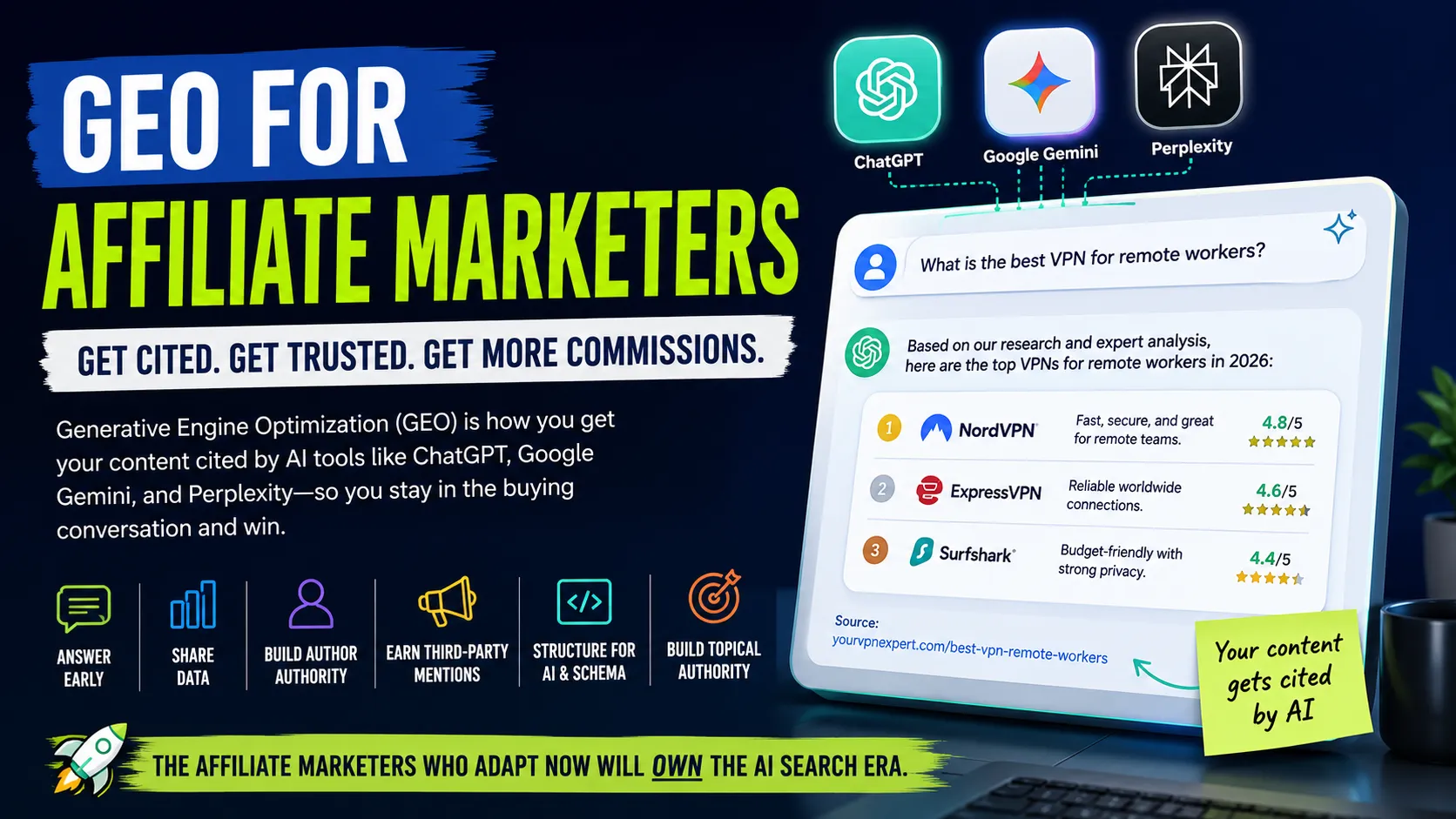
What Is GEO — and Why Should Affiliate Marketers Care?
GEO, short for Generative Engine Optimization, is basically SEO for AI. Instead of trying to rank on Google alone, you are trying to get AI tools like ChatGPT, Google Gemini, Perplexity AI, and Microsoft Copilot to mention and trust your content when answering questions.
Think of it like this:
- Old SEO was fighting for a spot on page one.
- GEO is getting the AI itself to say, “Yep, this source knows what it’s talking about.”
And for affiliate marketers, that changes everything.
Before, someone might scroll through 10 review articles. Now the AI gives them one clean answer in seconds. If your content gets cited, you win trust instantly. If not, you are basically invisible.
That is why a GEO agency matters so much in 2026. Millions of people now use AI tools every week to decide what to buy, compare, or download. Affiliate marketers who learn GEO early are getting pulled into those conversations — while everyone else gets left behind.
GEO vs SEO: A Practical Comparison for Affiliates
Understanding how GEO differs from traditional SEO helps you prioritize where to invest your time and resources.
| Factor | Traditional SEO | GEO |
| Goal | Rank in a list of links | Be cited in an AI-generated answer |
| Success metric | Click-through rate, rankings | Share of Model (SoM), citation frequency |
| Content format | Keyword-optimized pages | Structured, answer-first, data-rich content |
| Authority signals | Backlinks, domain authority | Third-party citations, author credentials, original data |
| Primary platforms | Google, Bing | ChatGPT, Perplexity, Gemini, AI Overviews |
Importantly, GEO does not replace SEO — it builds on top of it. Brands that excel at GEO in 2026 are typically the same brands with strong traditional SEO foundations.
Why Affiliate Sites Are Uniquely Positioned (and Uniquely at Risk)
Affiliate sites are in a great spot because AI loves the exact kind of content you already create: “best of” lists, product comparisons, and buying guides. Big players like Forbes Advisor, NerdWallet, and G2 show up in AI answers all the time because their content is clear, well-structured, and trusted.
But here is the scary part.
Those sites are not just examples. They are your competition. If AI trusts them more than you, they get the spotlight, the clicks, and the commissions while your content sits in the dark like a forgotten homework assignment.
6 Actionable GEO Strategies for Affiliate Marketers
1. Lead With the Answer, Not the Build-Up
AI is impatient. It does not want a dramatic movie intro.
If someone asks for the best VPN, put your top pick and the reason why right at the beginning. Think of it like answering a friend who says, “Just tell me which one to buy already!”
A simple structure works best:
- Start with your #1 recommendation
- Add a quick comparison table with affiliate links
- Follow with detailed reviews
2. Add Original Data and Statistics
AI loves real numbers because numbers feel like proof.
Do your own testing, run a survey, or compare products yourself. Instead of repeating what the company says, write something like, “We tested 12 VPNs, and this one was the fastest for streaming.”
That kind of sentence is gold. It tells AI, “This site did the homework.” And when AI sees that, it is much more likely to quote you.
3. Build Real Author Authority
AI does not trust mystery writers anymore. If your article says “Written by Admin” or “Content Team,” that is basically invisible to modern AI.
Put a real person behind your content. Add author bios, experience, and links to places like LinkedIn, Reddit, Quora, and X. Think of it like building your online reputation score. The more real and active you look, the more AI trusts you.
4. Earn Mentions From Other Websites
When other websites talk about you, AI pays attention.
It is like school. If one kid says you are smart, cool. But if five different people say it? Now everyone believes it.
Write guest posts, share useful research, answer questions on Reddit and Quora, and get mentioned on trusted websites in your niche. Those outside mentions act like trust signals for AI systems.
5. Make Your Content Easy for AI to Read
AI loves organized content.
Use:
- FAQ sections
- Comparison tables
- Clear headings
- Schema markup
- Easy-to-scan reviews
Basically, do not make AI dig through a giant wall of text like it is searching for treasure in a messy bedroom.
6. Go Deep, Not Just Wide
One random “Best VPN” article is not enough anymore.
AI rewards websites that clearly know their topic inside and out. So instead of making one review, build a whole library:
- VPN guides
- Privacy tips
- Streaming tutorials
- Remote work security articles
The deeper your content goes, the more AI sees you as an expert instead of just another affiliate site chasing clicks.
How to Measure Your GEO Performance
In the old days, marketers obsessed over rankings. With GEO, the big question is simpler: “Does the AI mention me or not?”
This is called Share of Model (SoM). Think of it like counting how many times the teacher calls on you in class. If AI tools like ChatGPT, Perplexity AI, and Google Gemini keep mentioning your site, you are winning.
Here is how to track it:
- Ask AI your target keywords and see if your site is cited
- Check Google Analytics 4 for traffic coming from AI tools
- Use platforms like Semrush to monitor AI mentions
- Watch which competitors show up again and again
The First-Mover Window Is Open — But Not Forever
Right now, this feels a lot like SEO in the early days. Most small affiliate sites are still sleeping on GEO while the smart ones are quietly building their advantage.
That is your chance.
The sites that earn AI citations today are building momentum that can snowball for years. Once AI starts trusting you, it tends to keep coming back — like a friend who always asks you for the best tech advice.
Conclusion: GEO Is the Next Layer of Affiliate Marketing
Affiliate marketing has always been about one thing: earning trust when someone is ready to buy.
The difference now is that those buying decisions are happening inside AI answers instead of on a page full of blue links.
To win with GEO:
- Answer the question immediately
- Share original data and real testing
- Use real authors with visible expertise
- Get mentioned on other trusted websites
- Organize your content with FAQs, tables, and schema
- Build deep expertise around your niche
The affiliate marketers who adapt now will not just survive the AI revolution.
They will become the sources AI trusts, quotes, and recommends again and again. And that is where the real money will be made.