

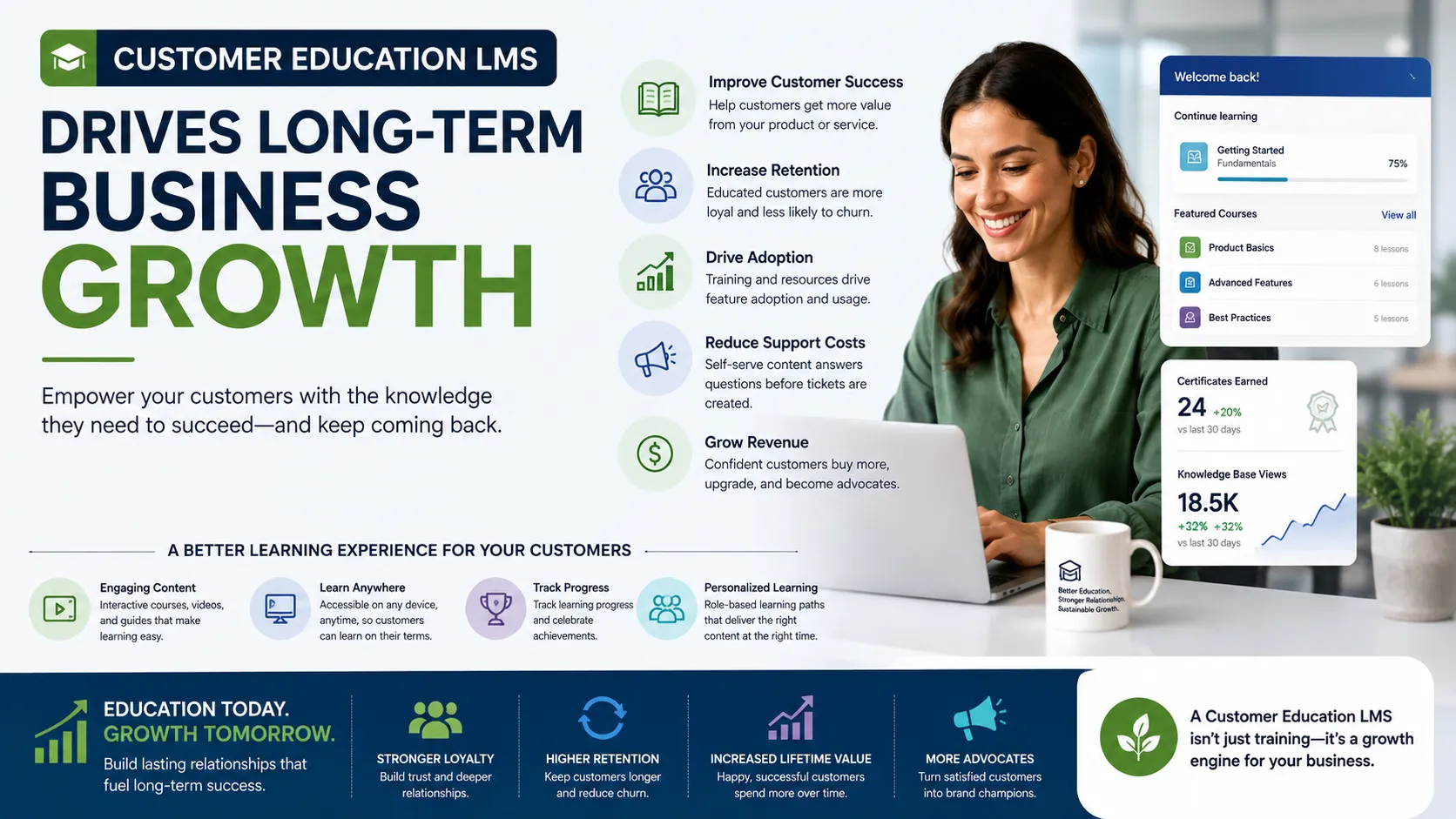
Customer education affects far more than early product setup. It shapes daily use, confidence, support needs, and renewal decisions over time.
When buyers receive clear instructions after purchase, they reach meaningful outcomes sooner and with less strain.
That steadier progress helps companies protect revenue, reduce avoidable service pressure, and build stronger customer relationships.
Faster Value
Early frustration can stall momentum before customers experience practical results.
At that stage, a customer education LMS gives teams a single place to deliver guided lessons, track milestones, and provide timely support resources.
Customers move through core tasks with less hesitation, while internal leaders see where people slow down, pause, or need reinforcement. Faster progress during those first weeks often sets the tone for the full account relationship.
Better Adoption
Usage improves when instructions match the exact tasks customers need to complete. Short modules, clear examples, and searchable answers reduce hesitation during setup and routine work.
As users gain fluency, the product becomes part of normal operations rather than a tool used only in bursts.
That shift matters because renewal risk rises when teams never build dependable habits around a purchase.
Lower Support Demand
Support teams often absorb work that training could prevent. Repeated questions about setup, access, or basic workflows usually signal missing instructions rather than product failure.
A structured education program addresses those issues before a ticket appears. Service staff can then focus on exceptions, edge cases, and sensitive problems that require judgment, context, and direct attention from an experienced person.
Stronger Retention
Retention grows when customers feel capable after the sale, not stranded once onboarding ends. Education reinforces competent use through practice, repetition, and timely reminders tied to real work.
People who reach desired outcomes are less likely to cancel during budget reviews or leadership changes. That pattern has financial weight because keeping an account usually costs less than replacing one through fresh acquisition efforts.
Higher Expansion
Expansion rarely comes from pressure alone. It comes from a visible value that customers can recognize in their own operations.
Education helps surface advanced features, broader use cases, and team-level workflows at the right moment.
Once buyers understand how added capacity improves results, larger plans or additional seats feel justified. Clear instructions give expansion a practical basis rather than a sales-driven pitch.
Clearer Data
Training activity produces useful operational signals. Completion rates, quiz scores, lesson drop-off points, and search behavior reveal where customers hesitate or lose clarity.
Those patterns help teams revise content and tighten onboarding sequences. Product leaders also gain evidence about which features create confusion, which supports better interface decisions. Over time, learning data can improve communication across service, sales, and product functions.
More Consistent Onboarding
Onboarding quality often shifts when delivery depends fully on live calls or individual account habits. A shared training system creates a steadier experience across customer types and team sizes.
Each new account receives the same core guidance, regardless of location or account owner. That consistency strengthens trust and makes growth easier to manage when volume rises faster than headcount or training capacity.
Stronger Partner Enablement
Partners need accurate instructions if they are expected to represent a product well. Resellers, agencies, and channel teams perform better when guidance is current, structured, and easy to access.
A formal education program helps them explain features clearly and support buyers with fewer errors. Better-prepared partners can improve customer confidence early, which supports stronger retention and cleaner handoffs after the sale.
Customer Proof
Education also strengthens credibility in the market. Customers who learn quickly often reach useful outcomes sooner, which can lead to better reviews, stronger references, and more persuasive case studies.
Teams can connect training completion with adoption patterns, renewal timing, and account health signals. That evidence helps leadership show that education contributes measurable business value rather than serving as a side initiative.
Long-Term Efficiency
Growth becomes expensive when every new customer needs the same explanation from a person each time. Education creates reusable resources that continue delivering value after launch.
Lessons can be updated, localized, and assigned across multiple accounts without rebuilding the full experience for each. Over time, that model improves cost control and service quality without requiring staffing growth to keep pace.
Choosing What Matters
Strong programs begin with customer tasks, not content volume. Companies benefit most when learning paths reflect roles, common workflows, and clear success markers.
Navigation should remain simple, reporting should be useful, and updates should be easy to manage. Training earns repeat use when it answers real needs at the right time. Relevance, more than quantity, determines whether education supports lasting business results.
Conclusion
A customer education LMS supports durable growth by improving what matters after you sign the contract. Clear training helps customers adopt more quickly, require less routine support, stay longer, and expand with better judgment.
Those effects build on one another over time, which makes education a practical business function rather than a nice extra. Companies that teach customers well often achieve higher retention, greater efficiency, and steadier revenue quality.