

You are eleven days into your first hotel purchase. The purchase agreement is signed, the seller is motivated, and the banker on the phone has just asked you to send over the STR report and the current PIP scope. You have no idea what either of those is. You have the last three years of tax returns, you have a personal financial statement, and you have a very good feeling about the property. None of that is what he asked for.
That call is where most first-time hotel deals lose two or three weeks, and sometimes lose the deal. It is not because the buyer is unqualified. It is because a hotel is underwritten as an operating business with a nightly revenue line, a franchise contract, and a renovation obligation attached, and almost nobody tells you that before you apply. The American Hotel and Lodging Association reported in its 2026 State of the Industry release that gross operating profit per available room in 2025 was still running at roughly 90 percent of 2019 levels. Lenders know that number. It is why they read hotel files harder than they read a dental practice.
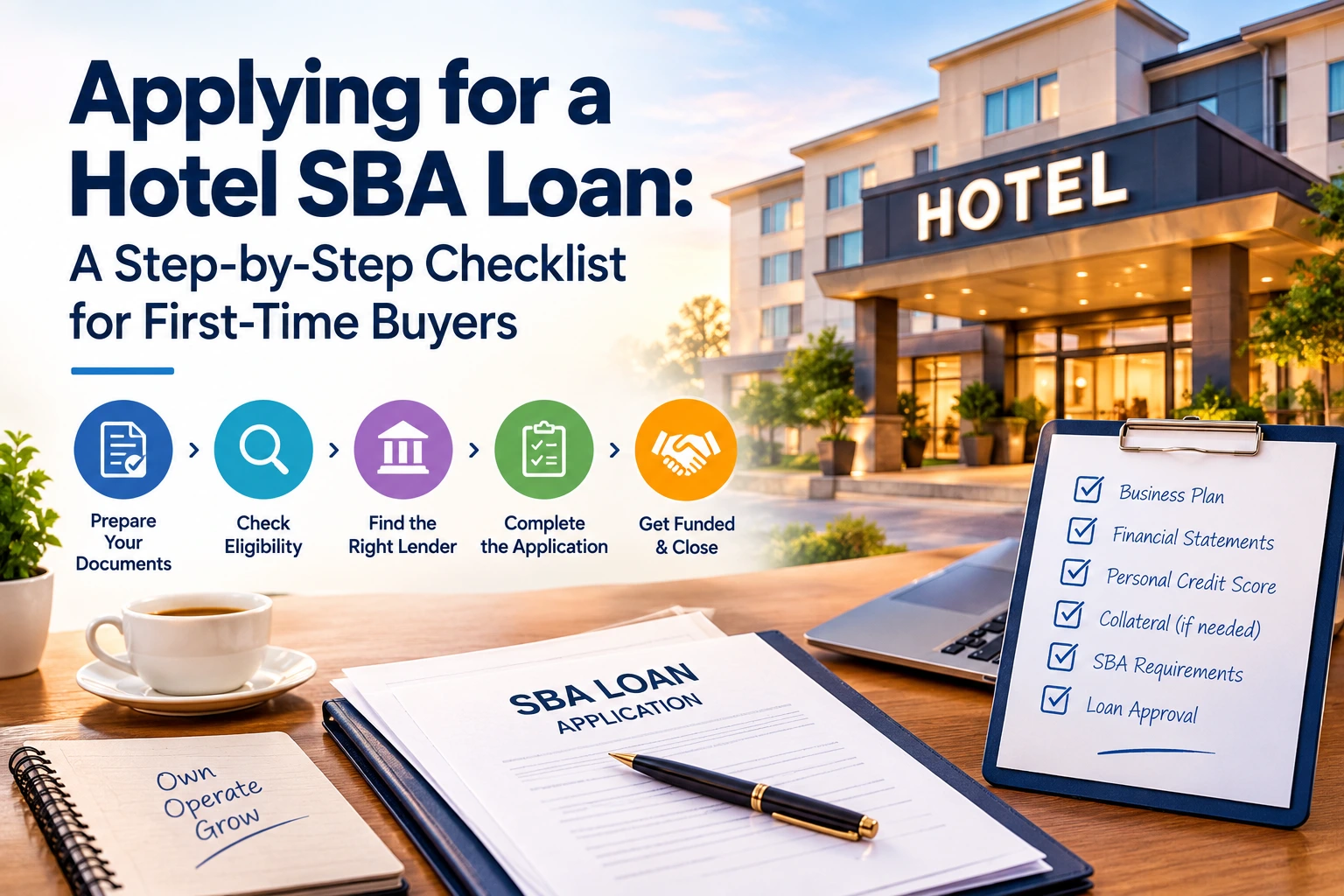
What follows is the application in the order it actually happens, from the work you do before you talk to anyone through to the closing table. Every term is defined the first time it shows up.
The Vocabulary You Will Hear Before You Hear a Yes
Learn these six before you make the first call. Most of the confusion in a first hotel application is vocabulary, not finance.
SBA 7(a) loan. A small business loan made and funded by a bank or a non-bank lender, with the U.S. Small Business Administration guaranteeing a majority share of it for that lender. The SBA is not writing you a check. A participating lender is, and the guaranty is what makes the lender willing to write it.
Occupancy, ADR, and RevPAR. Occupancy is the share of your available rooms that sold. ADR is the average daily rate, meaning the average revenue per occupied room. RevPAR is revenue per available room, which is occupancy multiplied by ADR. RevPAR is the number an underwriter reaches for first, because it captures whether you are filling rooms at a price that actually works.
STR report. A benchmarking report that measures one property against a competitive set of nearby hotels on occupancy, ADR, and RevPAR. Lenders want it because it answers a question your own profit and loss statement cannot: is this a weak hotel, or a weak market?
Flag. The brand over the door, meaning the franchise agreement with a hotel company such as a Hilton, Marriott, or Choice brand. An unbranded property is called independent.
PIP. Property improvement plan. The list of renovations a franchisor requires, on a deadline, usually triggered when the property changes hands or the franchise agreement is renewed.
DSCR. Debt service coverage ratio, calculated as the property’s annual net operating income divided by its annual loan payments. A ratio of 1.25 means the hotel produces one dollar and twenty five cents of income for every dollar of debt service.
Step 1: Confirm Your Deal Fits Under the $5 Million Ceiling
The SBA caps an individual 7(a) loan at $5,000,000. That is a hard number, and hotel deals bump into it more often than any other vertical, because the purchase price is rarely the whole cost. Add a required renovation, add furniture and equipment, add a few months of working capital for the first slow season, and a $4.2 million hotel becomes a $5.4 million project.
Run that total first. If it clears the ceiling, you are looking at a different structure, most likely the SBA 504 program, which splits a project across a conventional lender and a Certified Development Company and reaches higher totals on real estate-heavy deals. If you land under the ceiling, 7(a) is usually the better tool for a first hotel, because one loan can carry the business, the real estate, the equipment, the renovation, the working capital, and a refinance of existing debt.
Doing this arithmetic on day one saves you from the most demoralizing version of this process, which is spending six weeks assembling a 7(a) file for a project that was never going to fit inside a 7(a).
Step 2: Pre-Qualify Yourself Before a Lender Does It for You
Baseline SBA eligibility is straightforward. The business must be for-profit, based in the United States, small under the SBA’s size standards, and unable to get comparable credit on reasonable terms elsewhere. You must be able to show creditworthiness and the ability to repay. That gets you in the room. It does not get you approved.
Four things decide a hotel file.
Equity injection. The SBA floor for a 7(a) is 10 percent. On hospitality, and particularly for a buyer with no hotel operating history, lenders routinely want more than the floor. They are pricing your inexperience, and they will say so if you ask.
Personal guarantee. Under SBA’s rules on loan conditions, holders of at least a 20 percent ownership interest generally must guarantee the loan. There is no version of this deal where forming a new entity makes the guarantee go away.
Coverage. Every lender sets its own minimum DSCR and its own adjustments, typically deducting a management fee and a furniture and equipment replacement reserve before it calculates coverage, even if the current owner never booked either one. Ask each lender how it adjusts. The answer changes the number materially.
Operating history. Yours and the property’s. If you have never run a hotel, a lender will look for a management company, a partner with hospitality experience, or a franchisor training program in the file. Bringing that to the table before you are asked reads as competence.
Step 3: Assemble the Hotel Document Set
This is the stage where the eleven-day phone call happens. Build the file before a lender asks, and you compress the timeline by weeks. A working checklist for a hotel acquisition:
- Three years of the property’s profit and loss statements and federal tax returns, plus year-to-date figures.
- A trailing twelve-month operating statement, month by month, so the lender can see the seasonality rather than an annual average.
- The STR report for the property, covering occupancy, ADR, and RevPAR against the competitive set.
- The franchise agreement, if the hotel is flagged, plus the franchise disclosure document and any transfer requirements.
- The PIP scope and cost estimate, if one has been issued or is expected on transfer.
- The purchase agreement, the asset schedule, and the seller’s rent roll or group contracts if any exist.
- Your personal financial statement, three years of personal tax returns, and a resume that establishes management experience.
- A business plan with your projections and the assumptions under them, stated plainly.
- Entity documents, licenses, and permits.
- Environmental site assessment scope, which lenders order on almost every hotel because of underground tanks, dry cleaning history, and pool chemical storage.
Two notes on this list. The trailing twelve-month statement matters more than the annual one, because a seasonal property that averages fine on paper can be uncoverable in February. And your projections should reconcile to the STR data, not float above it. Underwriters compare the two, and an optimistic projection with nothing beneath it costs you credibility on every other number in the file.
Step 4: Read the Flag and Price the PIP Before You Apply
Franchise obligations are the single most common surprise in a first-time hotel deal, and they land after the numbers are already set.
When a flagged hotel changes ownership, the franchisor generally has to approve the buyer, and it usually issues a property improvement plan as a condition of the transfer. That PIP can run from cosmetic soft goods work to a full guest room and lobby renovation with a completion deadline. It is a real, contractual capital obligation, and a lender will treat it as one whether or not you budgeted for it.
Do three things before you submit an application. Ask the seller for any PIP already issued or discussed. Contact the franchisor directly about transfer requirements and expected scope. Then put the estimate into your project total in Step 1 and back into your coverage math in Step 2. A PIP discovered during underwriting adds cost, and it also resets your loan amount, your equity injection, and sometimes your eligibility under the ceiling, all at the point where you have the least time to react.
If you are converting a flag or taking an independent property into a brand, the scope grows again. That is a workable deal, and lenders fund conversions all the time. It is not a deal to price casually.
Step 5: Shortlist Lenders That Actually Fund Hotels
Two lenders can read the same file and reach opposite conclusions, because one has funded forty hotels and the other funded one in 2019 and is still thinking about it. Hospitality sits inside some lenders’ credit boxes and outside others, and the ones that avoid it rarely say so on the website.
What you are looking for is specific. Does this lender fund hotel acquisitions in this asset class and this price range? Does it have delegated authority from the SBA, which the agency grants for a term of up to two years to lenders with a demonstrated ability to process, close, service, and liquidate SBA loans, and which in practice means the lender can approve inside its own credit process rather than waiting on the agency? Does it understand a PIP without you having to explain one? Names that come up repeatedly on hospitality files include Live Oak Bank, Celtic Bank, Byline Bank, Huntington National Bank, GBank, and Bank of Hope, though appetite shifts year to year and a lender that was aggressive on hotels last spring may have filled its concentration by now. Treat any list, including that one, as a starting point rather than an answer.
Deal size sorts lenders as sharply as asset class does. Below roughly $500,000, a hotel request competes for attention against small-ticket, largely automated small business lending, and the online lenders that dominate that lane mostly do not write hospitality acquisitions at all. Between $500,000 and the $5,000,000 ceiling, which is where nearly every real hotel purchase sits, the file needs a lender with an actual hospitality credit officer, a construction or renovation draw process for the PIP, and recent hotel closings to point at. Those are not the same institutions. A borrower who starts at the branch where the business checking account lives is usually starting outside the right group entirely, and the branch will take four weeks to work that out.
Finding out which lender is genuinely open this quarter is the part borrowers cannot do efficiently on their own, because it means calling banks one at a time and being told no slowly. Brokers exist for this. 7aSavvy, for example, works specifically on SBA 7(a) loans for hotels and other large deals in the $500,000 to $5,000,000 band, reading the file first and then routing it to a lender that already writes hotel acquisition financing, with the introduction going to someone at Vice President level or higher rather than into a branch queue. The firm states more than 100 SBA 7(a) lender connections; it re-matches a file to another lender if the first one passes, and because lenders pay a referral fee when the loan funds, the borrower is not charged for the match.
However you build the shortlist, build it before you send the file anywhere. Applying to four lenders in sequence and hoping is the slowest possible path to a hotel closing.
Step 6: Compare What You Are Actually Offered
When term sheets arrive, read past the headline rate.
Most 7(a) loans are variable and quoted as a base rate plus a spread. For a hotel loan, which will be well above $350,000, SBA’s published maximums cap a variable rate at the base rate plus 3.0 percent. When the lender uses prime as its base, that ceiling moves with prime, and the Federal Reserve’s H.15 release put the bank prime loan rate at 6.75 percent as of September 3, 2026. Do the arithmetic yourself for whatever prime reads on the day you are quoted, and remember it is a ceiling, not a quote. A lender competing for a good hotel file will price under it.
Then compare the rest, because this is where offers separate:
- Maturity. SBA allows up to 25 years on real estate, which is what stretches a hotel payment into something coverable. Shorter maturities are legal and are sometimes offered. They change the DSCR outcome more than a quarter point of rate does.
- The SBA guaranty fee, which the lender pays and may pass to the borrower, and which is set annually by fiscal year.
- Prepayment terms, which on longer 7(a) maturities carry a declining penalty in the early years.
- Whether the PIP and working capital sit inside this loan or require a second facility.
- What is being escrowed, including any replacement reserve, and whether the lender counts that reserve against coverage.
Step 7: Get Through Underwriting Without Stalling
Once the file is in, three things drive the calendar: the appraisal, the environmental report, and whatever the underwriter asks for that you do not have yet.
A hotel appraisal is a business valuation with real estate attached, and it typically takes longer than a straight commercial appraisal because the appraiser works through your operating statements and comp set. Order it early. Environmental review runs on its own track and can escalate from a first phase assessment to a second phase, which adds time. If your property has a history of underground storage tanks or an adjacent dry cleaner, expect the escalation and plan for it.
The rest of underwriting is responsiveness. A standard 7(a) commonly runs 45 to 90 days from funding application, and the files that land at the short end of that band are the ones where every request comes back inside 48 hours with a complete answer. The ones that take four months are usually not complicated deals. They are deals where someone took nine days to find a franchise document.
Step 8: Close
The last stretch is conditions clearing. Expect a title commitment, a survey, entity and licensing verification, franchise transfer approval in writing, proof of your equity injection with sourcing documentation, and insurance. On insurance, the SBA’s loan conditions require hazard insurance on all collateral for 7(a) loans greater than $500,000, so a hotel deal will always trigger it. Start the insurance conversation two weeks before you think you need to, because binding coverage on a coastal or wildfire-exposed hotel is not a same-day errand.
Then you own a hotel, and the PIP clock starts.
Key Takeaways
- Total the whole project, not the purchase price, before anything else. Purchase plus PIP plus equipment plus working capital has to fit under the $5,000,000 7(a) ceiling, or the deal belongs in a different structure.
- The SBA equity floor is 10 percent, and hotel lenders frequently want more from a first-time operator. Any owner at 20 percent or above signs a personal guarantee.
- The STR report and a month-by-month trailing twelve-month statement are the two documents first-time buyers are least likely to have, and lenders are most likely to want first.
- Price the property improvement plan before you apply, not during underwriting. It moves your loan amount, your equity, and your coverage all at once.
- Lender fit decides hotel deals. Ask directly about hospitality appetite, delegated authority, and how the lender adjusts net operating income before it calculates DSCR.
- Compare maturity, fees, prepayment, and reserve treatment alongside the rate. The SBA ceiling for a loan of this size is the base rate plus 3.0 percent, and a competitive lender will price beneath it.
- Budget 45 to 90 days, and understand that your own response speed is the variable you actually control.
Nothing in this list requires a hospitality background. It requires knowing what the questions are going to be a few weeks before anyone asks them, which is the entire difference between a first hotel purchase that closes on schedule and one that spends its option period looking for paperwork.