Earnings Per Click (EPC): What It Means and How to Use It
Earnings per click (EPC) tells you the average amount of revenue generated for every 100 clicks sent to an affiliate offer. It’s one of the most widely used metrics for comparing affiliate programs, but it only tells part of the story — here’s how to read it correctly.
What does EPC mean in affiliate marketing?
EPC stands for Earnings Per Click. It’s a benchmark affiliate networks display next to each merchant or offer so publishers can gauge earning potential before sending traffic.
EPC is typically calculated per 100 clicks rather than per single click, since a per-click figure would usually be a fraction of a cent and harder to compare at a glance. It’s one of the core metrics referenced throughout affiliate marketing programs, alongside conversion rate and commission structure. You’ll see EPC on network dashboards like this one from CJ Affiliate:
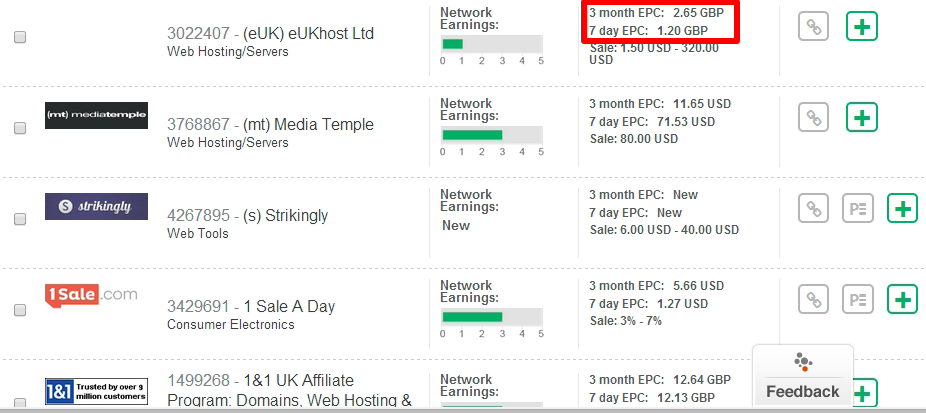
Publishers use EPC to shortlist which merchants or offers are worth testing, then validate performance against their own traffic once a campaign is live.
How to calculate EPC
The standard EPC formula is:
EPC = (Affiliate earnings ÷ Number of clicks) × 100
For example, if an offer generated $700 in commissions from 2,000 clicks:
($700 ÷ 2,000) × 100 = $35 EPC
That means for every 100 clicks sent, the affiliate earned $35 on average.
A few things to keep in mind about the formula:
- It’s a historical average, not a guarantee. EPC reflects what happened over a past period (often the last 7 or 30 days), not what you’ll necessarily earn going forward.
- It’s blended across all affiliates on that offer. Your actual results will vary based on your traffic quality, audience match, and where clicks originate.
- Networks calculate it slightly differently. Some use a rolling 7-day window, others 30 or 90 days — always check which period a displayed EPC covers before comparing offers across networks.
If you’re trying to compare an affiliate offer against a display-advertising unit, EPC can be converted into RPM (revenue per thousand impressions) — useful when you want to weigh affiliate offers against CPM-based ad units on an apples-to-apples basis.
What is a good EPC?
There’s no universal “good” EPC number — it depends heavily on the vertical, the network, and the average order value of the product being promoted. A high-ticket B2B software offer will naturally post a much higher EPC than a $15 consumer product, simply because commissions per sale are larger.
That said, here’s a general way to evaluate whether an EPC is strong for a given offer:
| Signal | What it suggests |
| EPC is well above the network/category average | Offer converts well and pays competitively — worth testing |
| EPC is in line with category average | Solid, unremarkable offer — fine as one option among several |
| EPC is far below category average | Either low commission, poor conversion, or low relevance — investigate before committing traffic |
| EPC is unusually high relative to relevance | Treat with caution — may reflect a small sample size or an unsustainable promo rate |
Rather than chasing the single highest EPC number, compare it against:
- The network or category average EPC (most networks display this alongside the merchant’s own EPC)
- How closely the merchant matches your audience — high EPC on an irrelevant offer usually converts worse than the reported number suggests
- Cookie duration and commission structure, which affect real-world earnings even when EPC looks similar between two offers
As covered in the Predictive Power considerations below, a site’s own conversion rate can push realized earnings meaningfully above or below the published EPC — so “good” is ultimately confirmed by testing, not just by the number on the dashboard.
EPC vs CPC
EPC and CPC are often confused because both are click-based metrics, but they measure opposite sides of the transaction:
| EPC (Earnings Per Click) | CPC (Cost Per Click) | |
| Perspective | Publisher/affiliate earnings | Advertiser cost |
| Measures | Revenue earned per click sent | Amount paid per click received |
| Used in | Affiliate marketing | PPC advertising (Google Ads, Bing Ads, etc.) |
| Formula | Earnings ÷ Clicks × 100 | Ad spend ÷ Clicks |
| Goal | Maximize (as a publisher) | Minimize (as an advertiser), while maintaining conversion volume |
In short: EPC tells a publisher how much they’re likely to earn for the traffic they send. CPC tells an advertiser how much they’re paying for the traffic they receive. They’re two ends of the same click — a high EPC for a publisher on an affiliate offer doesn’t have any direct relationship to what an advertiser might pay per click in a PPC campaign for a similar product.
It’s also worth distinguishing EPC from cost per action (CPA), the pricing model most affiliate programs actually run on. Under CPA, the advertiser only pays when a click converts into a sale, lead, or signup — EPC is simply how publishers express their average earnings from that CPA arrangement on a per-click basis.
Predictive Power: Why Realized EPC Can Differ from Reported EPC
The EPC shown on an affiliate dashboard is a network-wide average — the amount your site actually realizes can be meaningfully higher or lower, mainly due to differences in conversion rate between sites.
Under the affiliate model, a click alone doesn’t generate revenue. The referring site earns a commission only when a specific action completes (a purchase, a signup, etc.). So:
- If your site’s conversion rate is higher than average, your realized EPC will be higher than the reported EPC
- If your site’s conversion rate is lower than average, your realized EPC will be lower than the reported EPC
Higher EPC Isn’t Always Better
EPC is useful for comparison, but it shouldn’t be the only number publishers weigh. Consider a blog about classic cars evaluating two merchants:
And here’s merchant number two:
The first merchant (AT&T) shows an EPC of nearly $350 per 100 clicks — more than 10x the second merchant. But the second merchant is far more relevant to the blog’s audience, which means the click-through rate on that link will likely be much higher, as will the conversion rate once visitors land on the offer.
Put another way, actual affiliate earnings break down as:
Earnings = Pageviews × Click Rate × Conversion Rate × Commission
EPC only captures the last two variables in that equation — and only as network averages, not for your specific site. Click rate matters just as much and isn’t reflected in the EPC figure at all.
EPC Affiliate Programs
An “EPC affiliate program” isn’t a distinct type of program — it just refers to any affiliate program where EPC (per 100 clicks) is the metric used to report earning potential. This makes it easy to compare profitability across different partners side by side, and to see how different campaigns or links for the same product perform relative to one another.
FAQ
What does EPC (Earnings Per Click) mean?
EPC stands for Earnings Per Click. It’s used by affiliate marketers to compare offers by taking total earnings and dividing by the number of clicks generated (typically expressed per 100 clicks).
What is the difference between PPC and EPC?
PPC (pay-per-click) is an advertising model where advertisers pay a publisher each time their ad is clicked. EPC, by contrast, measures the commission an affiliate generates and how many clicks it took to generate it — one is a cost metric, the other is an earnings metric.
How is the EPC formula calculated?
Take total earnings generated over a period and divide by the total number of clicks generated over that same period, then multiply by 100.
Why is EPC an important metric?
EPC gives publishers a benchmark for the amount of money they can expect to earn per click, based on historic performance — useful for comparing and prioritizing affiliate offers.
What is a good EPC?
It depends on the vertical and average order value of the offer. Rather than judging EPC in isolation, compare it to the network or category average, and confirm it against your own traffic’s conversion rate once live.
How does EPC differ from CPC?
EPC measures what a publisher earns per click sent (affiliate marketing); CPC measures what an advertiser pays per click received (PPC advertising). They represent opposite sides of the same click.
EPC Affiliate Program
EPC affiliate programs are schemes that pay commission per 100 clicks achieved, making it easy to assess the profitability of different affiliate partnerships side by side, as well as showing how different campaigns and links for the same product or partner perform compared to each other.
FAQ
What does EPC (Earning Per Click) Mean?
EPC stands for Earnings Per Click, and is used for affiliate marketers for different offers. For your campaigns you take total earnings and divide it by number of clicks.
What is the difference between PPC and EPC?
PPC is the pay per click advertising model wherein advertisers pay the publisher each time their ads are clicked. Whereas, EPCis concerned with the total commission that is generated and how many clicks it has used to do it
how the earning per click (EPC) formula is calculated?
To calculate earning per click (EPC), it simply just by taking the total earning you have generated over a period, and the then dividing that by the total number of clicks you have generated over the same period
Why is earning per click (EPC) an important metric?
Earning per click (EPC) gives you the exact amount of money you can expect to receive for every click generated based on historic performance