

Imagine a campaign that can tweak its own message, move money to the best channels, pause weak ads, and give each customer a personal experience — all while you sit back with zero dashboard drama.
That’s autonomous campaign orchestration, and it’s basically marketing on its own brainpower. Old automation was helpful, sure, but it still needed a human babysitter.
This new wave of AI doesn’t just follow orders — it thinks, adapts, and acts in real time. And honestly, whether you’re leading a brand or just trying not to waste ad money like it’s confetti, this is the future you need to understand.
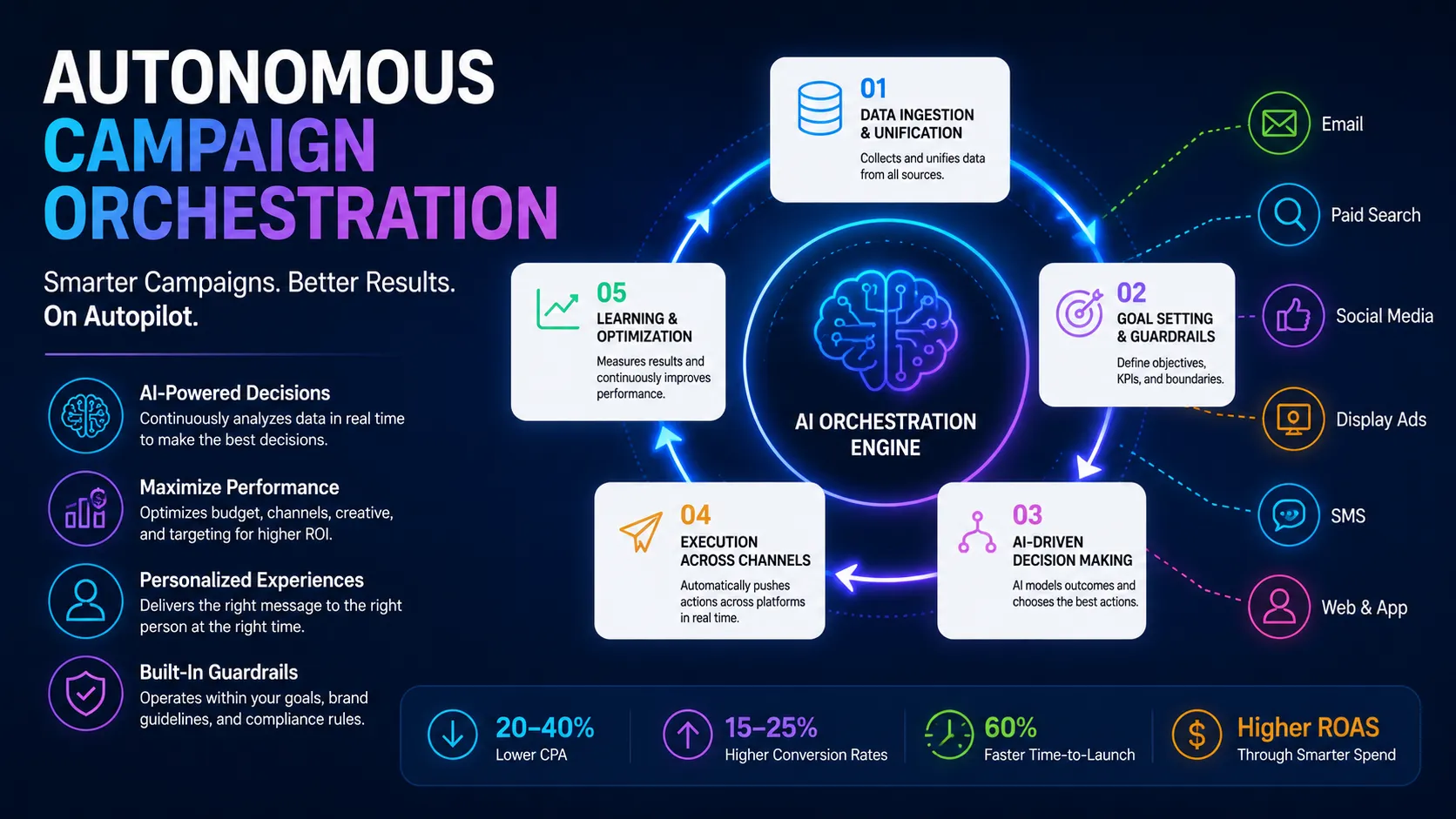
What Is Autonomous Campaign Orchestration?
Autonomous campaign orchestration is like having an AI marketing teammate that never sleeps. Instead of waiting for someone to tell it what to do, it watches what’s happening, learns from the data, and makes smart decisions on its own.
Think of traditional automation as a robot following a checklist. Autonomous orchestration is more like a skilled coach constantly changing the game plan to help the team win.
Key things it can do include:
- Coordinate every channel — Keeping email, social media, ads, SMS, and other channels working together instead of acting like separate teams.
- Move budget automatically — Sending more money to what’s working and cutting spend on what isn’t.
- Find the right people early — Predicting who is most likely to become a customer before they even raise their hand.
- Improve ads on the fly — Mixing and matching headlines, images, and offers to find winning combinations.
- Learn from results — Tracking what actually drives sales and using those lessons to get smarter over time.
Why Is Autonomous Orchestration Gaining Momentum Now?
A few big changes have pushed autonomous campaign orchestration from a cool idea to something marketers genuinely need in 2026.
1. The End of Third-Party Cookies
Marketers lost one of their favorite tracking tools when third-party cookies disappeared. AI stepped in by using first-party data and smarter audience insights, often doing an even better job while respecting privacy.
2. Too Many Channels to Manage
Think about how often you switch between apps in a day. Customers do the same with brands. When people interact through email, social media, ads, websites, and more, keeping everything consistent manually becomes a nightmare.
3. AI Got a Lot Smarter
Modern AI can create and test hundreds of ad versions in the time it takes a human to write a few. It learns what people respond to and keeps improving, almost like a marketing scientist running nonstop experiments.
4. Data Moves in Real Time
Today’s systems can collect and process customer data almost instantly. That means AI isn’t making guesses based on yesterday’s information—it can react to what’s happening right now and make better decisions faster.
How Does Autonomous Campaign Orchestration Actually Work?
At first, autonomous campaign orchestration can sound like magic. But it’s really just a smart system following a process—kind of like a super-fast marketing coach that never sleeps.
Step 1: Gather All the Data
First, the AI collects information from everywhere: websites, ads, customer databases, emails, and more. Think of it as gathering all the puzzle pieces before trying to see the full picture.
Step 2: Set the Goals and Rules
Humans still decide what success looks like. Maybe the goal is more sales, lower costs, or reaching a certain number of people. We also set the “do not cross” lines, like budget limits and brand guidelines. The AI gets freedom, but not a free pass.
Step 3: Let the AI Make Smart Choices
Now the fun begins. The AI constantly asks questions like:
- Who should see this ad?
- Which channel should get more attention?
- Should we spend more or less money here?
- Which version of the ad is most likely to work?
It’s like a chess player thinking several moves ahead every second.
Step 4: Launch Actions Automatically
Once the AI decides what to do, it updates ads, emails, messages, and other channels automatically. No waiting around for someone to click a button.
Step 5: Learn and Get Smarter
Every click, purchase, and interaction becomes a lesson. The AI studies what worked, what flopped, and what surprised it. Over time, it gets better and better—like a gamer leveling up after every match.
What Are the Proven Business Benefits?
Companies using autonomous campaign orchestration aren’t just saving time—they’re getting better results with less guesswork.
- Lower customer acquisition costs — The AI quickly finds what’s working and stops wasting money on what isn’t.
- Faster campaign launches — Tasks that once took days can happen in hours, giving marketers more time for big ideas.
- Higher conversion rates — Customers get more relevant messages, making them more likely to click, sign up, or buy.
- Smarter ad spending — The system automatically shifts budget toward the channels delivering the best results.
- Stronger brand consistency — Customers get a smoother experience because every channel stays on the same page.
What Challenges Should Marketers Anticipate?
As powerful as this technology is, it’s not a magic wand. Like giving a race car to a new driver, you still need the right setup and skills.
Data Quality Matters
If the AI is fed messy or incomplete data, it can make bad decisions very quickly. Great data is the foundation of everything.
Less Creative Control
AI can optimize content on the fly, but without clear guidelines, your brand voice can start to wander. Humans still need to steer the ship.
Trusting the AI
Sometimes the system makes a decision that isn’t immediately obvious. Teams need transparency so they understand what the AI is doing and why.
Privacy and Compliance
AI must follow privacy laws and handle customer data responsibly. This can’t be an afterthought—it has to be built into the system from day one.
New Skills for Marketers
The role of marketers is changing. Instead of spending hours clicking buttons and managing campaigns, they’ll spend more time setting strategy, guiding AI, and thinking about the bigger picture.
Which Industries Are Leading the Adoption Curve?
Some industries jumped on autonomous campaign orchestration early because the benefits were too big to ignore.
- E-commerce and retail — AI helps recommend the right products, manage changing prices, and react to customer behavior instantly.
- Financial services — Banks and insurers use AI to spot important life moments, like buying a house or planning investments.
- Travel and hospitality — Since demand changes fast, AI helps adjust budgets and promotions on the fly.
- SaaS and technology — Long sales cycles become easier to manage when AI guides customers through the buying journey.
How Do You Get Started With Autonomous Campaign Orchestration?
You don’t need to flip a giant switch overnight. Think of it like learning to drive—you start in an empty parking lot before hitting the highway.
- Audit your data: Make sure your customer data is organized, accurate, and easy to access. AI can’t win a race with a broken engine.
- Set clear goals: Tell the system exactly what success looks like. The clearer the goal, the smarter the decisions.
- Start small: Pick one project, like optimizing email campaigns, and prove the value before expanding.
- Choose the right platform: Look for tools that are transparent, easy to integrate, and strong on privacy and compliance.
- Train your team: Autonomous doesn’t mean “forget about it.” Your team still needs to understand the AI and guide it in the right direction.
- Keep testing and learning: The best companies treat every campaign like a science experiment. Learn, improve, repeat.
Conclusion: The Future of Marketing Is Orchestrated, Not Operated
Marketing is changing fast. The future isn’t about humans spending hours tweaking ads and moving budgets around. It’s about humans setting the vision while AI handles the heavy lifting.
The companies that win won’t be the ones with the most people clicking buttons. They’ll be the ones that combine smart strategy, strong creativity, and intelligent AI systems.
In the years ahead, great campaigns won’t be built piece by piece. They’ll be orchestrated—like a conductor leading an entire orchestra, with every instrument playing at exactly the right moment.