

Imagine pouring your heart into blog posts, guides, and case studies — and then watching people read them, nod along, and disappear like they just remembered they left the stove on. Annoying, right? That is exactly why a B2B content marketing funnel matters.
According to the Content Marketing Institute, most B2B marketers use content, but the ones getting the best results are far more likely to have a clear strategy behind it. That gap is the whole game: good content alone is not enough. You need content that meets buyers at the right moment.
This guide explains what a B2B content marketing funnel is, why it matters, what content fits each stage, and how to track what is actually working — so your content does more than just exist.
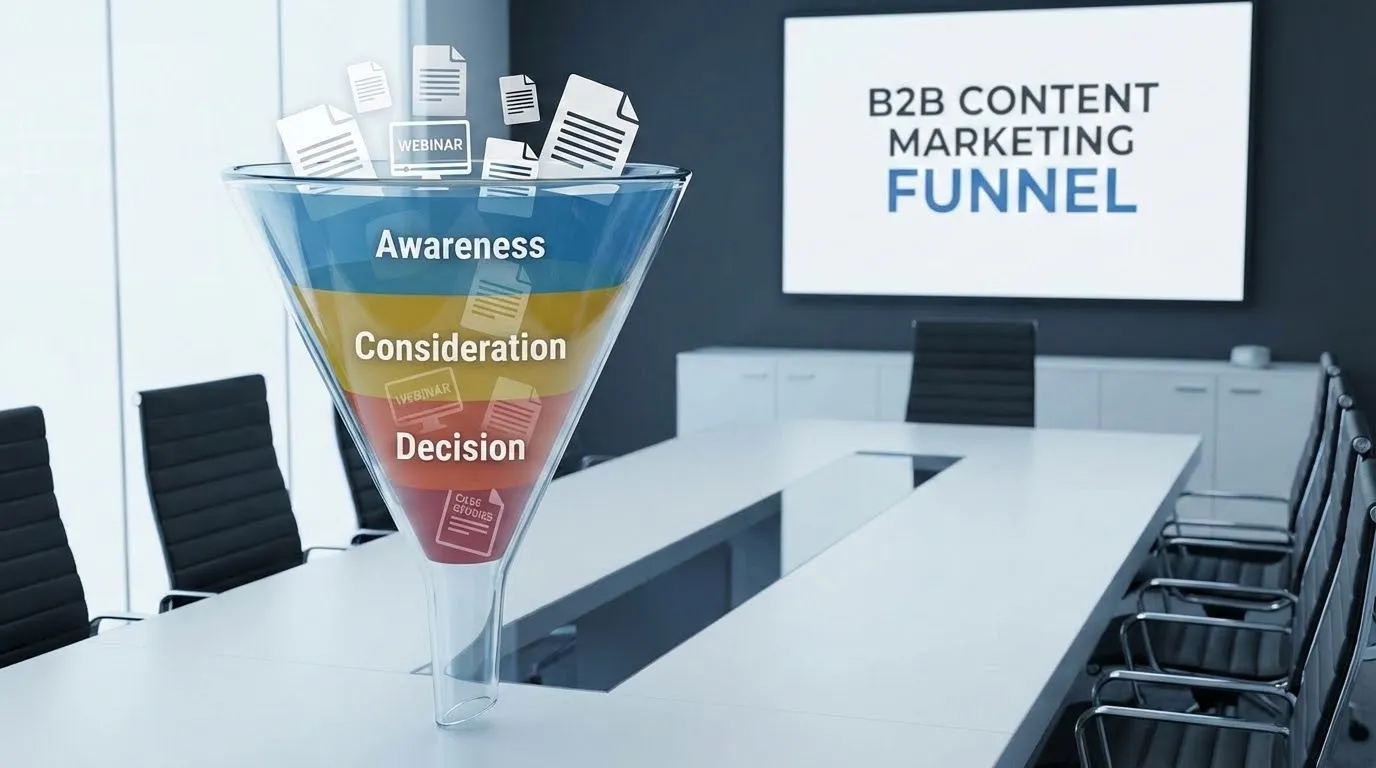
What Is a B2B Content Marketing Funnel?
A B2B content marketing funnel is just a smart way of matching the right content to the right stage of the buyer’s journey — from “I think I have a problem” to “Yep, this is the company I’m buying from.” And in B2B, that journey is usually crowded with a whole squad of decision-makers, not just one person with a credit card and a dream.
The wild part? Buyers spend most of their time researching on their own, not talking to vendors. So your content often has to do the heavy lifting before sales ever gets a chance to shine.
The funnel usually has three stages:
- Top of Funnel (TOFU) — Awareness: People realize they have a problem.
- Middle of Funnel (MOFU) — Consideration: They start comparing solutions.
- Bottom of Funnel (BOFU) — Decision: They pick the vendor they trust most.
| 📊 Key Statistic Content marketing generates three times as many leads as traditional marketing while costing 62% less. — Demand Metric |
Top of Funnel (TOFU): Create Awareness
At the top of the funnel, your job is not to sell — it is to show up. Think of it like this: your audience is Googling their problem at 2 AM, slightly stressed, maybe eating snacks, and your content is the first helpful answer they find. If you immediately scream “BUY MY PRODUCT,” they are gone. But if you teach them something useful? Now you have their attention.
Most B2B teams focus heavily here — and for good reason. This is where people first discover you, usually through search or social media. So your goal is simple: educate, help, and build trust before asking for anything in return.
Best TOFU Content Formats
- Blog Posts & SEO Articles — Write helpful, in-depth guides that answer real questions your audience is searching for. Think “teacher,” not “salesperson.”
- Short-Form Video — Quick, punchy videos that explain ideas fast. Perfect for grabbing attention on platforms like LinkedIn.
- Infographics & Data Visualizations — Turn boring stats into visuals people actually want to share. Make smart look simple.
- Podcasts & Webinars — Talk through ideas, tell stories, and show expertise. It is like letting people “hang out” with your brain for a bit.
- Social Media Content — This is your loudspeaker. Show up consistently, share insights, and be helpful. This is often where people discover you for the first time.
Middle of Funnel (MOFU): Nurture and Educate
Alright, this is where things get serious. At this stage, your audience is no longer just “curious” — they are comparing options like someone choosing a new phone after watching 20 YouTube reviews. This is where deals are won… or quietly lost.
Here is the reality: buyers are consuming tons of content on their own — reading, comparing, double-checking — all without talking to sales. So your content has to step up and basically act like a really helpful guide who says, “Hey, here’s why this solution actually makes sense for you.”
Best MOFU Content Formats
- Case Studies — Show real proof. Not “we’re amazing,” but “here’s exactly how we helped someone like you win.” Numbers make it hit harder.
- E-books & Whitepapers — Go deeper. This is for people who want to really understand the problem and solutions, not just skim headlines.
- Email Nurture Sequences — Think of this like staying in touch without being annoying. Helpful emails that keep reminding them, “Hey, we’ve got you.”
- Comparison Guides & Product Overviews — Help them choose. Break down differences clearly so they don’t get overwhelmed and give up. For example, InviteDesk’s comparison of event management software can help buyers evaluate different options before making a decision.
- Webinars & Virtual Events — This is your chance to connect, explain, and answer questions in real time — like a live class, but way more relevant to their problems.
Bottom of Funnel (BOFU): Drive Decisions
This is the final boss level. Your buyer is this close to choosing — like standing in a store holding two almost identical products, overthinking everything. One wrong doubt, and they walk away. Your job? Remove every bit of hesitation.
Here is the wild part: most buyers have already made up their mind before they ever talk to sales. So your content has to close the deal for you — building trust, answering objections, and making them feel like, “Yep… this is the one.”
Best BOFU Content Formats
- ROI Calculators & Interactive Tools — Show them the money. Help them clearly see, “If I choose this, here’s what I gain.”
- Testimonials & Customer Reviews — Real people, real results. It is like checking reviews before buying anything online.
- Free Trials & Product Demos — Let them test drive it. Once they experience it themselves, fear drops fast.
- Proposal Templates & Sales Enablement Decks — Make it easy for your champion (the person rooting for you inside their company) to convince everyone else.
Distribution: Getting Your Content Seen
Even the most compelling content is worthless if it never reaches your target audience. A documented distribution strategy is as important as the content itself. The most effective B2B distribution channels include:
| Channel | Primary Funnel Stage | Key Metric |
| TOFU + MOFU | Engagement Rate | |
| Email Marketing | MOFU + BOFU | Open & Click Rate |
| Organic Search (SEO) | TOFU | Organic Traffic & Rankings |
| Webinars / Events | MOFU + BOFU | Registrations & Conversions |
| Paid Social | TOFU + MOFU | CPL & MQL Volume |
Measuring Funnel Performance: Metrics That Matter
Many B2B teams chase page views and social likes, but those numbers do not pay the bills. Real content success is when your work actually helps create pipeline and bring in revenue. And with more than half of businesses planning to spend more on content in 2025, the message is clear: prove your content makes money, or budget gets tight fast.
Metrics to Track at Each Funnel Stage
TOFU Metrics:
- Organic traffic growth and keyword rankings
- Social reach and impressions
- New website visitors
MOFU Metrics:
- Marketing qualified leads (MQLs) generated by content
- Email open rates, click-through rates, and nurture sequence performance
- Webinar attendance and engagement rates
BOFU Metrics:
- MQL to SQL conversion rate (industry average: 13% — Implisit)
- Content-influenced pipeline and closed revenue
- Time-to-close for content-engaged leads vs. non-engaged
The Role of AI in Your Content Funnel
AI is like having a super-fast assistant who never sleeps. It helps you brainstorm ideas, summarize research, and even draft content — which is why most marketers are already using it. But here is the catch: AI is a tool, not the brain. If you rely on it to pump out boring, copy-paste content, people (and search engines) will notice… and ignore you.
Where AI really shines is personalization — showing the right content to the right person at the right time. That is how you turn random visitors into real buyers. But the winning teams? They use AI to scale smart strategies, not replace human thinking.
5 Actionable Tips to Optimize Your B2B Content Funnel
- Document your strategy — If it is all in your head, it is not a strategy. Writing it down makes everything clearer and keeps your team aligned.
- Audit and repurpose existing content — Do not reinvent the wheel. One webinar can turn into posts, emails, and more. Work smarter, not harder.
- Prioritize LinkedIn — This is where B2B magic happens. If you had to bet on one platform, this is it.
- Invest in long-form content — Go deep, not just wide. Detailed content builds trust and authority.
- Connect content metrics to revenue — Likes are nice, but money is better. Focus on what actually drives sales, not just what looks good on a dashboard.
Conclusion: Your Funnel Is Your Competitive Advantage
Think of your content funnel like a game plan. Without it, you are just running around hoping to score. With it? Every move has a purpose.
When your content matches each stage of the buyer’s journey, it stops being “just content” and starts acting like your best salesperson — working 24/7, no breaks, no complaints.
Here is the reality: buyers today figure things out on their own before ever talking to a company. So if your content is not guiding them step-by-step, someone else’s will.
Start simple — look at what content you already have, find the gaps, and build around the full journey. Do that consistently, and over time, everything gets easier: more traffic, cheaper leads, and faster sales.