

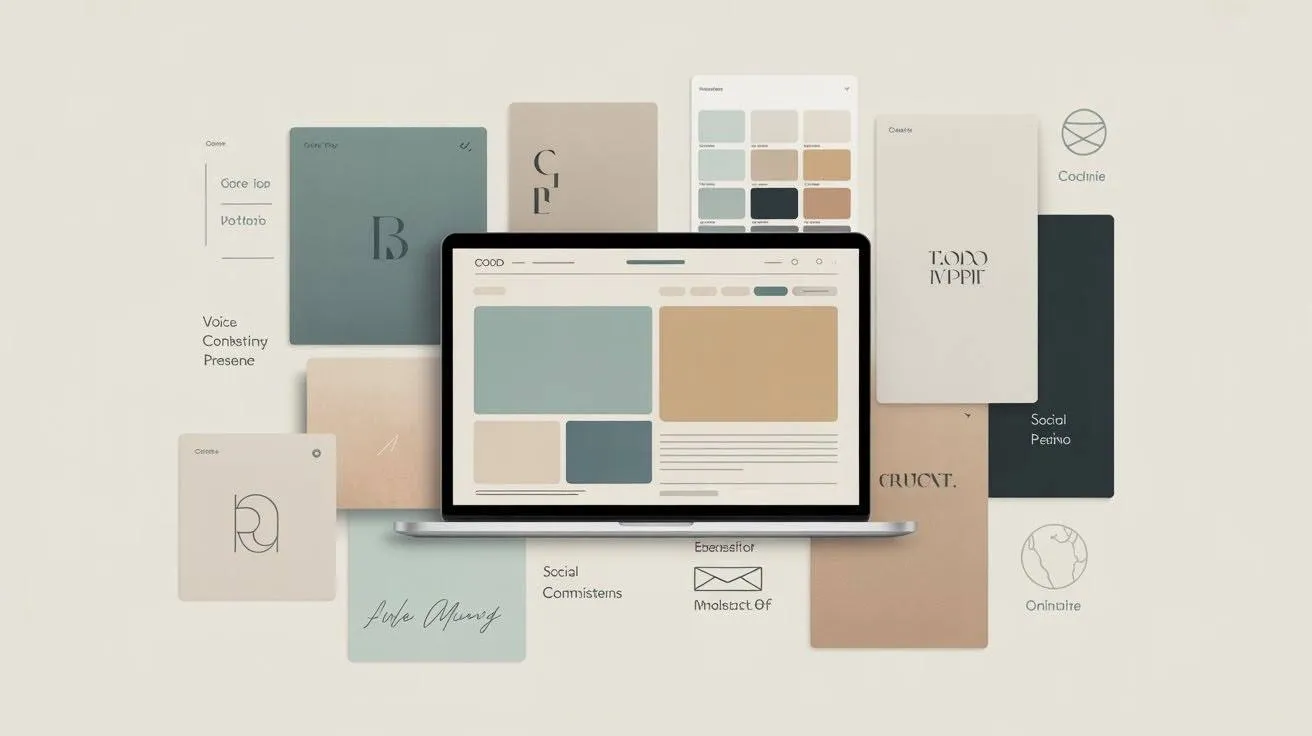
Most website owners get branding completely backwards
Pick a color. Grab a logo from Canva. Ship it. Done, right?
Not even close.
Here’s the thing nobody tells you when you’re deep in keyword research and content calendars: branding is not a design task. It’s a trust infrastructure. The reason a visitor clicks your affiliate link instead of bouncing. The reason a sponsor emails you instead of your competitor. Visual polish is just the surface layer – and honestly, a fairly thin one at that.
Lucidpress tracked this across hundreds of companies: consistent brand presentation lifts revenue by up to 23%. That’s not a rounding error. For a monetized site doing $8K/month, that gap is real money sitting on the table. Yet most publishers treat branding like a rainy-day project – something to clean up after the traffic comes. Traffic rewards the sites people already trust, though. So the logic collapses fast.
Where do you actually start? That depends on where the site is.
What “brand” means when your business lives on the internet
Forget the MBA definition for a second.
For a content site – affiliate blog, niche media property, whatever – brand is the thing that makes someone recognize your URL before they even read the headline. It’s a feeling, honestly. The specific texture of how information gets delivered. NerdWallet feels like a financial institution that learned to write for humans. The Strategist feels like a very opinionated friend with good taste. That’s not accidental. That’s built.
The building blocks look like this:
- Visual identity – logo, palette, typography, how images are treated (stock photo sites feel different from original photography for a reason)
- Voice and tone – is it dry and data-forward? warm and conversational? authoritative but never condescending?
- Positioning – what the site is specifically for, and equally important, what it’s not trying to be
- Cross-channel consistency – homepage, email, social, even the 404 page; readers absorb all of it
That last point is where things unravel for a lot of sites. Sleek homepage, chaotic Instagram, newsletter that sounds like it was written by a different person entirely. Readers pick up on this dissonance – not consciously, usually, but it erodes trust in ways that never show up cleanly in analytics.
Brand dissonance is the technical term. “Feels off” is what users actually experience.
DIY branding: where the ceiling is, and how to know when you’ve hit it
Early stage? DIY is probably fine. Smart, even.
The brand should evolve with the audience. Locking into a rigid visual system at month three is premature – you don’t yet know who keeps showing up. Canva, Figma’s free tier, and a half-decent style guide can carry a site surprisingly far. Pair those tools with a clear positioning sentence (one sentence – if it takes a paragraph, it’s not clear yet) and a writing voice that stays consistent across every page, and the site can punch above its apparent weight class.
Signs the DIY approach is actually working:
- Readers reference the site by name – not “some article I found”
- Email open rates improve over time without major list changes
- Sponsors or partners reach out inbound (they found you, not the other way around)
- Affiliate conversion holds steady or climbs – trust is doing its job quietly
The ceiling shows up differently for different sites. Sometimes it’s a visual identity that looks dated against newer competitors. Sometimes it’s a positioning problem – the site tries to be everything to everyone and ends up resonating with nobody particularly. Sometimes the writing voice has drifted across 400 articles and nobody noticed until a new writer joined and it became obvious.
When any of those hit, DIY stops being resourceful and starts being a drag on growth.
When hiring a branding agency actually makes sense
Most site owners wait too long – and then overcorrect by hiring too big.
The clearest signal isn’t aesthetic. It’s commercial. Traffic grows, but RPM doesn’t move. Sponsorship pitches go nowhere because the property “doesn’t look the part.” A rebrand stops being a cosmetic question and becomes a revenue question. That’s the moment.
Working with top branding agencies is worth serious consideration at this stage – but the right kind of agency matters enormously. The strongest firms don’t just hand over a logo ZIP file. They work through positioning, messaging architecture, visual identity, and implementation – building a system the site can actually use consistently, at scale, without falling apart when a second writer joins or a new content vertical launches.
Brand strategist Marty Neumeier nailed it: “A brand is not what you say it is. It’s what they say it is.” The gap between what a publisher thinks they’re communicating and what a visitor actually perceives – that’s the work. A good agency closes it.
Rough threshold for when a proper agency engagement starts making financial sense: somewhere around $50K–$150K in annual revenue. Below that, a focused freelancer or a defined brand sprint often delivers better ROI than a full engagement. Above it, the math shifts – higher CPMs, better partnership terms, improved conversion across the funnel all become meaningful.
How to evaluate a branding partner without getting burned
Portfolios are table stakes. Every agency worth considering has good-looking work. The real differentiators are less obvious.
Do they ask hard questions before opening design software? Positioning, audience, success metrics – these should come before any visual conversation. If the first meeting is logo concepts, that’s a process problem masquerading as enthusiasm.
Do the deliverables hold together as a system? A logo without a usage framework is just a file. The output should show how everything works across the site, email, social, product – whatever touchpoints the business actually uses. Vague guidelines that nobody references in six months are worse than no guidelines at all.
Does their existing work resemble where the site is going? Stage fit matters more than prestige. An agency with a trophy case full of Fortune 500 rebrands may be entirely wrong for an independent content publisher trying to scale from $10K to $100K/month.
Pricing transparency is underrated as a signal, too. Clean scope, clear deliverables, specific timeline – that combination usually predicts a cleaner engagement. Sprawling proposals that gesture vaguely at “brand transformation” tend to end the same way.
Final thoughts
The sites that sustain real audience loyalty – the ones with strong RPM, inbound sponsorships, and readers who actually recommend them – almost never got there by accident. Clarity is the pattern. Clear about who they’re for. Consistent in how they look and sound. Deliberate about the gap between how they want to be perceived and how they actually come across.
That clarity doesn’t require an agency from day one. It starts with a positioning sentence, a visual system someone will stick to, and a writing voice that doesn’t shift depending on who’s publishing that week. But when the site outgrows that foundation – when the brand is measurably holding back commercial momentum – knowing when and how to bring in outside expertise is itself a business skill worth developing.
The best branding tends to be invisible to the reader. They just trust the site. They couldn’t explain why if you asked. That’s the whole point – and the goal worth building toward.