

You’re driving traffic to your ecommerce store. Ads are running. SEO is producing clicks. But sales aren’t matching your expectations. The culprit? Your conversion rate might be below par — and you might not even know what “good” looks like.
Your ecommerce conversion rate is one of the most critical metrics in your digital marketing arsenal. It tells you how effectively your website turns visitors into paying customers. Understanding what constitutes a good conversion rate — and how to improve yours — can be the difference between a thriving online store and one that bleeds ad spend without return.
In this guide, we break down industry benchmarks, factors that influence conversion rates, and proven strategies to push your numbers higher.
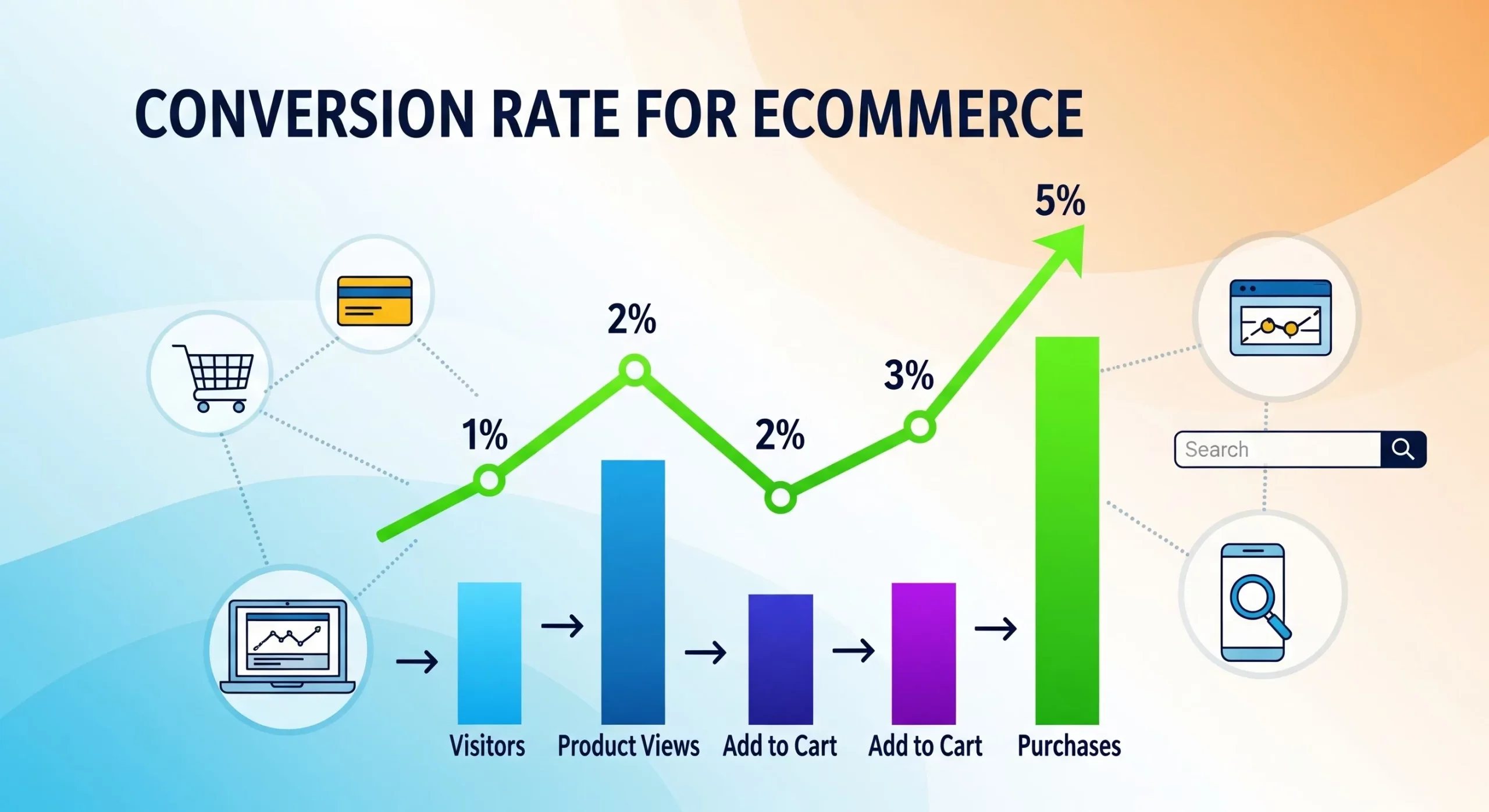
What Is an Ecommerce Conversion Rate?
An e-commerce conversion rate is the percentage of people who visit your site and do the thing you want, usually buy something. Simple formula:
Conversion Rate = (Number of Conversions ÷ Total Visitors) × 100
Example: 10,000 visitors and 200 buyers = 2%.
Think of your site like a school bake sale: visitors are the kids who walk by, conversions are the ones who actually buy a cookie. Micro-conversions (small wins that matter) include: adding to cart, signing up for emails, making an account, finishing a checkout step, or spending time on a product page. Track those to spot where people bail so you can patch the leak.
What Is a Good Ecommerce Conversion Rate?
A common shorthand is 2%–4% — thanks to data from IRP Commerce and Statista — but averages lie. Here’s a clearer split:
By Performance Tier
- Bottom 25% of stores: Below 1%
- Average stores: 1%–3%
- Top 25% of stores: 3%–5%
- Top 10% (elite performers): 5% and above
Littledata found Shopify medians around 1.4% and top shops ~3.7%+.
By Industry Vertical
Conversion rates vary significantly by niche. According to data from WordStream and Smart Insights (2024):
- Food & Beverage: 4%–5% (highest-converting category)
- Health & Beauty: 3%–4%
- Fashion & Apparel: 1%–2.5%
- Electronics: 1%–1.5%
- Jewelry: 0.6%–1.5%
- Furniture & Home Goods: 0.5%–1%
If your store sells luxury furniture, a 1% conversion rate might actually be excellent. If you sell affordable snacks, 1% would be a sign of serious optimization problems. Always benchmark against your specific vertical, not the general average.
Factors That Influence Ecommerce Conversion Rates
If your store isn’t converting, something is rubbing visitors the wrong way. Think of conversions like vibes — if the vibe is off, people leave. Here’s what usually makes or breaks it:
Traffic Quality
Not all clicks are created equal. Someone searching “buy running shoes size 10” is basically holding a wallet. Someone who clicked a random ad? Just window-shopping. If conversions drop when you spend more on ads, it’s usually bad traffic — not a bad site.
Device Type
Most people shop on phones now… but they buy more on desktop. Data from Contentsquare shows mobile converts way worse than desktop. Translation: if your mobile site is annoying, you’re burning money.
Page Load Speed
Slow sites kill sales. According to Google and Deloitte, a one-second delay can crush conversions. Nobody waits. Not you. Not me. Not your customers.
Trust Signals
People are scared of getting scammed. No reviews? Sketchy checkout? Missing return policy? Bounce. Trust badges, reviews, and clear policies calm buyer anxiety.
Pricing & Offers
Your site can look amazing, but if your price feels off, people will ghost you. Shoppers compare. Always. Your conversion rate tells you when your offer isn’t competitive.
10 Proven Strategies to Improve Your Ecommerce Conversion Rate
Alright, this is where the fun starts. These are the moves real ecommerce pros use to turn “just browsing” into “shut up and take my money.”
1. Optimize Your Product Pages
Your product page is your salesperson. If it’s lazy, you don’t get paid. Use clear photos, zoom, videos, size guides, and simple descriptions. If shoppers can’t see it or understand it, they won’t buy it.
2. Simplify the Checkout Process
Checkout should feel like sliding down a water slide — fast and easy. Too many steps, forced accounts, or surprise fees? Boom. They’re gone. Keep it short. Be honest about costs.
3. Use Social Proof Aggressively
People trust people, not brands. Reviews, star ratings, real photos — this stuff screams, “Relax, others bought this and survived.” No reviews = sketchy vibes.
4. Implement Exit-Intent Popups
Someone’s about to leave? Tap them on the shoulder with a deal. A small discount or free shipping at the last second can save a sale that was seconds from dying.
5. A/B Test Everything
Tiny changes can make big money. Button text, images, headlines — test it all. Sometimes changing one word beats spending thousands on ads.
6. Offer Multiple Payment Options
If someone wants to pay and you say “nah,” that’s on you. Cards, wallets, buy-now-pay-later — the easier you make it, the more you sell.
7. Leverage Live Chat & Chatbots
Questions kill momentum. Chat brings it back. A quick “Hey, need help?” can turn doubt into checkout.
8. Personalize the Experience
Show people stuff they actually want. “You might like this” works because… yeah, they probably will.
9. Create Urgency (But Don’t Be Fake)
Real scarcity works. “Only 3 left” hits different when it’s true. Fake countdowns? Congrats, you just lost trust.
10. Fix Your Site Speed
Slow sites don’t sell. Period. If your page takes forever, people leave before they even see the price. Fast = money.
How to Benchmark and Track Your Conversion Rate
You can’t fix what you don’t measure. Improving conversions starts with actually watching what people do on your site — not guessing.
- Google Analytics 4 (GA4): Track who buys, where they came from, what device they used, and where they dropped off. It’s like a scoreboard for your store.
- Shopify / WooCommerce analytics: Built-in dashboards show the funnel — add to cart → checkout → purchase — so you see where people panic and quit.
- Heatmaps (Hotjar, Microsoft Clarity): See where users click, scroll, or rage-tap. It’s like spying… but for good.
- Session recordings: Watch real users struggle, hesitate, or give up. It’s humbling — and insanely useful.
Check your conversion rate weekly and break it down by traffic source, device, and product. One bad segment can quietly drain your sales while the “average” looks fine.
Conclusion: Stop Settling for Average
A “good” conversion rate isn’t a magic number — it’s one that’s better than yesterday. Benchmarks (like 2%–4%) are just a map, not the destination.
The brands winning today aren’t just buying more traffic. They’re obsessed with what happens after the click. They test, tweak, personalize, and remove every tiny annoyance that makes buyers hesitate.
Know your current rate. Pick 2–3 fixes. Test them. Even tiny improvements add up fast — like leveling up in a game. Small boosts × lots of visitors = serious money. That’s how smart ecommerce stores win.