

The phone in your hand is now one of the biggest money-makers in advertising. People spend so much time inside apps that in-app ads have become a huge deal in digital marketing. By 2026, this is not just one option among many — it is where a lot of the action is.
So whether you run brand budgets, build apps, or plan campaigns, you need to understand how in-app ad money is moving in 2026. This article breaks down the numbers, the trends, and the smart moves you need to keep up.
The Numbers: How Big Is In-App Advertising in 2026?
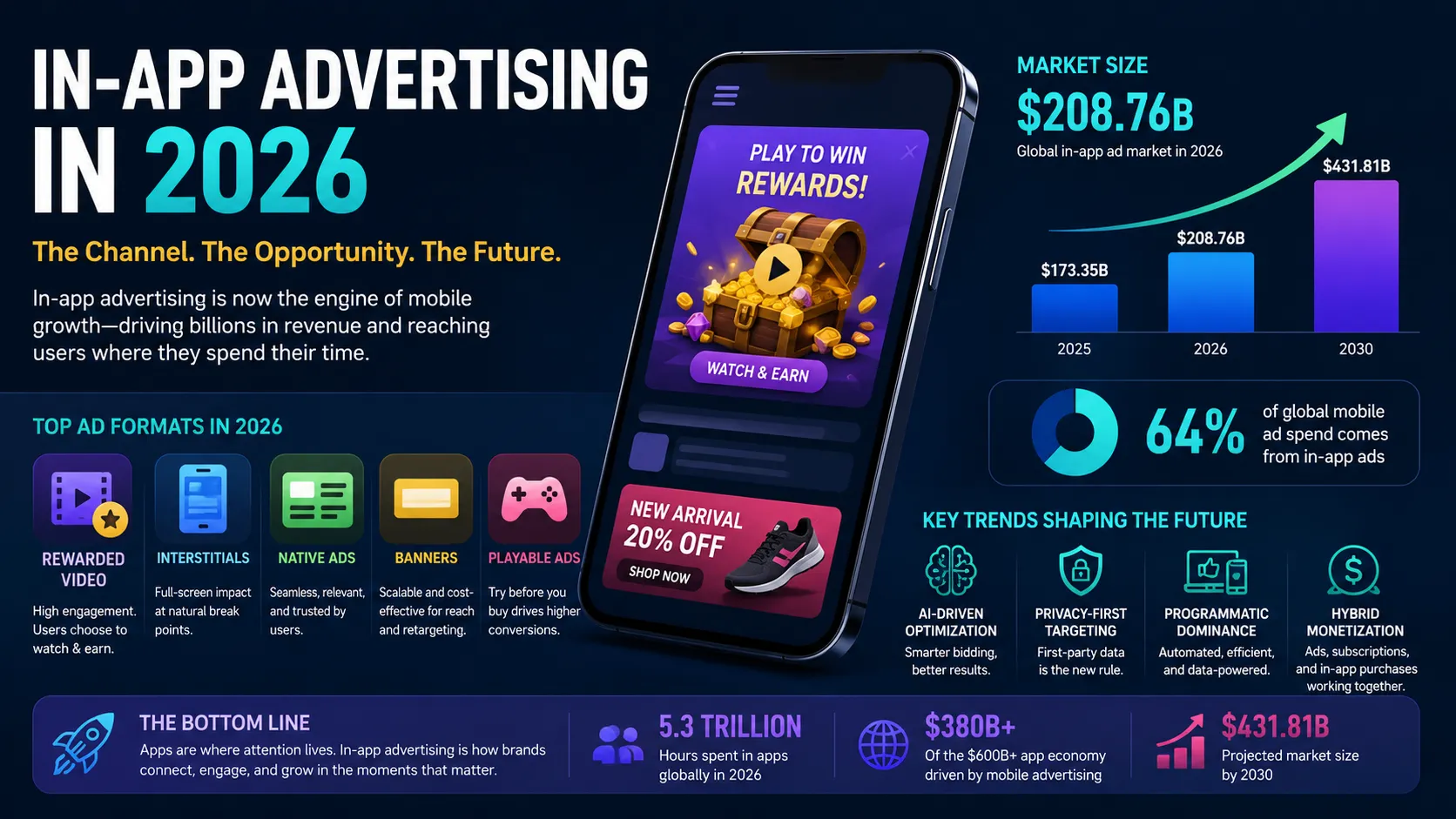
Let’s put it this way: in-app ads are no longer “big” — they’re huge. The market jumped from $173.35 billion in 2025 to about $208.76 billion in 2026, which is wild growth by any standard. And by 2030, it could hit $431.81 billion.
In plain English: the money keeps piling into apps because that is where people actually live on their phones.
In fact, in-app ads make up 64% of global mobile ad spend, and in the U.S. they bring in far more money than mobile web ads — nearly 5 times as much. So if the mobile browser is the old mall, apps are the packed concert venue where everyone’s attention is. And advertisers know it.
Why In-App Advertising Dominates: The Attention Advantage
The secret is simple: attention. In 2026, people spent an incredible 5.3 trillion hours inside apps. Think about your own phone — chances are you’re opening apps way more often than a web browser. Advertisers follow that attention like bees chasing flowers.
Apps also create a stronger connection with users. When someone is watching videos, playing a game, or scrolling their favorite social app, they’re focused and engaged, not bouncing between tabs. That makes ads more powerful.
A few reasons apps win:
- Full-screen experiences: Ads can take over the entire screen, making them hard to miss.
- Faster buying journeys: Someone can see an ad, check out a product, and buy it within minutes.
- Smarter targeting: Apps provide useful signals about user behavior, helping advertisers show more relevant ads while adapting to a privacy-first world.
At the end of the day, apps aren’t just where people spend time—they’re where people pay attention. And in advertising, attention is everything.
Ad Formats Driving Revenue in 2026
Not all in-app ads work the same. The days of boring banner ads ruling the internet are long gone. In 2026, the biggest winners are the formats that feel more natural, interactive, and fun for users.
1. Rewarded Video
This is the superstar of in-app ads. You watch a short video and get something in return—extra lives, coins, or premium content. Everyone wins, which is why users rarely complain about these ads.
2. Interstitials
These are full-screen ads that appear during natural breaks, like between game levels. When done right, they feel less like an interruption and more like a quick commercial break.
3. Native Ads
Native ads blend into the app so smoothly that they feel like part of the experience. They’re less annoying and often get more attention than traditional ads.
4. Banners
The old-school classic is still around. Banner ads are cheap and easy to scale, but many users barely notice them anymore. They work best as part of a bigger advertising strategy.
5. Playable Ads
Imagine trying a game before downloading it. That’s a playable ad. They’re fun, interactive, and incredibly effective at convincing people to install an app. Even brands outside gaming are starting to borrow this idea.
The big lesson? The best ads in 2026 don’t just grab attention—they give users a reason to engage.
The Technology Revolution: AI, Programmatic, and Privacy
Three big forces are reshaping in-app advertising in 2026: AI, automation, and privacy.
AI Is Everywhere — and It’s Working
AI has become the engine behind modern advertising. It helps advertisers decide where to spend money, who to target, and even which ads to show—all in real time. Think of it like a super-smart assistant making thousands of decisions every second to get better results.
Programmatic Dominates Buying
Most in-app ads are now bought automatically through programmatic systems. This makes advertising faster and more efficient, but it also creates new challenges. Advertisers have to watch out for things like fake clicks and make sure their ads appear in safe, trustworthy places.
The Privacy-First Pivot
The days of tracking people everywhere online are fading. Instead, advertisers are relying more on first-party data and contextual targeting. In simple terms, they’re focusing more on what someone is doing inside an app rather than following them across the internet. It’s a big shift toward a more privacy-friendly future.
Regional Spotlight: Where In-App Revenue Is Growing Fastest
The in-app advertising boom is happening worldwide, but some regions are growing faster than others.
- United States: Still the biggest market, with advertisers spending enormous amounts to reach mobile users.
- Asia-Pacific: The largest region overall, powered by massive app usage in countries like China, Japan, and South Korea.
- India: The world’s biggest app download market, with rapid growth in finance, shopping, and payment apps.
- Emerging Markets: Countries across Southeast Asia, Latin America, and Africa are becoming major growth engines as millions of people experience the internet mainly through apps.
The exciting part? We’re still in the early chapters of this story. As more people spend more of their lives inside apps, the opportunities for advertisers, developers, and creators will only keep growing.
Monetization Models: Beyond the Single Revenue Stream
The smartest apps in 2026 don’t put all their eggs in one basket. Instead of relying only on ads or subscriptions, they mix multiple ways to make money.
A winning formula looks like this:
- Free version with ads: Brings in lots of users and generates steady ad revenue.
- Premium subscription: Gives people an ad-free experience for a monthly fee.
- In-app purchases: Lets power users spend money on extra features, content, or upgrades.
Think of it like a game that lets you play for free, pay to remove ads, or buy cool extras. By giving users choices, apps make more money and keep more people happy.
Key Takeaways for Marketers and Advertisers
If you’re running campaigns in 2026, here are the big lessons:
- Design for phones first: Vertical videos and full-screen ads usually perform best.
- Build first-party data: The better you know your audience, the better your targeting will be.
- Try rewarded ads: People are much more willing to watch ads when they get something valuable in return.
- Watch for fraud: Not every click is real, so monitoring matters.
- Use AI wisely: AI can boost results, but it still needs human oversight.
- Think beyond one revenue source: The biggest winners combine ads, subscriptions, and purchases.
Conclusion: The In-App Advertising Era Is Now
In-app advertising isn’t the future anymore—it’s the present. With billions of people spending huge chunks of their day inside apps, that’s where attention lives, and attention is what every advertiser wants.
Think about your own phone. It’s where you chat, watch videos, play games, shop, and learn new things. For brands, being part of those moments is incredibly valuable.
The companies that win won’t treat in-app advertising as just another marketing trick. They’ll make it a core part of their strategy, using data, creativity, and technology to connect with people in smarter ways.
The audience is already there. The tools are already there. The real question is: who’s ready to take advantage of it?